




01. Edit your form online
Type text, add images, blackout confidential details, add comments, highlights and more.

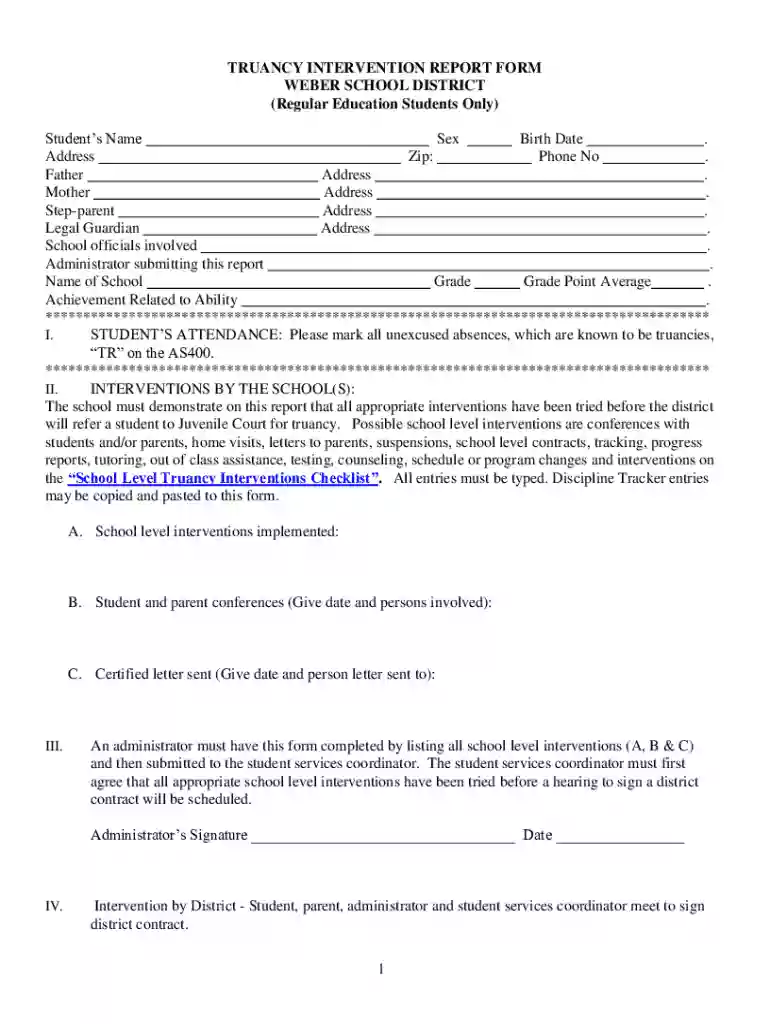
Type text, add images, blackout confidential details, add comments, highlights and more.

Draw your signature, type it, upload its image, or use your mobile device as a signature pad.

Send it via email, link, or fax. You can also download it, export it or print it out.
The Truancy Intervention Report Form is a critical document utilized by school administrators to monitor and report instances of unexcused student absences in educational settings. Predominantly employed within the Weber School District, this form aims to outline the interventions attempted by the school before involving external entities like Juvenile Court. By systematically gathering essential information about the student and their family, this report ensures a structured process in handling truancy cases.
Completion of the Truancy Intervention Report Form involves a series of methodical steps to ensure accuracy and compliance with district policies. The form is typically filled out by a school administrator who is familiar with the student’s attendance records and history.
Gather Basic Information:
Document Absences:
Outline Interventions:
Final Approval:
Understanding the components of the Truancy Intervention Report Form is essential for its effective use. Each section is designed to capture specific data points necessary for a comprehensive overview of the truancy issue.
This form is primarily used by school administrators and other educational personnel responsible for monitoring student attendance. Its purpose extends to serving as a collaborative tool between schools and external organizations like juvenile courts when necessary.



The Truancy Intervention Report Form must comply with specific legal requirements, particularly regarding documentation and interventions prior to court referral. Understanding these legal frameworks ensures that the form serves its purpose effectively without legal repercussions.
While the Truancy Intervention Report Form is standardized within the Weber School District, specific rules and practices might vary across different states. This may affect how forms are utilized and sanctioned.
Failure to properly use the Truancy Intervention Report Form can lead to a range of consequences, both for the school district and the parents of the truant student.
The practical application of the Truancy Intervention Report Form can often be seen in real-world scenarios where school districts intervene successfully before legal actions are necessary.
Typically, the Truancy Intervention Report Form can be accessed through the school district’s administrative offices or its official website.
This structured guide provides comprehensive coverage of the Truancy Intervention Report Form, detailing its use, legal importance, and real-world implications.
At DocHub, your data security is our priority. We follow HIPAA, SOC2, GDPR, and other standards, so you can work on your documents with confidence.


The Truancy Intervention Guide is an electronic resource guide that provides a single source of information for parents and professionals involved in theRead more
U.S. juvenile detention leans toward punishment: children may be placed in secure facilities for minor offenses such as truancy, shoplifting, or skipping schoolRead more
The Catalog of Truancy Intervention Models contains promising intervention models that have been implemented in schools and districts in Connecticut and across


