




01. Edit your fire department notification online
Type text, add images, blackout confidential details, add comments, highlights and more.

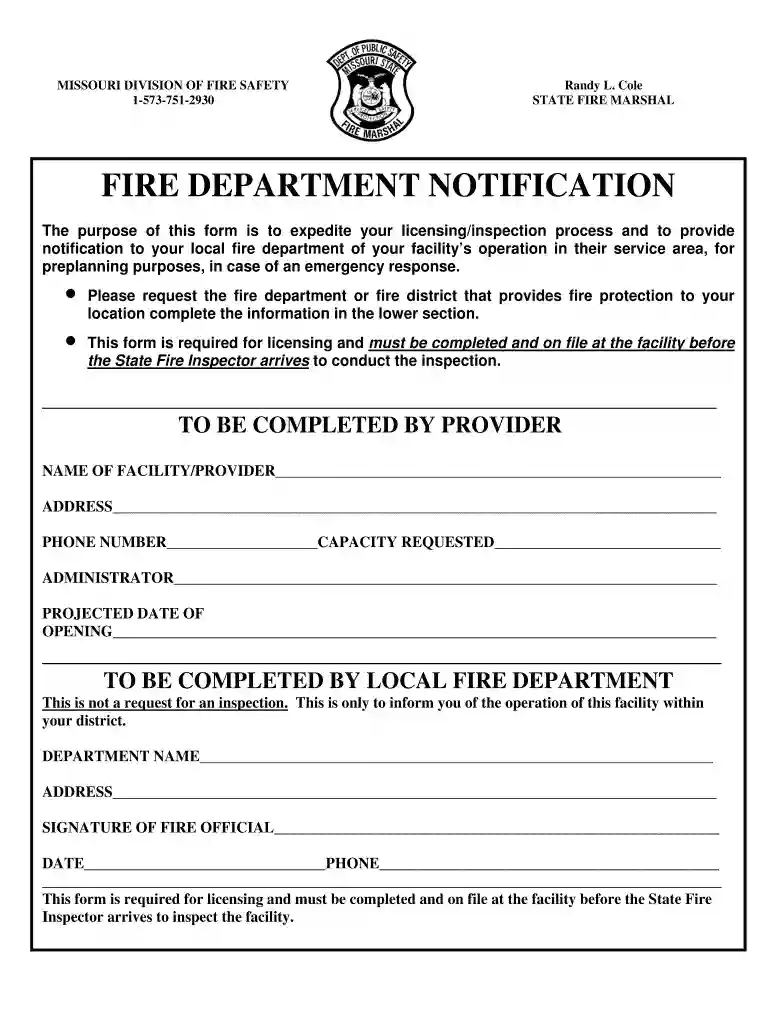
Type text, add images, blackout confidential details, add comments, highlights and more.

Draw your signature, type it, upload its image, or use your mobile device as a signature pad.

Send it via email, link, or fax. You can also download it, export it or print it out.
The fire department notification is a critical document issued by the Missouri Division of Fire Safety. It serves as a formal communication tool to inform the relevant fire department about the operations of a facility. This notification is integral to emergency response planning, ensuring that fire safety authorities are aware of the facility’s existence and its specific safety needs. By expediting the licensing and inspection process, the notification aids in aligning the facility's safety protocols with local and state regulations.
Facilities such as nursing homes, schools, or large commercial spaces typically use the fire department notification. For instance, a new community center planning to open its doors might need to submit this form to ensure that the local fire department is aware of the facility's layout and potential hazards. Similarly, businesses undergoing significant renovations that affect fire safety systems may need to update their notification to reflect the changes and maintain compliance with safety standards.
To utilize the fire department notification effectively, facility managers must prepare the necessary information before submission. This document becomes a vital part of the overall fire safety strategy, enabling the facility to coordinate with fire departments seamlessly.
Completing the fire department notification requires careful attention to detail. Here are the necessary steps you need to follow:
Gather Information: Assemble all pertinent data about your facility, such as the physical address, the nature of operations, and emergency contact information.
Fill In Facility Details: Accurately provide information about the facility, including size, number of floors, and occupancy type.
Complete Fire Department Section: Some sections of the form need to be filled out by the local fire department, confirming they are informed about the facility.
Review For Accuracy: Double-check all entries to ensure they are correct and fully reflect your facility's situation.
Sign and Date the Form: Ensure that the final form is signed by an authorized representative and dated appropriately.
Submit the Form: Provide the completed form to the designated office within the Missouri Division of Fire Safety.
In some situations, certain forms might require additional documentation, such as blueprints of the facility. It's crucial to verify the specific requirements that apply to your facility to avoid delays or rejections.
The fire department notification includes various key components that facilitate emergency response planning.
Each element of the notification is essential to ensure comprehensive coverage of safety needs. For instance, detailed contact information allows the fire department to quickly coordinate with facility managers during an incident.
Submitting a fire department notification is more than a bureaucratic requirement; it is a proactive measure in enhancing safety. By ensuring that fire departments are aware of the facilities operating within their jurisdictions, responses to emergencies can be more informed and efficient.
The fire department notification is predominantly used by a range of facility operators. These include:


Understanding the terminology related to fire department notifications is crucial for correct and efficient form completion:
For example, “emergency response planning” could involve determining strategic evacuation routes within a facility, while “regulatory compliance” may require adherence to specific fire extinguisher placement guidelines.
Getting access to the fire department notification form involves several steps to ensure that the correct version is used.
For facilities new to the process, some fire departments offer informational resources or workshops to assist managers and owners in accurately completing their notifications.
We've got more versions of the fire department notification form. Select the right fire department notification version from the list and start editing it straight away!
At DocHub, your data security is our priority. We follow HIPAA, SOC2, GDPR, and other standards, so you can work on your documents with confidence.
Where the facility is not served by a fire department, notification of appropriate emergency forces shall be transmitted by the most expedient means available
SFD Impairment notification form shall be emailed to FirePrevention@syrgov.net. 315-471-1161. An email notification shall be sent to FirePrevention@syrgov.net.


