







Definition and Meaning
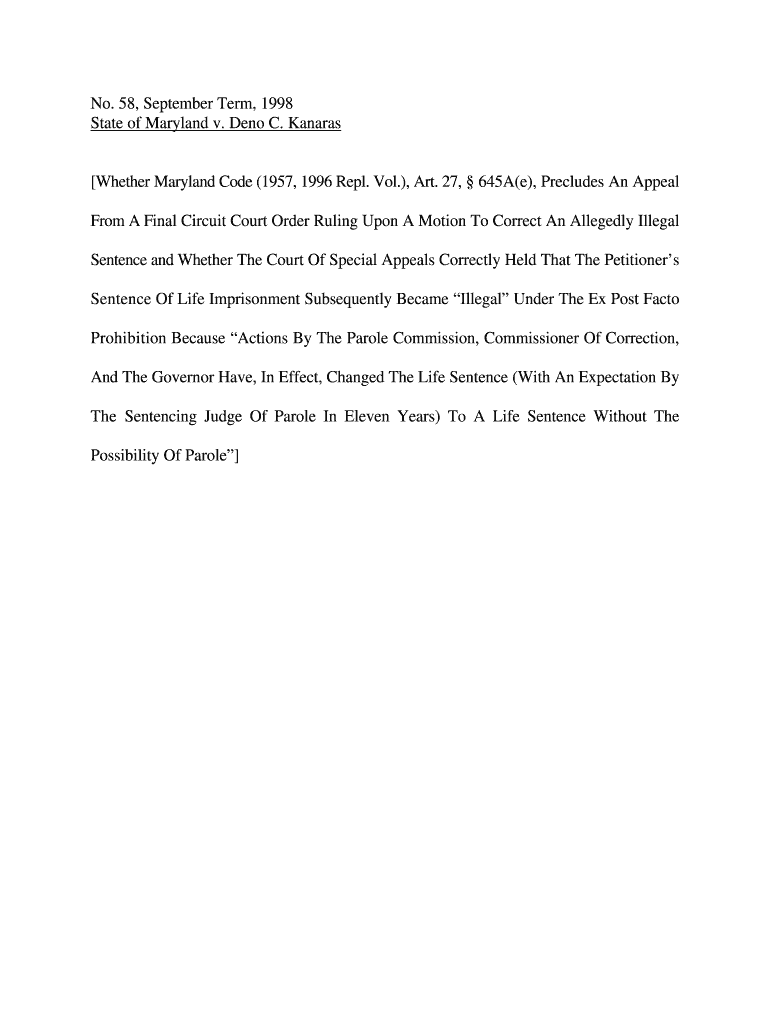
The form titled "No 58, September Term, 1998 State of Maryland - Maryland Courts - courts state md" primarily refers to a legal opinion by the Court of Appeals of Maryland concerning an appeal in a specific legal case. This form encompasses a summary and analysis of the court's decision regarding the issues raised in the case, such as the legality of a sentence based on parole changes and the appeal process. Understanding this form involves recognizing its role in documenting judicial decisions, which provides guidance and precedent for future cases within the Maryland judicial system.
How to Use the Form
The emphasis of this form is on providing detailed insights into the court's reasoning and rulings, which can be used by legal professionals to inform strategy in similar legal circumstances. Attorneys may refer to this legal opinion when handling cases involving sentence appeals or parole eligibility disputes in Maryland. Additionally, it can serve as an educational resource for law students seeking to understand the nuances of appellate court decisions. Importantly, the form contains case details relevant for those studying or practicing Maryland state law.
How to Obtain the Form
To access this specific court opinion, individuals usually turn to the official online databases maintained by Maryland Courts, where legal opinions and documents are digitally archived. Alternatively, visiting a law library and consulting with the Clerk’s office at the court where the original case was heard could also prove beneficial. Access might require some form of credentialing or permission, given the document's legal nature. Ensuring secure and authorized access aligns with ethical standards and privacy laws related to judicial documentation.
Steps to Complete a Review of the Form
- Identify the Case Context: Begin by understanding the background of the case referenced by the form.
- Analyze Legal Arguments: Focus on the legal points addressed by the court, including the appeal’s basis and the interpretation of ‘illegal sentence.’
- Review Court's Decision: Scrutinize the court's conclusion and its impact on similar legal circumstances.
- Cross-Reference Regulations: Align the findings with Maryland’s statutory requirements and other similar precedents.
- Document Findings: Summarize insights for future reference or academic use.
Understanding the full context and potential implications of the court's decision is essential for comprehending the document's legal significance.
Who Typically Uses the Form
This document is primarily used by legal professionals such as attorneys, judges, and law clerks. It serves as a reference for navigating Maryland’s legal standards, particularly in relation to appeals on sentence legality and parole issues. Additionally, scholars and students in legal studies utilize such documents in their research and coursework to understand judiciary reasoning processes. Understanding who typically uses this form underscores its role in the wider legal framework of Maryland.


Key Elements of the Form
- Case Summary: A brief outline of the case facts, parties involved, and legal issues at hand.
- Legal Questions Addressed: Focused questions the court is required to answer or clarify.
- Court's Analysis: Detailed examination of arguments presented, applying existing legal statutes and precedents.
- Final Judgment: The conclusion reached by the court, with its broader implications.
- Dissenting Opinions (if any): Alternative perspectives offered by other judges involved in the case.
Each of these elements is pivotal in providing comprehensive insights into the court's decision-making process.
Legal Use of the Form
The form serves as a vital legal resource to ensure precedential integrity and adherence to established Maryland legal procedures. It is often cited in future cases and used in legal writings or arguments where previous rulings or interpretations are relevant. Lawyers may use it to build cases, while judges reference it to administer justice consistently. This illustrates its importance in maintaining legal coherence and continuity within the Maryland court system.
State-Specific Rules Related to the Form
Maryland has specific legal provisions governing appeals and the definition of illegal sentences. This form exemplifies procedural adherence, such as which decisions are appealable and the standards for sentence legality assessments. Understanding state-specific rules ensures proper interpretation and application of the form’s content, which is crucial for practitioners working within Maryland's jurisdiction.




