




01. Edit your pub 501 online
Type text, add images, blackout confidential details, add comments, highlights and more.

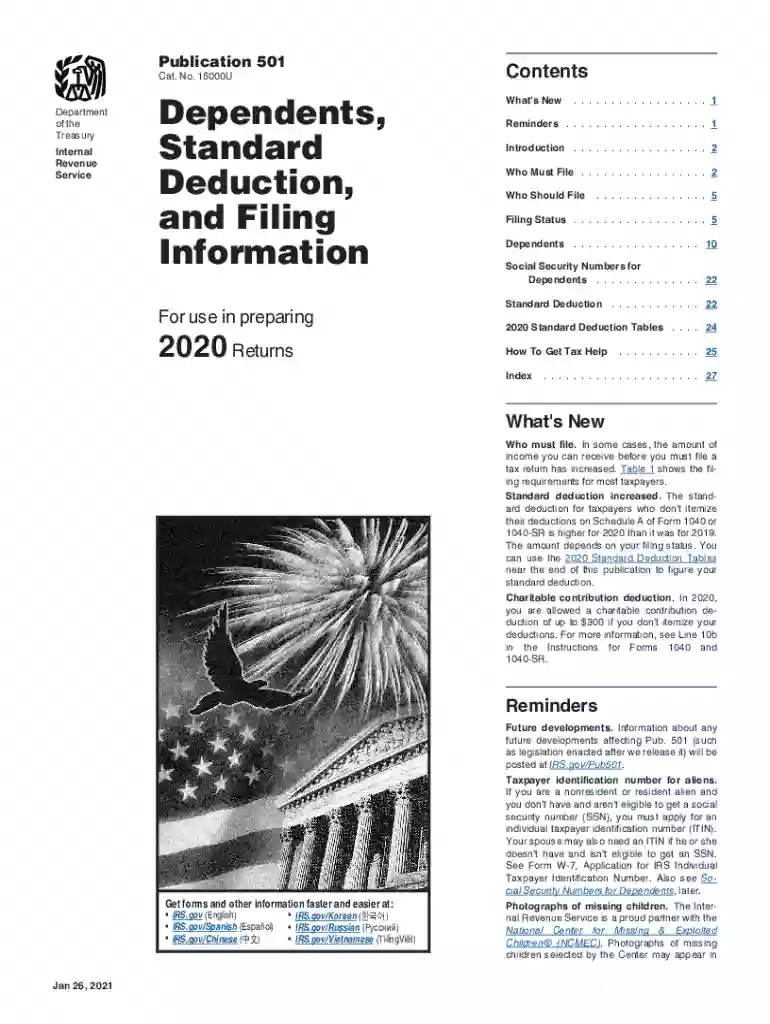
Type text, add images, blackout confidential details, add comments, highlights and more.

Draw your signature, type it, upload its image, or use your mobile device as a signature pad.

Send it via email, link, or fax. You can also download it, export it or print it out.
Form 501 is a critical document used primarily by U.S. taxpayers to understand tax filing requirements, standard deductions, and criteria for claiming dependents. This form provides detailed guidance on income thresholds necessitating a tax return, ensuring taxpayers comply with IRS mandates. Understanding Form 501 is crucial for properly managing your tax obligations and maximizing eligible deductions, particularly for those with dependents or filing status variations. It serves as a reference guide, updated annually to reflect changes in tax law, helping taxpayers to stay informed.
To effectively use Form 501, identify the sections relevant to your financial situation. Start by reviewing the criteria for determining if you're required to file a tax return, which depends on your income, filing status, and age. Next, understand the guidelines for claiming dependents to ensure you meet all eligibility requirements and can take full advantage of the associated tax benefits. Finally, familiarize yourself with the standard deductions applicable to your filing status. Utilizing Form 501 effectively can help streamline your tax preparation process and ensure compliance.
Determine Your Filing Requirement: Review the income thresholds on Form 501 to ascertain if you're required to file a tax return.
Identify Eligible Dependents: Evaluate your family situation to determine which dependents you can claim, using the criteria outlined in the form.
Calculate Eligible Deductions: Understand the standard deduction amounts related to your filing status and apply these to your tax return calculations.
Review Federal Tax Changes: Check for any updates or changes in tax laws affecting your filing process. Form 501 includes updates relevant to each tax year.
Complete and File: Use the information from Form 501 to fill out your tax return accurately, ensuring no errors or omissions.
Income Requirements: Details the income levels at which you're required to file a tax return, varying by age and filing status.
Dependent Criteria: Explains who qualifies as a dependent and the process for claiming them on your tax return.
Standard Deduction Amounts: Provides the deduction limits available for different filing statuses (e.g., single, married filing jointly).
Tax Law Updates: Highlights changes made to previous tax codes and how these affect current year filings.
Resource and Assistance: Information on where to obtain help should you need guidance completing your tax return.
Taxpayers must adhere to key deadlines outlined in Form 501. The regular filing deadline is typically April 15, with exceptions noted for holidays or weekends pushing it to the next business day. Extensions may be requested, which generally allow until October 15 to file a return. It's vital to submit your return by the deadline to avoid penalties and interest charges. Form 501 also provides guidance on estimated tax payment deadlines throughout the year to prevent underpayment penalties.
Form 501 applies to U.S. taxpayers who need clarity on dependent claims, standard deductions, or filing requirements. This includes:
Single Filers: Individuals filing on their own without qualifying dependents or tax partners.
Married Couples: Those filing jointly or separately, who must consider combined income and deductions.
Heads of Household: Single taxpayers who support a home for qualifying dependents.
Taxpayers with Dependents: Any filer with dependents who may be eligible for additional credits or deductions.
Amid complexities, Form 501 supports diverse scenarios, guiding taxpayers to accurate tax filing.


Form 501 is compatible with tax preparation software such as TurboTax and QuickBooks, which automate many functions relevant to this form. By importing Form 501 details into these platforms, users can ensure compliance through accurate deductions and claims. Each software integrates Form 501 data, allowing efficient e-filing and precise calculation of tax obligations. Check specific software guides for the best use practices regarding Form 501, ensuring all inputs reflect the latest IRS guidelines.
Failure to comply with the requirements detailed in Form 501 can lead to significant penalties. If eligible taxpayers miss the filing deadline, expect late fees and accruing interest on any taxes owed. Incorrectly claiming deductions or dependents can prompt IRS audits, leading to additional fines. Form 501 educates taxpayers about these penalties, emphasizing the importance of accuracy and timeliness. Adhering to guidelines within Form 501 helps avoid these issues, maintaining compliance with federal tax regulations.
We've got more versions of the pub 501 form. Select the right pub 501 version from the list and start editing it straight away!
| Versions | Form popularity | Fillable & printable |
|---|---|---|
| 2024 | 4.6 Satisfied (27 Votes) | |
| 2023 | 4.4 Satisfied (50 Votes) | |
| 2022 | 4.6 Satisfied (22 Votes) | |
| 2021 | 4.9 Satisfied (31 Votes) | |
| 2020 | 4.4 Satisfied (197 Votes) | |
| 2019 | 4.4 Satisfied (71 Votes) | |
| 2018 | 4.3 Satisfied (197 Votes) | |
| 2017 | 4.4 Satisfied (163 Votes) | |
| 2016 | 4.4 Satisfied (1747 Votes) | |
| 2015 | 4 Satisfied (41 Votes) | |
| 2014 | 4 Satisfied (55 Votes) |
At DocHub, your data security is our priority. We follow HIPAA, SOC2, GDPR, and other standards, so you can work on your documents with confidence.
View the pattern for Five-SeveN Heat Treated Seed 501. Browse seed patterns, screenshots, and color data on pattern.wiki.
I transfer all rights, title and interest in the above-described vehicle to: PRINTED NAME OF BUYER (LAST, FIRST, MIDDLE). DATE OF PURCHASE. BUYERS ADDRESS.Read more
An organization exempt from taxation under subsection (a) shall be subject to tax to the extent provided in parts II, III, and VI of this subchapter.Read more


