




01. Edit your form online
Type text, add images, blackout confidential details, add comments, highlights and more.

Type text, add images, blackout confidential details, add comments, highlights and more.

Draw your signature, type it, upload its image, or use your mobile device as a signature pad.

Send it via email, link, or fax. You can also download it, export it or print it out.
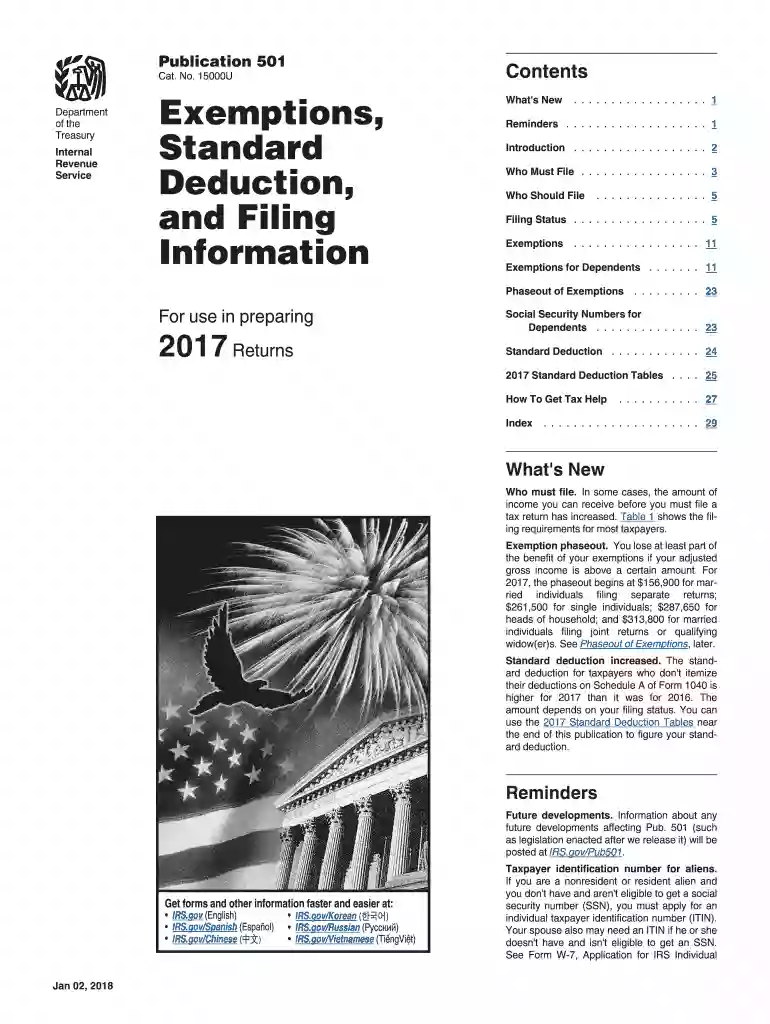
The 501 Form for 2017 serves as a comprehensive guide for understanding the nuances of tax exemptions, standard deductions, and compliance requirements for the U.S. taxpayer community. This form outlines the requisite details for filing tax returns, focusing on factors like income thresholds, filing status, age, and dependent exemptions. Being well-versed with this form ensures correct filing and maximizes potential tax benefits.
Gather Required Information:
Understand Exemption Rules:
Identify Standard Deductions:
Verify Preliminary Calculations:
Review and Finalize:
The 501 Form is relevant to a wide array of U.S. taxpayers:


Understanding these terms is vital for accurate completion of the form and benefits realization.
The IRS provides clear criteria and instructions for utilizing the 501 Form. It mandates:
Referencing IRS guidelines ensures adherence to legal requirements and minimizes audit risks.
Ensure timely filing to avoid penalties or interest on unpaid taxes.
Having these documents ready streamlines the filing process and supports claim validations.
Failure to comply with the filing requirements of the 501 Form may result in:
Addressing non-compliance issues promptly can prevent additional financial repercussions.
We've got more versions of the 501 2017 form form. Select the right 501 2017 form version from the list and start editing it straight away!
| Versions | Form popularity | Fillable & printable |
|---|---|---|
| 2024 | 4.6 Satisfied (27 Votes) | |
| 2023 | 4.4 Satisfied (50 Votes) | |
| 2022 | 4.6 Satisfied (22 Votes) | |
| 2021 | 4.9 Satisfied (31 Votes) | |
| 2020 | 4.4 Satisfied (197 Votes) | |
| 2019 | 4.4 Satisfied (71 Votes) | |
| 2018 | 4.3 Satisfied (197 Votes) | |
| 2017 | 4.4 Satisfied (163 Votes) | |
| 2016 | 4.4 Satisfied (1747 Votes) | |
| 2015 | 4 Satisfied (41 Votes) | |
| 2014 | 4 Satisfied (55 Votes) |
At DocHub, your data security is our priority. We follow HIPAA, SOC2, GDPR, and other standards, so you can work on your documents with confidence.
Section 501(c)(3) and 501(c)(4) organizations are required to report the amount of grants and Amount for 2017. Schedule A (Form 990 or 990-EZ) 2017.Read more
May 2, 2017 501(c)(3). Federal govt. Check this box if you are a federal government entity or instrumentality. Box bThird-party sick pay. Check thisRead more
Jan 2, 2018 Who must file. In some cases, the amount of income you can receive before you must file a tax return has increased. Table 1 shows the fil-.Read more


