




01. Edit your form online
Type text, add images, blackout confidential details, add comments, highlights and more.

Type text, add images, blackout confidential details, add comments, highlights and more.

Draw your signature, type it, upload its image, or use your mobile device as a signature pad.

Send it via email, link, or fax. You can also download it, export it or print it out.
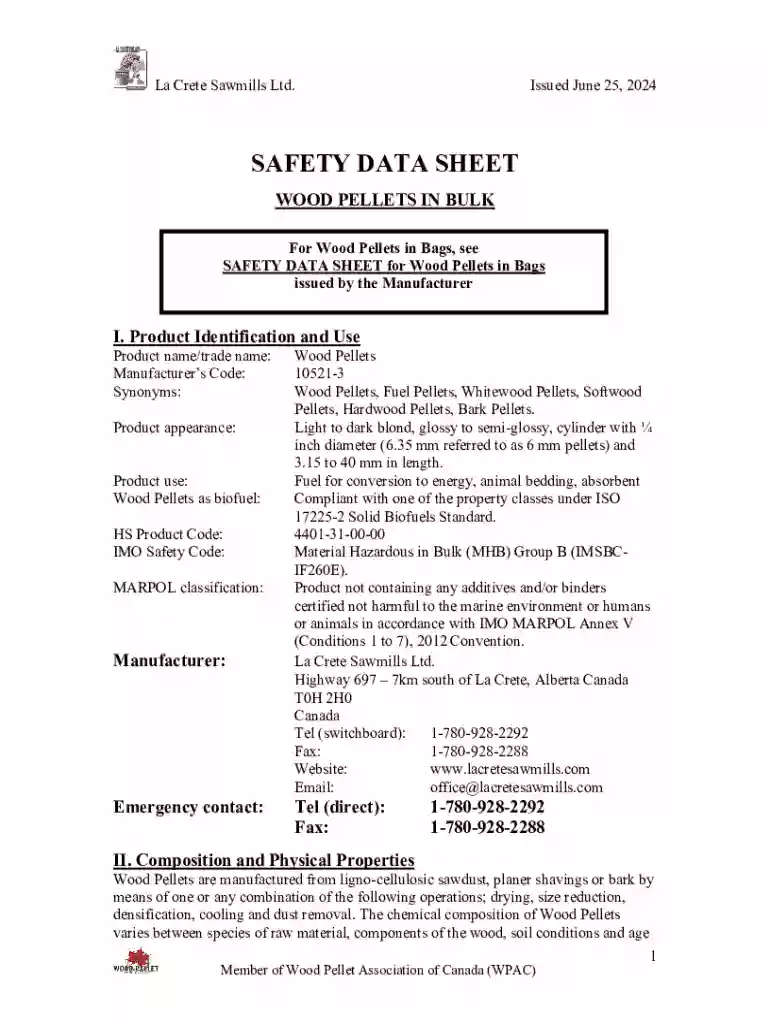
A Safety Data Sheet (SDS) for Wood Pellets in Bulk is a document that provides detailed information on the properties and handling of wood pellets. Issued by organizations like La Crete Sawmills Ltd, it serves as a crucial guide for understanding the product's identification, health hazards, composition, first aid measures, fire and explosion precautions, and more. Generally, this SDS is designed to ensure the safe handling, storage, and transport of wood pellets. Key elements covered include exposure control, toxicological data, and emergency contact information, emphasizing the importance of proper ventilation and safety protocols to mitigate risks associated with dust and emissions.
Understanding the proper use of the SDS is essential for maintaining safety and compliance. Here's how to navigate the document:
These steps help users properly understand and utilize the SDS, promoting safety and regulatory compliance.
While users don't "complete" an SDS as they do with forms requiring input, understanding how to interpret and apply it in a workplace setting is critical:
Following these steps ensures the SDS is effectively integrated into day-to-day operations, enhancing overall workplace safety.
The SDS for wood pellets is typically used by:
These groups utilize the SDS to maintain safety, minimize health risks, and ensure regulatory compliance during daily operations involving wood pellets.


Legal compliance in the U.S. requires that workplaces handling wood pellets maintain an up-to-date SDS and make it accessible to all employees:
Understanding these legal implications helps organizations comply with mandatory health and safety requirements while leveraging the SDS as a tool to mitigate liability and risk.
Several practical applications demonstrate the use of an SDS:
These examples underscore the importance of integrating SDS information into standard operating procedures and emergency planning.
To obtain the SDS, certain documents and information may be required:
Ensuring readiness with this documentation helps businesses efficiently request and receive relevant safety data sheets for their products.
Digital and paper versions of the SDS offer different advantages:
Choosing between these formats depends on organizational needs and existing tech capabilities, but maintaining both can offer redundancies that enhance accessibility and compliance.
We've got more versions of the Safety Data Sheet - WOOD PELLETS IN BULK form. Select the right Safety Data Sheet - WOOD PELLETS IN BULK version from the list and start editing it straight away!
At DocHub, your data security is our priority. We follow HIPAA, SOC2, GDPR, and other standards, so you can work on your documents with confidence.




Jul 4, 2026 Local pellet production can create jobs and enhance energy security, yet stakeholders raise concerns about air quality, storage safety (CO off-Read more
by AT Simpson 2016 Cited by 27 There are a number of health and safety hazards associated with the transportation and storage of wood pellet and wood chip fuels, including airborne dust (woodRead more
Safety Data Sheets for all campuses are below, SDS can be searched by product or manufacturer name. (Bulk Chemical Services)


