Definition and Purpose of the Liquid-Penetrant-Quality-Control-and-Inspection-Report-Form
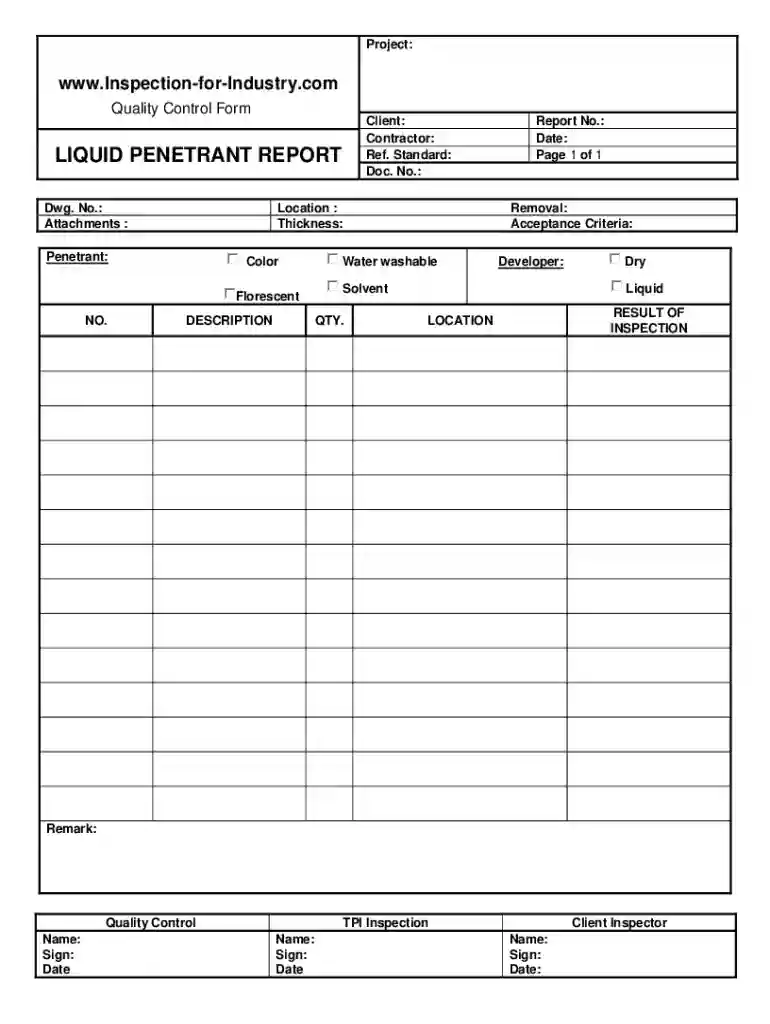
The Liquid-Penetrant-Quality-Control-and-Inspection-Report-Form is a document used primarily in the non-destructive testing (NDT) industry to detail the quality control process involved in liquid penetrant inspections. This form serves as an official record, capturing essential details about the inspection carried out, including client and contractor information, inspection results, acceptance criteria, and inspector signatures. The form is crucial for validating that all steps of the inspection process have been meticulously followed and documented, assuring compliance with industry standards and regulations.
Key Elements Captured in the Form
- Client and Contractor Information: Includes the names, addresses, and contact details necessary for administrative purposes and follow-ups.
- Inspection Results: Records the findings of the penetrant inspection, detailing any defects or areas of concern identified during the process.
- Acceptance Criteria: Outlines the standards or benchmarks used to evaluate whether the inspected item meets quality requirements.
- Signatures: Provides spaces for various inspectors to sign, confirming their role in and responsibility for the inspection process.
How to Use the Liquid-Penetrant-Quality-Control-and-Inspection-Report-Form
Using this form involves a systematic approach to ensure that all pertinent information is accurately captured. The steps are designed to facilitate a thorough and compliant inspection process.
Step-by-Step Procedure
- Prepare the Inspection Area: Ensure that the environment is suitable for inspection, free from contaminants that could affect results.
- Fill in Initial Details: Start by entering the client and contractor information, specifying dates, and detailing the inspection environment.
- Conduct the Inspection: Perform the liquid penetrant test according to the specified procedures, ensuring that all necessary equipment and methods are used correctly.
- Document Inspection Results: Record observations and results, highlighting defects or areas that require further attention.
- Sign Off: Obtain signatures from all involved inspectors to validate the documentation's accuracy and completeness.
Steps to Complete the Liquid-Penetrant-Quality-Control-and-Inspection-Report-Form
Completing this form correctly involves several critical steps to ensure compliance and accuracy in documenting the inspection process.
Detailed Instructions
-
Enter Identifying Information:
- Begin with client and contractor information.
- Include date and location of the inspection.
-
Record Inspection Procedures:
- Document the specific techniques used in the penetrant inspection.
- Note any deviations from standard procedures and justify them.
-
Detail Inspection Findings:
- Precisely record any flaws or defects found.
- Include measurements and photographs if applicable.
-
Outline Acceptance Criteria:
- Specify the criteria used to determine the acceptability of the inspected item.
- Ensure clarity on standards referenced in the inspection.
-
Finalize and Submit:
- Obtain necessary signatures.
- Review for completeness.
- Submit to relevant authorities or store in company records as required.
Key Elements of the Liquid-Penetrant-Quality-Control-and-Inspection-Report-Form
Essential Components
- Inspection Overview: Summary of the inspection scope and objectives.
- Test Methodology: Detailed account of the procedures and equipment used.
- Findings and Analysis: In-depth analysis of inspection results.
- Verification and Compliance: Sections for verifying compliance with industry standards and internal procedures.
Who Typically Uses the Liquid-Penetrant-Quality-Control-and-Inspection-Report-Form
This form is predominantly used by professionals in industries that require non-destructive testing to ensure the integrity and reliability of components.

Typical Users
- Quality Control Inspectors: Responsible for overseeing the entire inspection process and ensuring compliance.
- Engineering Teams: Utilize the form to verify the safety and performance of materials.
- Manufacturing Companies: Ensure production components meet stringent quality standards.
Legal Use of the Liquid-Penetrant-Quality-Control-and-Inspection-Report-Form
The information contained in the form must align with regulatory requirements, providing legal protection and assurance of compliance with industry standards.
Compliance Requirements
- Record Keeping: Ensures that all inspection records are maintained for a specified period, as required by law.
- Regulatory Standards: Meets standards set by organizations such as ASTM International or ASME, ensuring legal adherence.
Examples of Using the Liquid-Penetrant-Quality-Control-and-Inspection-Report-Form
Practical Applications
- Aircraft Maintenance: In aviation, ensuring the safety and integrity of components through detailed inspections is crucial.
- Pipeline Integrity: Used extensively in inspecting pipelines to prevent leaks and ensure operational safety.
- Construction and Fabrication: Helps verify the quality of welded joints and structural components.
State-Specific Rules for the Liquid-Penetrant-Quality-Control-and-Inspection-Report-Form
While the form itself is standardized, certain state-specific rules may govern how inspections should be conducted.
Specific Considerations
- Local Regulatory Bodies: Each state may have its regulatory authority setting forth guidelines or additional requirements regarding documentation.
- Industry-Specific Variances: Certain industries might have distinct state-level requirements impacting how forms are filled out or stored.