




01. Edit your 2019 oid online
Type text, add images, blackout confidential details, add comments, highlights and more.

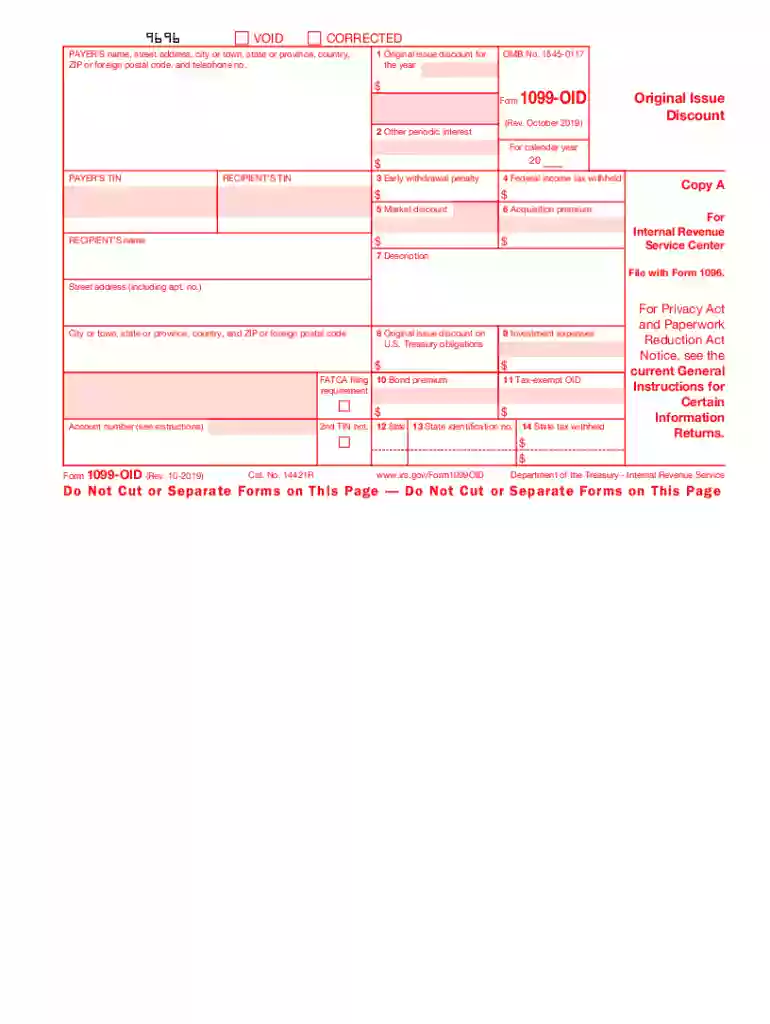
Type text, add images, blackout confidential details, add comments, highlights and more.

Draw your signature, type it, upload its image, or use your mobile device as a signature pad.

Send 1099 oid via email, link, or fax. You can also download it, export it or print it out.
Form 1099-OID, issued by the IRS, is used to report Original Issue Discount (OID) income. OID represents the difference between the face value of a bond or other financial instrument and its original sale price, often recognized as interest over the life of the instrument. This form ensures that both the IRS and taxpayers accurately report and pay any applicable taxes on that income. Understanding OID is crucial for investors dealing with discounted financial instruments.
Form 1099-OID is primarily used by individuals and entities who invest in discounted financial products. These products might include bonds or certificates of deposit (CDs) issued at below face value. Banks, corporations, and individual investors dealing with securities sold at a discount that generate accrued OID income must report such income. Financial institutions or brokers are responsible for issuing this form to the investors and the IRS.
Using Form 1099-OID is essential for compliance with tax regulations since it helps ensure accurate reporting of OID income. This form prevents possible issues with the IRS due to under-reporting of interest and related income, which can result in fines or penalties. Ensuring that OID income is properly reported maintains transparency in financial transactions and helps with the efficient management of tax obligations.
According to the IRS, Copy A must be submitted on paper due to its compatibility with their scanning technology; digital or unofficial copies might not be accepted. Be mindful of the IRS requirements for electronic filing if issuing 250 or more forms. Failing to adhere to these guidelines can result in penalties. The enabling legislation like the ESIGN Act confirms that proper electronic handling of these forms is legally binding when performed correctly.
Non-compliance with Form 1099-OID submission requirements can result in significant penalties from the IRS. Penalties vary based on the lateness and severity of the non-compliance but can be substantial, particularly for large operations. Consistently disregarding reporting requirements might lead to increased fines, both for issuers not distributing forms and taxpayers failing to report OID income accurately.
While electronic filing is encouraged, specific conditions mandate the use of paper filings for IRS compliance, specifically for Copy A. Issuers must ensure that both electronic and paper versions of Form 1099-OID are appropriately handled, especially in light of IRS acceptance criteria and technological compatibility with paper forms. Accurate digital filing ensures fewer errors and quicker processing, aligning with modern document management practices.
The responsibility for issuing Form 1099-OID typically falls on financial institutions, banks, and brokers managing accounts that include investments generating OID income. These entities are required to provide the form to both the IRS and the taxpayers who earned the discount income. Accuracy in this process is crucial for maintaining the operational integrity and compliance of these institutions.
We've got more versions of the 2019 oid form. Select the right 2019 oid version from the list and start editing it straight away!
| Versions | Form popularity | Fillable & printable |
|---|---|---|
| 2024 | 4.1 Satisfied (26 Votes) | |
| 2019 | 4.8 Satisfied (29 Votes) | |
| 2019 | 4.3 Satisfied (112 Votes) | |
| 2018 | 4.4 Satisfied (207 Votes) | |
| 2017 | 3.9 Satisfied (28 Votes) | |
| 2016 | 4.3 Satisfied (259 Votes) | |
| 2015 | 4.1 Satisfied (47 Votes) | |
| 2014 | 4 Satisfied (56 Votes) | |
| 2013 | 4 Satisfied (44 Votes) | |
| 2012 | 4 Satisfied (49 Votes) | |
| 2011 | 4 Satisfied (20 Votes) | |
| 2010 | 4 Satisfied (30 Votes) |
At DocHub, your data security is our priority. We follow HIPAA, SOC2, GDPR, and other standards, so you can work on your documents with confidence.
Instructions for Forms 1099-INT and 1099-OID. A chart in the general instructions gives a quick guide to which form must be filed to report a particular.Read more
1099 configure vlan add ports 1100 configure vlan add ports private-vlan oid 1618 delete identity-management role 1619 delete ldap domain 1620.Read more
Information about Form 1099-OID, including recent updates, related forms, and instructions on how to file. File Form 1099-OID if the OID includible in gross


