




01. Edit your 2016 oid online
Type text, add images, blackout confidential details, add comments, highlights and more.

Type text, add images, blackout confidential details, add comments, highlights and more.

Draw your signature, type it, upload its image, or use your mobile device as a signature pad.

Send 1099 oid example via email, link, or fax. You can also download it, export it or print it out.
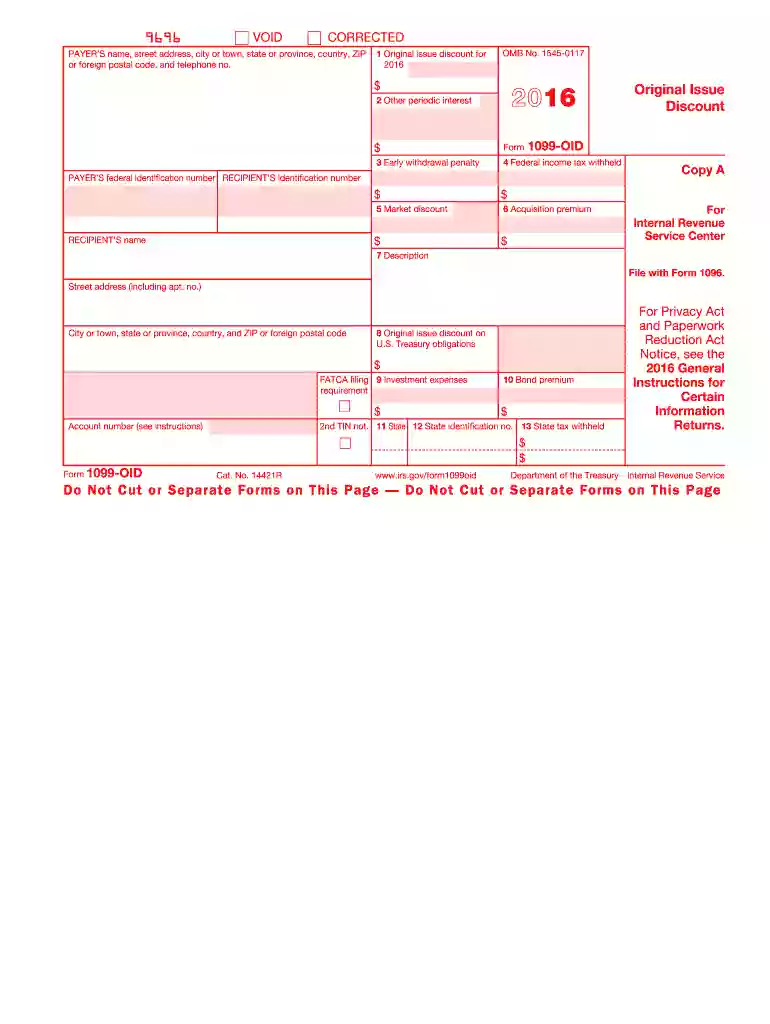
The Form 1099-OID is used to report original issue discount income, which arises when bonds or debt instruments are issued at a price lower than their redemption value at maturity. The difference between the issuance price and the redemption value accumulates as interest income over the life of the bond or instrument. The 2016 version of this form is specifically used for transactions and tax reporting pertaining to that year. It is a critical document for taxpayers and financial institutions to accurately report and pay the correct amount in federal taxes.
The 1099-OID 2016 form is utilized by both payers and recipients. Payers who issue such financial instruments report to the IRS the amount of OID income generated. As a recipient, you must include this income when calculating your total taxable income for tax returns. The form is filled with detailed sections that indicate the issuer's information, the recipient’s identification, and specific dollar amounts of interest and other financial particulars, ensuring compliance with tax regulations.
To obtain a 1099-OID form, individuals can typically contact the financial institution or entity that has issued the original issue discount-based instrument. If you need a blank form to complete, you might visit the official IRS website to download a copy—remember, Copy A must be the official IRS version. Additionally, financial software like QuickBooks or TurboTax can also help you fill and manage these forms.
The 1099-OID form comprises several critical boxes that collect financial details. Key elements include:
The IRS issues guidelines dictating who must file Form 1099-OID and under what circumstances. These outline the specific criteria for reporting thresholds, the necessity of electronic filing if you are submitting multiple forms, and how additional forms must be used depending on the situation of the transactions involved. Consult the IRS's official publication on 1099-OID for precise definitions and instructions.
Filing and furnishing deadlines for the 1099-OID form are paramount for compliance. The recipient should receive their copies of the form by January 31st of the following tax year. For filing with the IRS, the deadline is typically February 28th, or March 31st if filing electronically. Adhering to these important dates can prevent late fees and penalties.
Failure to accurately complete and timely submit the 1099-OID form can result in significant penalties imposed by the IRS. These can vary based on how late the form is filed and the size of the filer’s business. Penalties can range from $50 to $270 per form, depending on the date it is filed, with higher penalties for intentional disregard.
By understanding the significance and requirements of the 1099-OID 2016 form, taxpayers ensure compliance and avoid potential fines. Utilizing tax software and consulting financial professionals can offer significant assistance in navigating these obligations accurately.
We've got more versions of the 2016 oid form. Select the right 2016 oid version from the list and start editing it straight away!
| Versions | Form popularity | Fillable & printable |
|---|---|---|
| 2024 | 4.1 Satisfied (26 Votes) | |
| 2019 | 4.8 Satisfied (29 Votes) | |
| 2019 | 4.3 Satisfied (112 Votes) | |
| 2018 | 4.4 Satisfied (207 Votes) | |
| 2017 | 3.9 Satisfied (28 Votes) | |
| 2016 | 4.3 Satisfied (259 Votes) | |
| 2015 | 4.1 Satisfied (47 Votes) | |
| 2014 | 4 Satisfied (56 Votes) | |
| 2013 | 4 Satisfied (44 Votes) | |
| 2012 | 4 Satisfied (49 Votes) | |
| 2011 | 4 Satisfied (20 Votes) | |
| 2010 | 4 Satisfied (30 Votes) |
At DocHub, your data security is our priority. We follow HIPAA, SOC2, GDPR, and other standards, so you can work on your documents with confidence.
Internal Revenue Service. Reproducible copies of federal tax forms and instructions.Read more
Feb 25, 2021 Name of each exchange on which registered. Common Shares, par value CHF 24.15 per share. CB. New York Stock Exchange.Read more
To complete Form 1099-OID, use: the 2016 General Instructions for Certain Information. Returns, and. the 2016 Instructions for Forms 1099-INT and 1099-OID.Read more


