




01. Edit your form online
Type text, add images, blackout confidential details, add comments, highlights and more.

Type text, add images, blackout confidential details, add comments, highlights and more.

Draw your signature, type it, upload its image, or use your mobile device as a signature pad.

Send it via email, link, or fax. You can also download it, export it or print it out.
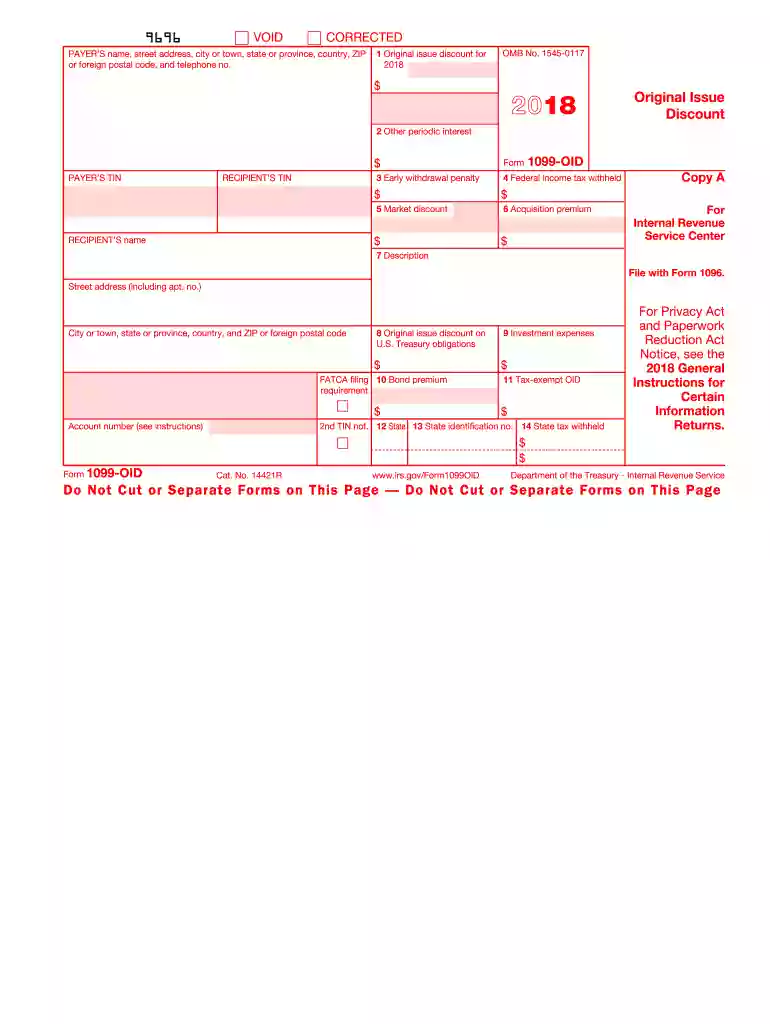
Form 1099-OID, specifically the 2012 version, refers to a tax form used in the United States to report original issue discount (OID) income. OID is the excess of the stated redemption price at maturity over the issue price of a bond or other debt instrument. Essentially, it represents interest that accrues from the issuance of certain financial instruments at less than face value. The 1099-OID form documents this interest income for both the issuer and the investor, ensuring proper taxation.
OID income must be reported to the Internal Revenue Service (IRS) as it contributes to taxable income, impacting both the issuer's and the recipient's financial declarations. Given the role of OID in financial instruments, understanding and accurately completing this form is crucial for complying with IRS regulations.
Filing the 1099-OID 2012 form serves multiple purposes, including documenting interest income for tax reporting and ensuring compliance with federal tax laws. Here is how to correctly utilize the form:
Identify Eligible Instruments: Determine if your bond or debt instrument is subject to OID. This includes zero-coupon bonds and other financial instruments issued below face value that accrue interest over time.
Accumulate Information: Gather financial details, including the issue date, face value, and redemption price, to calculate the OID.
Complete the Form: Use the information collected to fill out the form. Report total OID for the year in designated boxes, ensuring figures are accurate.
Provide Copies: Ensure recipients of the interest have their copy of the form for their records. It is crucial for recipients to accurately report this income when completing their tax filings.
Filing a Form 1099-OID involves several detailed steps to ensure accuracy and compliance. Follow these steps carefully:
Input Identification Information:
Details of Original Issue Discount:
Checkboxes and Other Details:
Verification and Submissions:
Retain Copies:
Various entities and individuals typically need to use the 1099-OID form:
Issuers of Debt Instruments: Organizations that issue bonds or similar financial instruments are responsible for providing this form to recipients who earn OID.
Individual Investors: Individuals holding financial investments subject to OID receive this form to ensure accurate tax reporting of earned interest income.
Financial Institutions: These entities frequently handle bulk preparations of the 1099-OID forms for numerous clients, ensuring compliance with tax regulations.


Timing is critical when filing Form 1099-OID. Adherence to the following deadlines ensures compliance and avoids penalties:
Filing with Taxpayers: Issuers must send Form 1099-OID to recipients by January 31 of the year following the tax year.
Submission to the IRS: The form should be filed with the IRS by February 28 if filed on paper. If filing electronically, the deadline extends to March 31.
Abide by these dates to guarantee that submissions are processed smoothly and without incurring potential fines.
Several key terms are associated with Form 1099-OID, understanding these is vital:
Original Issue Discount (OID): The difference between the redemption price and the initial offering price of a bond or debt instrument.
Stated Redemption Price at Maturity: The amount payable to the holder at maturity, excluding any interest that accrues over the life of the instrument.
Accrued Interest: The interest earned by a bond or debt instrument but not yet paid out.
Failure to properly complete or timely file Form 1099-OID can lead to significant penalties, which vary according to the nature and degree of the oversight:
Monetary Penalties: Ranges depending on when the correct form is filed, with increased fines for delays past specified deadlines.
Increased Scrutiny: Continued non-compliance may trigger audits and additional oversight from the IRS, with a focus on ensuring full disclosure of taxable income.
Therefore, understanding the requirements and deadlines for filing Form 1099-OID is essential to maintain financial and legal compliance.
The IRS provides specific guidelines on the proper use of Form 1099-OID. Following these guidelines is fundamental:
Use Official Forms: Only use the IRS's official printed version of Copy A. Printed or reproduced versions might result in penalties as they are not suitable for scanning.
Accurate Reporting: Ensure all values, especially OID calculations, are accurate. Errors can lead to rejections or misreporting penalties.
By adhering to IRS instructions, issuers and recipients can ensure compliance and maintain accurate financial records.
We've got more versions of the 1099 oid 2012 form. Select the right 1099 oid 2012 version from the list and start editing it straight away!
| Versions | Form popularity | Fillable & printable |
|---|---|---|
| 2024 | 4.1 Satisfied (26 Votes) | |
| 2019 | 4.8 Satisfied (29 Votes) | |
| 2019 | 4.3 Satisfied (112 Votes) | |
| 2018 | 4.4 Satisfied (207 Votes) | |
| 2017 | 3.9 Satisfied (28 Votes) | |
| 2016 | 4.3 Satisfied (259 Votes) | |
| 2015 | 4.1 Satisfied (47 Votes) | |
| 2014 | 4 Satisfied (56 Votes) | |
| 2013 | 4 Satisfied (44 Votes) | |
| 2012 | 4 Satisfied (49 Votes) | |
| 2011 | 4 Satisfied (20 Votes) | |
| 2010 | 4 Satisfied (30 Votes) |
At DocHub, your data security is our priority. We follow HIPAA, SOC2, GDPR, and other standards, so you can work on your documents with confidence.
To help address that problem the legislature in 2012 enacted a new statute, GS 14-118.6, making it a Class I felony to knowingly present for filing a false lien.Read more
The products you should use to complete. Form 1099-OID are the 2012 General Instructions for Certain. Information Returns and the 2012 Instructions for Forms.Read more
As the largest for-profit education company, and the company that pioneered the modern for- profit education model, Apollo Group, Inc. has the potential toRead more


