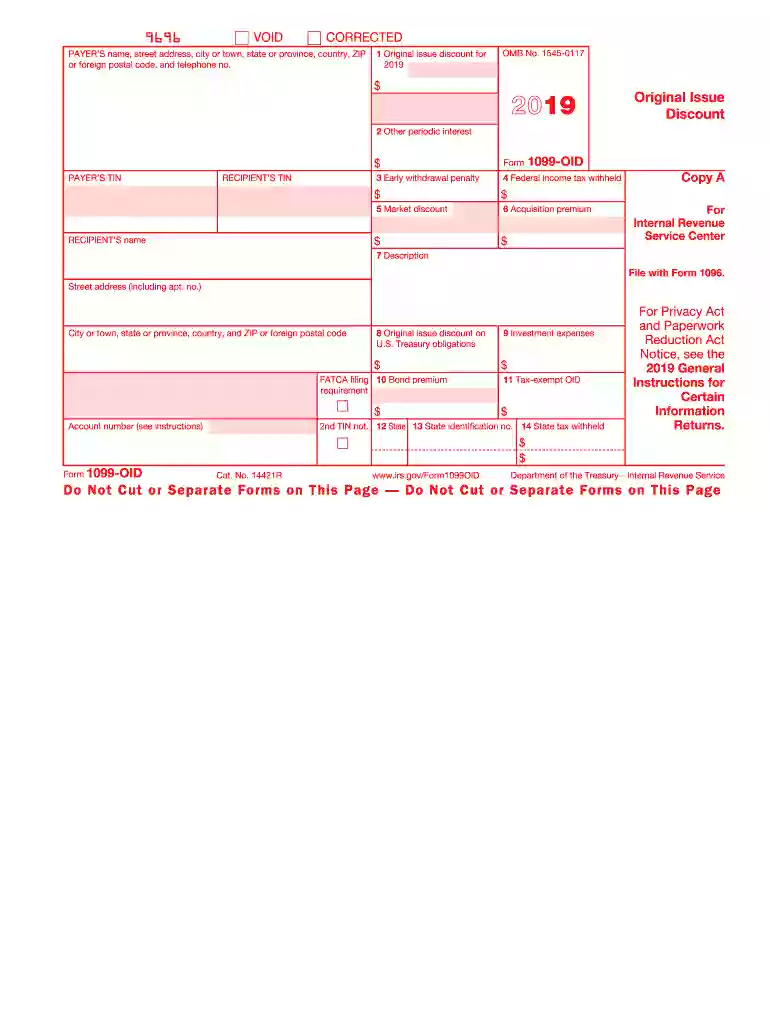
1099 oid-2026

Get Form
1099 oid for bills Preview on Page 1

Here's how it works

01. Edit your 1099 oid for bills online
Type text, add images, blackout confidential details, add comments, highlights and more.

02. Sign it in a few clicks
Draw your signature, type it, upload its image, or use your mobile device as a signature pad.

03. Share your form with others
Send 1099 oid bills paid via email, link, or fax. You can also download it, export it or print it out.

Definition and Meaning of Form 1099-OID

Form 1099-OID, also known as Original Issue Discount, is a tax form used to report income generated from certain types of financial instruments. This income accrues on bonds and other securities issued at a discount to face value. The difference between the discounted purchase price and the face value at maturity represents the Original Issue Discount, or OID, which is considered taxable interest income by the IRS. The form is crucial for taxpayers and financial institutions to accurately report this income, ensuring compliance with federal tax obligations.

Financial Instruments Involved

  • Bonds issued at a discount
  • Certificates of deposit (CDs)
  • Treasury inflation-protected securities (TIPS)
  • Other debt instruments with an OID feature

Tax Implications

OID is treated as interest income and must be reported annually, even if the financial instrument is not yet matured or cashed in. Proper documentation is necessary to avoid discrepancies during tax filing.

Steps to Complete the Form 1099-OID

The process of filling out Form 1099-OID involves a detailed understanding of the taxpayer's financial transactions. Here's a step-by-step guide to help accurately complete the form:

  1. Gather Necessary Information

    • Obtain details of the payer, such as name, address, and taxpayer identification number (TIN).
    • Collect taxpayer (recipient) information. Ensure names and TINs match official records.
  2. Identify OID Income

    • Calculate the total OID earned during the year. Cross-reference with account statements for accuracy.
    • Include any exempt interest, early withdrawal penalties, or other relevant income adjustments.
  3. Fill Out the Form

    • Enter OID in the appropriate boxes, ensuring precise delineation of the types and sources of this income.
    • Double-check figures to align with both payer and recipient records.
  4. Review and Sign

    • Verify all computations and personal information.
    • Signature and date sections must be duly signed by the authorized individual.

Avoiding Common Errors

  • Ensure accuracy in TINs and account details
  • Avoid rounding off figures unless specified
  • Reconcile discrepancies in OID calculations before submission

How to Obtain Form 1099-OID

Acquiring Form 1099-OID is straightforward for both issuers and recipients. Here's how one can access it:

For Issuers

  • Access the form via IRS.gov, under the Forms and Publications section.
  • Use compatible tax software to generate the electronic version of the form.

For Recipients

  • The issuer is required to send the form by January 31st following the tax year in question. Ensure your details are up-to-date with the issuer to avoid delays.
  • If the form is not received, contact the issuer directly or check electronically via online banking tools if available.

Electronic vs. Paper Forms

  • Issuers and recipients can opt for electronic forms to streamline the process and ensure faster access.
  • Ensure compatibilities with software like TurboTax or QuickBooks for efficient record-keeping and submissions.

IRS Guidelines for Form 1099-OID

It is essential to adhere to IRS guidelines to avoid penalties and ensure the correct filing of OID income.

Reporting Obligations

  • Report all OID income irrespective of whether known or estimated.
  • Amend inaccurate returns promptly to avoid interest or penalties.

Form Submission Requirements

  • Submit the completed form to the IRS and send copies to the recipient.
  • Ensure timely submissions to avoid late filing penalties.

Key Considerations

  • Analyze changes in IRS guidelines annually for updates.
  • Adopt IRS-recommended practices to ensure compliance.

Filing Deadlines and Important Dates

Ensuring adherence to important filing deadlines is crucial for both issuers and taxpayers to avoid penalties.

Key Filing Dates

  • January 31: Deadline to send Form 1099-OID to recipients.
  • February 28: Deadline for paper filing with the IRS.
  • March 31: Deadline for electronic filing with the IRS.

Importance of Timeliness

  • Late filings can incur substantial penalties; proactive filing prevents such financial consequences.
  • Automated reminders or tax software alerts can further facilitate timely submission.

Who Typically Uses Form 1099-OID?

Form 1099-OID is pivotal for various categories of taxpayers who earn OID income. Understanding these categories helps determine who needs to utilize this form.


Common Users

  • Individual Investors: Those holding bonds or securities at a discount.
  • Financial Institutions: Required to issue forms to account holders experiencing OID.
  • Mutual Funds and ETFs: Funds where OID securities form part of the portfolio.
decoration image ratings of Dochub

Tailoring Use Based on Circumstances

Each user category may experience unique circumstances influencing their OID reporting. Financial advisors can provide personalized guidance to align with range-specific complexities.

Penalties for Non-Compliance with Form 1099-OID

Failing to comply with 1099-OID regulations can result in severe penalties. Issuers and recipients alike must be vigilant to sidestep these repercussions.

Potential Penalties

  • Missed Deadlines: Monetary fines for lateness in filing or furnishing forms.
  • Incorrect Information: Penalties can arise if reported information is inaccurate.

Strategies to Minimize Risks

  • Regularly update financial records and TINs to prevent clerical errors.
  • Define internal audit processes to ensure compliance and avoid costly mistakes.

State-Specific Rules for 1099-OID

Where you file your taxes might dictate additional requirements for reporting OID income, adding complexity to the process.

Variations by State

  • Some states might require separate reporting or modifications to federal amounts.
  • Navigate these differences by consulting with a tax professional familiar with state-specific rules.

Best Practices

  • Keep abreast with updates and rules that vary by state to ensure full compliance.
  • Implement multi-state filing solutions if operating in jurisdictions with differing regulations.

See more 1099 oid versions

We've got more versions of the 1099 oid form. Select the right 1099 oid version from the list and start editing it straight away!
Versions Form popularity Fillable & printable
2024 4.1 Satisfied (26 Votes)
2019 4.8 Satisfied (29 Votes)
2019 4.3 Satisfied (112 Votes)
2018 4.4 Satisfied (207 Votes)
2017 3.9 Satisfied (28 Votes)
2016 4.3 Satisfied (259 Votes)
2015 4.1 Satisfied (47 Votes)
2014 4 Satisfied (56 Votes)
2013 4 Satisfied (44 Votes)
2012 4 Satisfied (49 Votes)
2011 4 Satisfied (20 Votes)
2010 4 Satisfied (30 Votes)
be ready to get more

Complete this form in 5 minutes or less

Get form

Security and compliance

At DocHub, your data security is our priority. We follow HIPAA, SOC2, GDPR, and other standards, so you can work on your documents with confidence.

Learn more
ccpa2
pci-dss
gdpr-compliance
hipaa
soc-compliance