




01. Edit your form online
Type text, add images, blackout confidential details, add comments, highlights and more.

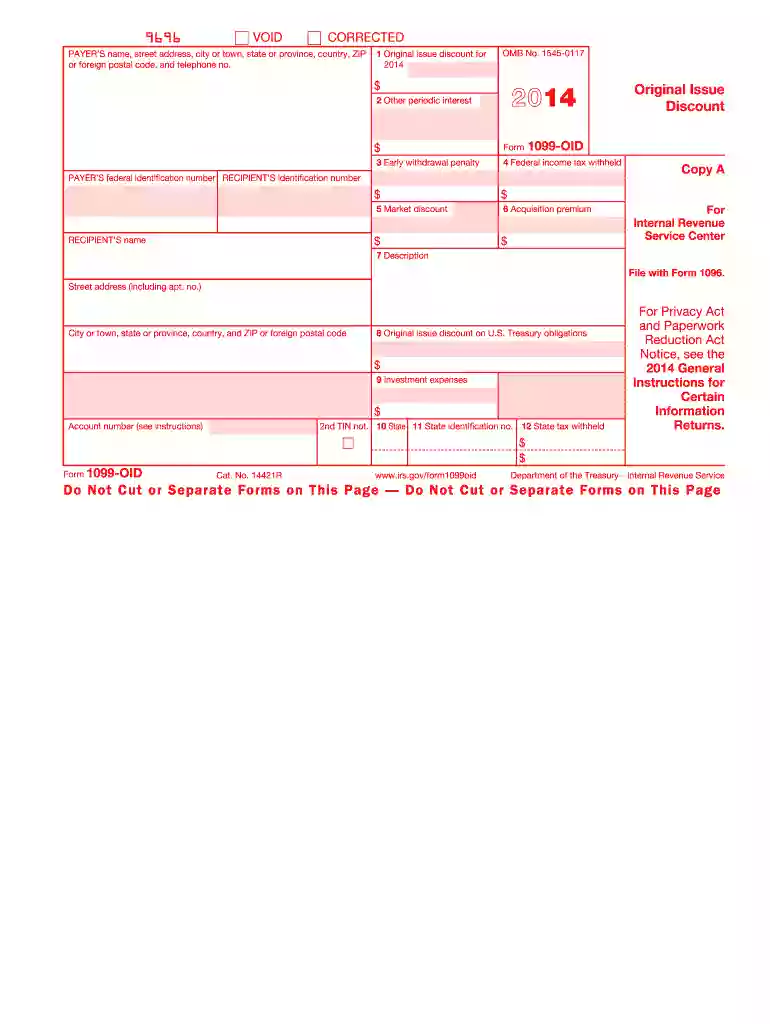
Type text, add images, blackout confidential details, add comments, highlights and more.

Draw your signature, type it, upload its image, or use your mobile device as a signature pad.

Send it via email, link, or fax. You can also download it, export it or print it out.
Form 1099-OID, or Original Issue Discount, is a tax document used primarily in the United States to report the amount of Original Issue Discount included in income for taxable purposes. OID arises when financial instruments such as bonds or securities are issued at a price lower than their face value. The difference between the actual price paid and the amount received upon maturity is considered interest income. This form assists in ensuring that investors accurately report this income to the IRS as part of their annual tax obligations.
Taxpayers use Form 1099-OID to disclose the income accumulated from OID as it impacts their taxable income. To accurately report this information, recipients must ensure that details such as the payer’s identification number, recipient’s identification number, and the OID amount are correctly entered. The reported income is used to calculate the total taxable income for the year. It's imperative that recipients do not file this form with the IRS, as this version is strictly for informational purposes. Instead, the data should be included in the tax return filed with the IRS via the appropriate channels.
Form 1099-OID is typically provided by the issuer of the financial instrument, such as banks, investment companies, or other financial institutions. The form is sent to both the IRS and the taxpayer by January 31 of the year following the tax year it encompasses. If you do not receive the form, it is important to contact the issuer directly to request a copy or clarification. Taxpayers can also access blank versions of the form through IRS-approved distribution channels online, which can be used for applying the reported OID in the annual tax filing.
Under U.S. tax law, Form 1099-OID is a critical document that maintains compliance with income reporting requirements established by the IRS. Legal use of the form mandates that both the issuer and recipient ensure accurate and timely reporting of OID income. Misreporting or failure to report this form properly can result in penalties or audits by the IRS. As a legally binding document, it is vital for both parties to maintain accurate records and facilitate direct communication to resolve any discrepancies.
Form 1099-OID must be furnished to both the IRS and the recipient by January 31 of the year following the tax year in which the OID income was constituted. It's crucial for taxpayers to file their tax returns including OID income by the typically established IRS deadline, generally April 15, unless otherwise adjusted for public holidays or weekends. To avoid penalties late submissions must be avoided, and it is advisable to organize personal finance and document gathering well in advance.
To effectively utilize Form 1099-OID, taxpayers will need several supporting documents:
These documents help validate the information provided on Form 1099-OID, ensuring that recipients file their tax returns accurately and comply with IRS regulations.
Failure to properly report OID income using Form 1099-OID can lead to significant penalties. This may include fines for late payments, inaccuracies, or total noncompliance in reporting taxable income. The IRS may commence an audit, further requesting detailed financial records to ensure the appropriate reporting of income. Taxpayers are encouraged to understand these penalties, maintain diligent records, and seek professional tax advice to prevent costly mistakes.
We've got more versions of the gov/form1099oid form. Select the right gov/form1099oid version from the list and start editing it straight away!
| Versions | Form popularity | Fillable & printable |
|---|---|---|
| 2024 | 4.1 Satisfied (26 Votes) | |
| 2019 | 4.8 Satisfied (29 Votes) | |
| 2019 | 4.3 Satisfied (112 Votes) | |
| 2018 | 4.4 Satisfied (207 Votes) | |
| 2017 | 3.9 Satisfied (28 Votes) | |
| 2016 | 4.3 Satisfied (259 Votes) | |
| 2015 | 4.1 Satisfied (47 Votes) | |
| 2014 | 4 Satisfied (56 Votes) | |
| 2013 | 4 Satisfied (44 Votes) | |
| 2012 | 4 Satisfied (49 Votes) | |
| 2011 | 4 Satisfied (20 Votes) | |
| 2010 | 4 Satisfied (30 Votes) |
At DocHub, your data security is our priority. We follow HIPAA, SOC2, GDPR, and other standards, so you can work on your documents with confidence.
Information about Form 1099-OID, including recent updates, related forms, and instructions on how to file. File Form 1099-OID if the OID includible in gross
Shows OID on a U.S. Treasury obligation for the part of the year you owned it. Report this amount on your Federal income tax return, and see Pub. 1212 to figureRead more
As the largest for-profit education company, and the company that pioneered the modern for- profit education model, Apollo Group, Inc. has the potential toRead more


