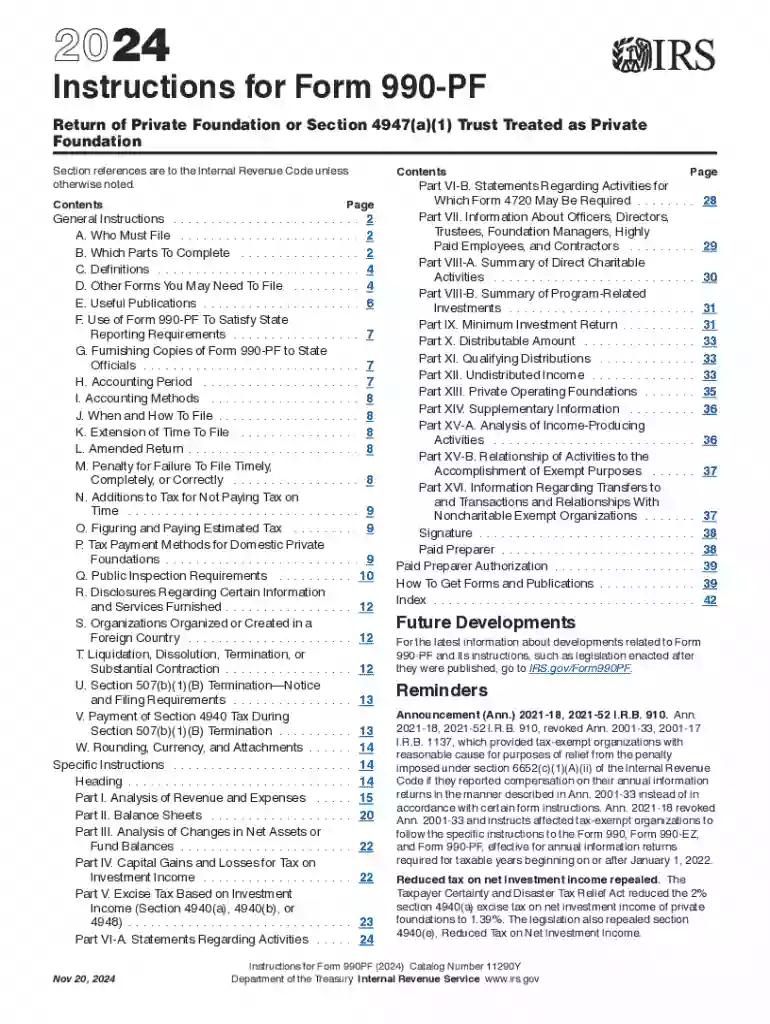
2024 Instructions for Form 990-PF Instructions for Form 990-PF, Return of Private Foundation or Sect-2026

Get Form
form 990pf instructions Preview on Page 1

Here's how it works

01. Edit your form 990pf instructions online
Type text, add images, blackout confidential details, add comments, highlights and more.

02. Sign it in a few clicks
Draw your signature, type it, upload its image, or use your mobile device as a signature pad.

03. Share your form with others
Send irs 990 pf instructions via email, link, or fax. You can also download it, export it or print it out.

Definition and Meaning

The 2024 Instructions for Form 990-PF provide detailed guidance for completing Form 990-PF, which is the annual return required for private foundations and certain nonprofit trusts. This form is mandated by the IRS for organizations that qualify as private foundations under U.S. tax law. Understanding the instructions is crucial for accurate reporting of financial data, ensuring compliance with regulatory requirements, and reflecting an organization's charitable activities correctly.

Key Components

  • Purpose: Highlights the form's role in disclosing a foundation's financials and charitable activities.
  • Scope: Clarifies who must file, including details on trust entities.
  • Structure: Outlines each section of the form and its significance.

How to Use the Form

Understanding how to apply the instructions is vital for properly completing the Form 990-PF. This involves familiarizing oneself with the format, answering questions accurately, and performing necessary calculations.

Step-by-Step Process

  1. Review Eligibility: Ensure your organization qualifies as a private foundation.
  2. Collect Financial Data: Gather income, expenditures, assets, and liabilities information.
  3. Follow Section Guidance: Complete sections based on detailed instructions provided.
  4. Calculate Excise Taxes: Accurate computation of taxes on investment income.
  5. Verify Completeness: Double-check all entries for accuracy.

Steps to Complete the Form

Accurate completion of the Form 990-PF requires attention to detail and a step-by-step approach to each section, ensuring compliance with IRS standards. Below are the fundamental steps:

  1. Read Instructions Carefully: Begin by thoroughly understanding the guidance for each part of the form.
  2. Gather Required Documents: Include financial statements, previous returns, and other relevant documents.
  3. Complete General Information Section: Fill out basic demographic and identification details about the organization.
  4. Provide Financial Information: Accurately report revenues, expenses, and distributions.
  5. Calculate Taxes: Use IRS guidance to determine applicable excise taxes.
  6. Review and Sign: After completion, review all information; the form must be signed by an authorized individual.

Important Terms Related to the Form

Grasping the terminology used in the instructions is crucial for effectively navigating and completing the form. Critical terms include:

Key Definitions

  • Private Foundation: A non-profit that typically receives most of its income from investments and endowments.
  • Qualifying Distributions: Outlays required to maintain tax-exempt status, such as grants and program-related investments.
  • Net Investment Income: Income subject to excise tax, including interest, dividends, and capital gains minus investment expenses.

Filing Deadlines and Important Dates

Understanding the calendrical framework for the Form 990-PF is essential to avoid penalties. The form must be filed annually, typically within five months after the foundation's fiscal year-end.

Key Deadlines

  • Annual Deadline: 15th day of the 5th month following the fiscal year-end.
  • Extension Availability: A six-month extension may be granted upon filing Form 8868, if needed.

Required Documents

Preparation for filing requires collecting a comprehensive set of documents. This documentation supports the information reported on the form and facilitates thorough verification.

Essential Documents

  • Financial Statements: Balance sheets, income statements, etc.
  • Previous Returns: Last year's Form 990-PF, for comparison and consistency.
  • Donation Records: Documentation of grants and donations received and given.

Form Submission Methods

The Form 990-PF can be submitted in various formats depending on organizational preference and capability, each with specific guidelines.

Available Methods

  • Online Submission: Using certified e-file systems accredited by the IRS.
  • Mail Submission: Physical copies can be sent to designated IRS addresses.
  • In-Person Submission: Hand-delivered to IRS offices, though this is less common.

Penalties for Non-Compliance

Failure to comply with filing requirements, including errors or omissions, can lead to serious financial penalties for the organization.

Key Penalties

  • Late Filing: Daily penalties accrue until submission is complete.
  • Incomplete Information: Penalties for missing or incorrect data.
  • Non-Filing: Potential for revocation of tax-exempt status in severe cases.

All in all, adherence to the 2024 Instructions for Form 990-PF ensures that private foundations maintain their regulatory obligations and operate transparently and effectively within legal frameworks. Understanding and utilizing each section of the form is crucial for organizational compliance and success.

be ready to get more

Complete this form in 5 minutes or less

Get form

Got questions?

We have answers to the most popular questions from our customers. If you can't find an answer to your question, please contact us.
Contact us
Generally, organizations use Form 1023, Application for Recognition of Exemption, for this purpose. All private foundations, including nonexempt trusts treated as private foundations, must annually file Form 990-PF, Return of Private Foundation.
Form 990-PF is used to calculate the amount of excise tax that has to be paid by a private foundation.
The Form 990-PF, entitled Return of Private Foundation is a report that must be filed each year with the Internal Revenue Service (IRS) by organizations exempt from Federal income taxes under section 501 of the Internal Revenue Code, and whose annual receipts are normally more than $25,000 a year.
There are several versions of Form 990: public charities file a Form 990, 990-EZ, or 990-N; private foundations file Form 990-PF (PF stands for Private Foundation). Learn more about the difference between public charities and private foundations.
If a nonprofit is incorporated in a state but has never been recognized by the IRS as tax-exempt, then it does not have an obligation to file an IRS Form 990.

Security and compliance

At DocHub, your data security is our priority. We follow HIPAA, SOC2, GDPR, and other standards, so you can work on your documents with confidence.
Learn more
ccpa2
pci-dss
gdpr-compliance
hipaa
soc-compliance
be ready to get more

Complete this form in 5 minutes or less

Get form

People also ask

What is the 990-PF? The 990-PF is the information return U.S. private foundations file with the Internal Revenue Service. This public document provides fiscal data for the foundation, names of trustees and officers, application information, and a complete grants list.
Form 990, 990-EZ, or 990-PF must be filed by the 15th day of the 5th month after the end of your organizations accounting period. Thus, for a calendar year taxpayer, Form 990, 990-EZ, or 990-PF is due May 15 of the following year.

Related links