




01. Edit your 864ez online
Type text, add images, blackout confidential details, add comments, highlights and more.

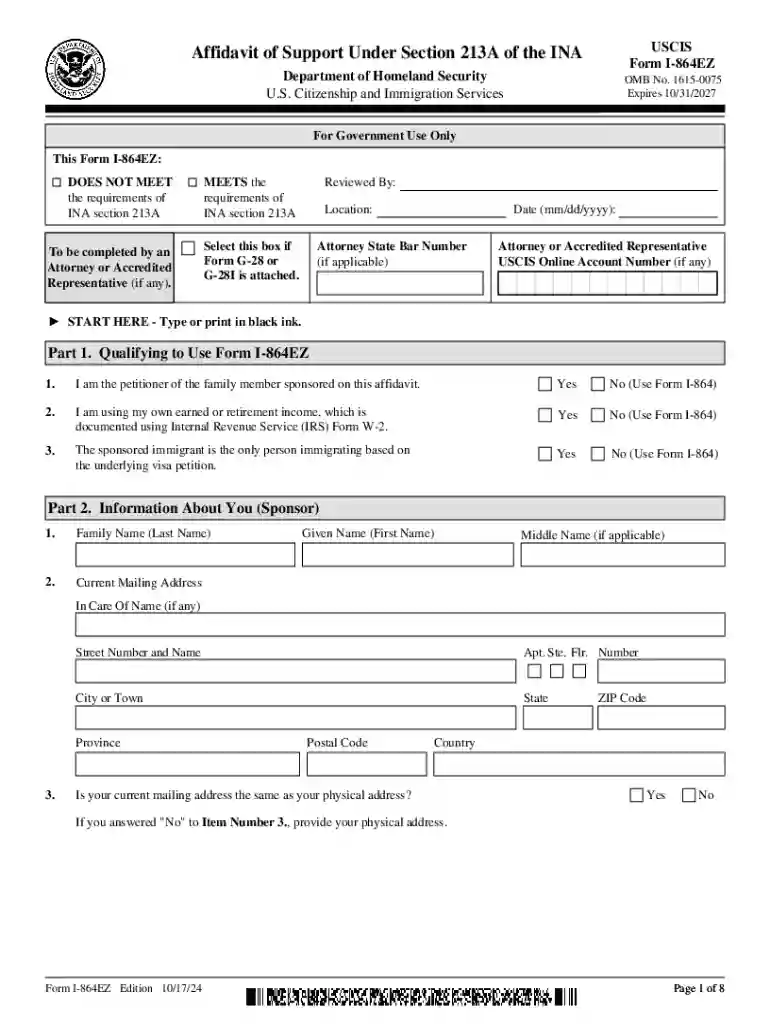
Type text, add images, blackout confidential details, add comments, highlights and more.

Draw your signature, type it, upload its image, or use your mobile device as a signature pad.

Send i 864ez via email, link, or fax. You can also download it, export it or print it out.
Form I-864, Instructions for Affidavit of Support Under Section 213A of the Immigration and Nationality Act (INA) is a critical document used in the United States immigration process. This form, sometimes referred to as the Affidavit of Support, plays a vital role in helping an intending immigrant become a lawful permanent resident. Its primary function is to demonstrate that the sponsor has sufficient financial resources to prevent the immigrant from becoming a public charge. Sponsors must prove their financial capacity to support the immigrant, ensuring the individual will not rely on government assistance.
To effectively use Form I-864, sponsors need to follow specific steps to ensure the form is completed accurately and submitted correctly. The process begins with downloading the form from the U.S. Citizenship and Immigration Services (USCIS) website. Sponsors should review the form's instructions in detail to understand the information required. The form includes sections on the sponsor's personal details, employment information, and financial circumstances. Sponsors must ensure all sections are filled out comprehensively and that any supporting documents that demonstrate financial capability are included. The completed form must then accompany the immigrant petition submission to USCIS.
Gather Required Information: Assemble all necessary details about your financial situation, including your income, assets, and household size.
Complete Part 1 - Sponsor’s Information: Enter your personal details, including your name, contact information, and relationship to the immigrant.
Fill Out Part 2 - Household Size: Detail the individuals you support, including any dependents and relatives living with you.
Provide Financial Information in Part 3: Accurately report your income, using tax returns and pay stubs as references. List any assets that can be included to meet the financial requirement.
Review and Sign the Form: Double-check all entries and sign the form where indicated, affirming that the information is truthful and complete.
Attach Supporting Documents: Include tax returns, W-2 forms, and proof of assets to substantiate your financial claims.
Submit to USCIS: Submit the form alongside the immigrant’s visa application and other required documents.
Form I-864 has specific eligibility criteria that sponsors must meet to provide the necessary financial support. The primary requirement is that the sponsor be a U.S. citizen or lawful permanent resident. Furthermore, the sponsor must reside in the United States or its territories and earn a minimum income of at least 125% of the federal poverty guidelines for their household size. Certain exceptions apply for active-duty military personnel, who may only need to meet 100% of the guideline.


Failing to comply with the responsibilities outlined in Form I-864 can lead to serious repercussions. If a sponsored immigrant receives government assistance, the sponsor may be legally obligated to repay those benefits. Additionally, non-compliance can result in civil lawsuits initiated by federal, state, or local government agencies seeking reimbursement. It is crucial that sponsors fully understand and adhere to the obligations and responsibilities they undertake by signing this form.
When completing Form I-864, certain supporting documents are required to validate the information provided:
While Form I-864 does not have a specific deadline, it is crucial that the form is submitted concurrently with the immigrant's visa application or adjustment of status packet. Sponsors should be mindful of any timelines associated with the immigrant’s case, ensuring all documentation is complete and submitted promptly to avoid processing delays. Any changes to income or household circumstances during the immigration process should be reported to USCIS as soon as possible.
Form I-864 serves a legal function in the immigration process by providing a binding contract between the sponsor and the U.S. government. By signing the affidavit, the sponsor agrees to support the immigrant financially and prevent reliance on public benefits. This legal requirement continues until the immigrant becomes a U.S. citizen, has worked 40 quarters (approximately ten years) in the U.S., departs the U.S. permanently, or passes away. Understanding the long-term legal implications is critical for sponsors.
The application process for Form I-864 involves detailed preparation and submission of supporting documentation. While USCIS does not publish specific processing times for Form I-864, it is usually assessed alongside the main immigration petition. Approval times can vary based on the complexity of the case, the completeness of the submission, and the workloads of USCIS. Sponsors can check processing times on the USCIS website and receive updates on the case status online or through customer service.
Though Form I-864 is a federal document, certain state laws might affect how resources and benefits are calculated. Some states may have additional social support programs that impact the sponsor’s obligations. Sponsors should consult with an immigration attorney or a local specialist in their state to understand any specific rules or obligations that might apply to their situation. Understanding these nuances can ensure full compliance with both federal and state requirements.
We've got more versions of the 864ez form. Select the right 864ez version from the list and start editing it straight away!
At DocHub, your data security is our priority. We follow HIPAA, SOC2, GDPR, and other standards, so you can work on your documents with confidence.
You must submit a Form I-864 Affidavit of Support for each intending immigrant you are sponsoring. You may submit photocopies if you are sponsoring moreRead more
Sep 30, 2021 1615-0075, INSTRUCTIONS FOR AFFIDAVIT OF SUPPORT UNDER SECTION 213A OF THE INA 1, 11 (2021), more


