Notary App Instructions-2015-11-21 docx-2026

Get Form
Notary App Instructions-2015-11-21 docx Preview on Page 1

Here's how it works

01. Edit your form online
Type text, add images, blackout confidential details, add comments, highlights and more.

02. Sign it in a few clicks
Draw your signature, type it, upload its image, or use your mobile device as a signature pad.

03. Share your form with others
Send it via email, link, or fax. You can also download it, export it or print it out.

Definition & Meaning

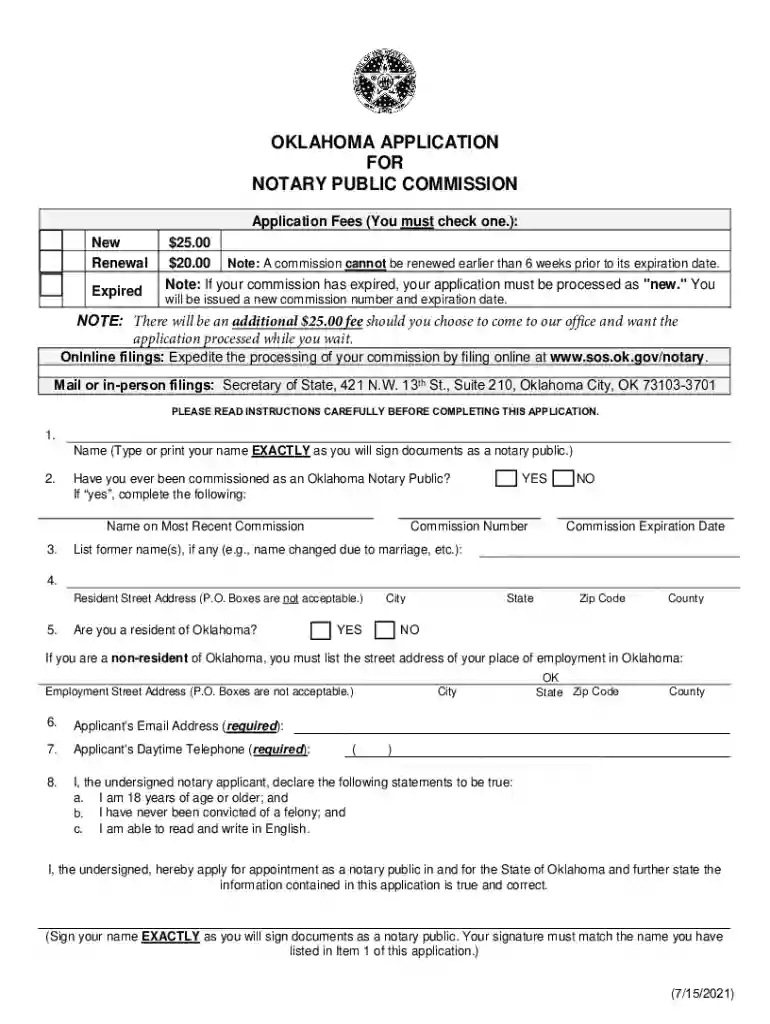
The "Notary App Instructions-2015-11-21 docx" serves as a comprehensive guide for individuals applying for a Notary Public Commission. It details the procedures involved, including the necessary forms, filing instructions, and legal requirements. A notary public is an official appointed to serve as an impartial witness to the signing of important documents, ensuring they are signed freely and willingly by all parties.

Key Functions of a Notary Public

  • Witnessing signatures to verify authenticity
  • Administering oaths and affirmations
  • Certifying copies of documents
  • Providing acknowledgment of documents

Understanding these functions is essential for applicants as it defines the scope and limits of their duties once commissioned.

Steps to Complete the Notary App Instructions-2015-11-21 docx

Completing the Notary App Instructions requires attention to detail and adherence to specific guidelines. Below are the essential steps to follow:

  1. Review Eligibility Criteria: Ensure that you meet age, residency, and language requirements.
  2. Gather Required Documentation: Collect identification documents, proof of residency, and any previous commissions or certifications.
  3. Complete the Application Form: Accurately fill in all sections of the application form, addressing every requirement outlined.
  4. Obtain a Surety Bond: Secure a bond from a licensed bonding company as required by your state’s laws.
  5. Submit the Application: Follow the specified submission method, whether online, by mail, or in person, and ensure all documents are included.
  6. Pay Fees: Be aware of the application fee and payment methods accepted.

Practical Example

Consider a resident of Oklahoma who is 25 years old with fluent English proficiency. They would gather their ID, proof of residency, and visit a local office to complete these steps, ensuring accuracy and completeness to avoid delays.

Key Elements of the Notary App Instructions-2015-11-21 docx

Understanding the document’s key elements aids in completing the application accurately:

  • Personal Information Section: Requires full name, address, and contact details.
  • Education and Experience Verification: May require listing relevant notarial experience or training.
  • Declaration of Intent: A statement expressing the applicant's understanding of the duties and commitment to faithfully perform them.

Common Errors to Avoid

  • Omitting required information
  • Submitting incomplete documentation
  • Misunderstanding the necessity of a surety bond

Legal Use of the Notary App Instructions-2015-11-21 docx

Legal compliance is crucial when using the notary application instructions. Adhering to both state and federal laws ensures a valid and enforceable commission.

Typical Legal Requirements

  • Age Limit: Most states require applicants to be at least 18 years old.
  • Residency: Proof of state residency is generally required.
  • Language Proficiency: Proficiency in English may be mandated, depending on jurisdiction.

Important Terms Related to Notary App Instructions-2015-11-21 docx

Understanding specific terminology used within the application process is vital for accurate completion:

  • Surety Bond: A financial security protecting the public from the notary's misconduct or negligence.
  • Jurat: A notarial act providing assurance that a document was signed in the presence of a notary.
  • Acknowledgment: A formal declaration before a notary ensuring the signer was not under duress and willing to sign.

Eligibility Criteria

Eligibility criteria for becoming a notary are uniform but may vary slightly depending on state-specific laws:


  • Minimum Age: Typically 18 years
  • Residency Status: Must be a legal resident of the state applying in
  • Criminal History: Clean background check usually required
decoration image ratings of Dochub

Example in Practice

A potential notary applicant must provide proof of residency, be of legal age, and not have any felony convictions, ensuring their suitability for the position.

State-by-State Differences

While the core requirements for notary applications are similar, each state may have unique stipulations:

  • Bond Amounts: Varies by state law
  • Term Length: Duration of commission can differ, generally ranging from four to ten years
  • Training and Exams: Some states require additional training or a passing score on a notary exam

Software Compatibility

Using "Notary App Instructions-2015-11-21 docx" with various digital platforms increases flexibility and efficiency:

  • Compatible Formats: Supported by common word processing software like Microsoft Word and Google Docs
  • Integration with DocHub: Allows digital editing, sharing, and storage of applications

Use Case Scenario

An applicant preferring digital applications might use DocHub to complete and store their application online, ensuring easy access and organization of documents.

Application Process & Approval Time

The application process, while similar across regions, has specific steps and potential timeframes that vary:

  1. Submission of Application: Done via prescribed method
  2. Review Period: Typically takes several weeks for approval or feedback
  3. Issuance of Commission: Upon approval, the notary seal and commission certificate are issued

Time Expectations

Most applications are processed within four to six weeks, although delays can occur due to incomplete applications or backlog at the issuing office.

be ready to get more

Complete this form in 5 minutes or less

Get form

Got questions?

We have answers to the most popular questions from our customers. If you can't find an answer to your question, please contact us.
Contact us
Notary fees by notarial act StateAcknowledgmentVerbal Oath/Affirmation TX Texas $10 UT Utah $10 VT Vermont No set fee VA Virginia $1047 more rows
Traditionally, notarizing a document has been done in person. This requires all signing parties to coordinate schedules so they can travel to the notary. On the day of the notarization, they need to bring a paper copy of the document to be docHubd along with all necessary identification.
Identify the signer appearing before you. To deter fraud and protect you from getting into trouble, each signer must appear before the notary public. Review the paperwork. Enter the notarial act in your journal. Perform the correct verbal ceremony. Complete the Notarial Certificate.
Filling out the main body of the Notary certificate Enter the correct date. This must be the actual date the notarization takes place. Write the signers and your name in the correct locations on the certificate! Sometimes careless Notaries will write their own names in a space intended for the signers name.
Notary Section: Each document will need to include a section for the notary public, it usually includes space for a signature, seal or stamp, their commission number, and the date the document was docHubd.

Security and compliance

At DocHub, your data security is our priority. We follow HIPAA, SOC2, GDPR, and other standards, so you can work on your documents with confidence.

Learn more
ccpa2
pci-dss
gdpr-compliance
hipaa
soc-compliance
be ready to get more

Complete this form in 5 minutes or less

Get form

People also ask

A Step-by-Step Guide to Notarizing Documents in California 1 Step 1: Understand the Role of a Notary Public. 2 Step 2: Locate a Notary Public. 3 Step 3: Gather Your Documents. 4 Step 4: Bring Proper Identification. 5 Step 5: Sign the Document in the Presence of the Notary. 6 Step 6: Verify Your Identity.
Do you solemnly swear under penalty of perjury that the statements in this document are true and correct to the best of your knowledge? The signer will reply, I do or Yes.
Failing to require signers to be present at the notarization is the number one claim of misconduct against Notaries.

Related links