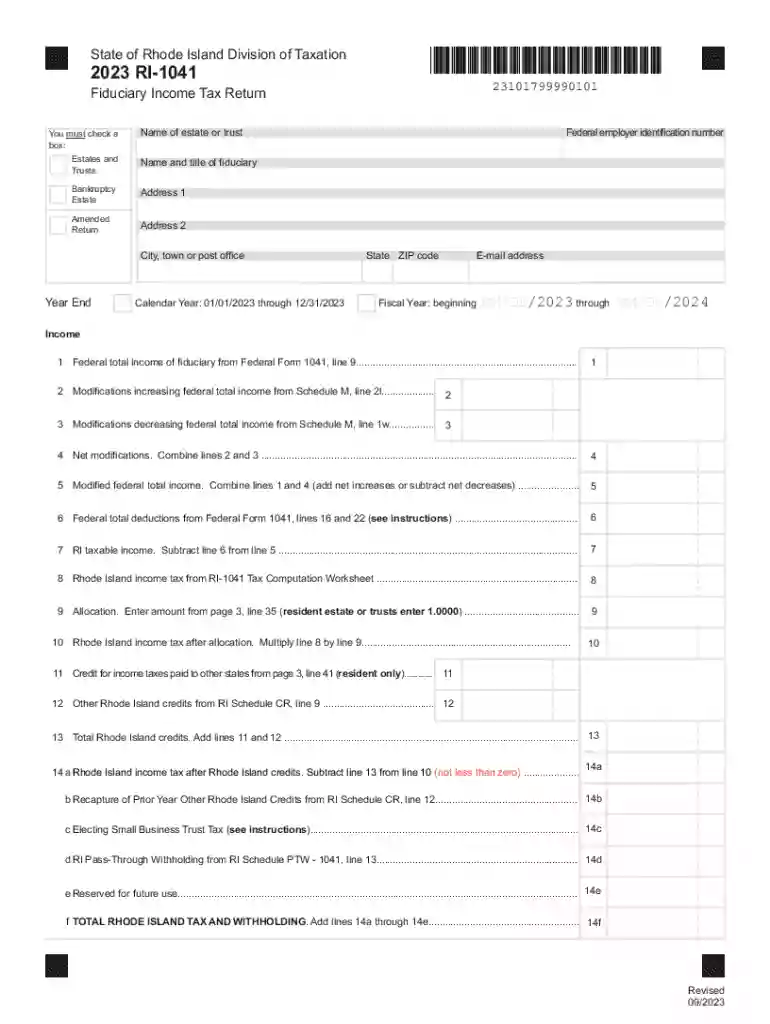
RI-1041 - Fiduciary Income Tax Return-2026

Get Form
RI-1041 - Fiduciary Income Tax Return Preview on Page 1

Here's how it works

01. Edit your form online
Type text, add images, blackout confidential details, add comments, highlights and more.

02. Sign it in a few clicks
Draw your signature, type it, upload its image, or use your mobile device as a signature pad.

03. Share your form with others
Send it via email, link, or fax. You can also download it, export it or print it out.

Definition and Meaning of RI-1041 - Fiduciary Income Tax Return

The RI-1041, or Fiduciary Income Tax Return, is a tax form utilized in the state of Rhode Island for reporting income by fiduciaries managing estates and trusts. This form is critical in outlining income, deductions, and tax credits for fiduciary entities. Fiduciaries are required to complete this form to accurately reflect financial activities concerning the estate or trust, ensuring compliance with state tax obligations.

Key Elements of the RI-1041

  • Income Reporting: Details on all taxable income generated by the estate or trust.
  • Deductions and Credits: Specific sections to detail allowable deductions and applicable tax credits.
  • Fiduciary and Beneficiary Information: Requires detailed identification of fiduciaries and beneficiaries involved.
  • Modifications to Federal Income: Adjustments specific to Rhode Island’s tax codes.

How to Use the RI-1041 - Fiduciary Income Tax Return

Using the RI-1041 form involves a comprehensive review of the estate or trust’s financial activities during the tax year. Fiduciaries need to gather all necessary financial documentation, accurately calculate taxable income, and systematically apply deductions or credits where applicable. It's important to verify all information to avoid discrepancies that could lead to penalties.

  • Gather Financial Records: Collect support documents for income, deductions, and credits.
  • Accurate Calculations: Use precise methods for calculating taxable income and deductions.
  • Verification: Ensures the information corresponds to financial records and meet state requirements.

Steps to Complete the RI-1041 - Fiduciary Income Tax Return

  1. Obtain Necessary Documents: Collect all required documents such as bank statements, invoices, and investment income records.
  2. Report Income: Input all sources of income for the estate or trust on the form.
  3. Apply Deductions: Explicitly list any deductions applicable to the estate or trust.
  4. Calculate Tax Owed: Use the Rhode Island tax tables to determine any tax liabilities or refunds.
  5. Submit the Form: Depending on preference, submit the form either online, via mail, or in person.

Required Documents

  • Financial Statements: Includes all related bank and investment account statements.
  • Expense Records: Documentation supporting deductions claimed.
  • Income Documents: Such as W-2s, 1099 forms, or similar.

Filing Deadlines and Important Dates

The RI-1041 must be filed by the 15th day of the fourth month following the close of the tax year, typically aligning with the federal filing deadline in April. Extensions may be granted but require proper application, and any taxes due should be paid by the original filing date to avoid penalties.

  • Filing Deadline: Aligns with federal tax deadlines.
  • Extension Requests: Must be submitted before the filing deadline.

Who Typically Uses the RI-1041 - Fiduciary Income Tax Return

Primarily used by fiduciaries, the form applies to those managing estates and trusts, such as executors, trustees, or personal representatives. These figures must understand fiduciary responsibilities and ensure accurate and timely tax filings.


decoration image ratings of Dochub

Roles Responsible for Filing

  • Trustees: Manage trusts and ensure compliance with tax obligations.
  • Executors: Handle the financial responsibilities for an estate.
  • Personal Representatives: Represent the estate or trust in legal and financial matters.

Legal Use of the RI-1041 - Fiduciary Income Tax Return

The RI-1041 must be used in compliance with Rhode Island state tax laws to report and pay tax liabilities associated with estates and trusts. It is crucial for fiduciaries to follow legal guidelines to avoid potential penalties for non-compliance.

Compliance Measures

  • Accurate Record Keeping: Maintain thorough records supporting all claims made in the tax return.
  • Timely Filing: Submit the form by the required deadline, or apply for an extension if needed.

Penalties for Non-Compliance

Failure to file the RI-1041 or pay due taxes can result in penalties and interest. The fiduciary may be held liable for late fees, inaccuracies, or failing to adhere to deadlines, emphasizing the importance of timely and accurate form submission.

  • Late Fees: Accrual of penalties for missed deadlines.
  • Interest on Overdue Taxes: Interests are applied to any unpaid taxes after the deadline.

Examples of Using the RI-1041

Consider a trust that generates rental and investment income. The trustee will need to report this income on the RI-1041, deduct relevant property management expenses, and apply for any credits like energy efficiency improvements. This accurate and comprehensive filing ensures the trust complies with Rhode Island tax laws.

Example Scenarios

  • Estate Sale Proceeds: Reporting income from the sale of estate properties.
  • Investment Income: Documenting dividends or interest earned.
  • Expense Management: Claiming deductible business-related costs.

These sections provide comprehensive insight into managing fiduciary responsibilities using the RI-1041, ensuring fiduciaries can fulfill tax obligations effectively.

be ready to get more

Complete this form in 5 minutes or less

Get form

Got questions?

We have answers to the most popular questions from our customers. If you can't find an answer to your question, please contact us.
Contact us
The fiduciary (or one of the joint fiduciaries) must file Form 1041 for a domestic trust taxable under section 641 that has: Any taxable income for the tax year, Gross income of $600 or more (regardless of taxable income), or. A beneficiary who is a nonresident alien.
If you are responsible for overseeing an estate or trust, you are the fiduciary of that estate or trust. Estates and trusts can own property and receive income, just like an individual or business. Fiduciary income tax is the tax that is paid on income received by estates and trusts.
Form 1040 is used to report the income of an individual taxpayer, while Form 1041 is used for the decedents estate or a trust. For example: Form 1040 covers the income earned by an individual before their date of death. Form 1041 handles income earned by the estate or trust after the individuals death.
The Final Tax Return (T1): This captures income up to the date of death and ensures that all taxes owed by the deceased are accounted for and paid. The T3 Trust Return: This is used to declare any income generated by the estate during the administration period, i.e., after the individuals death.
When preparing an estate or trusts income tax Form 1041, you may deduct fiduciary fees. Fiduciary fees are the amounts executors, administrators, or trustees charge for their services.

Security and compliance

At DocHub, your data security is our priority. We follow HIPAA, SOC2, GDPR, and other standards, so you can work on your documents with confidence.
Learn more
ccpa2
pci-dss
gdpr-compliance
hipaa
soc-compliance
be ready to get more

Complete this form in 5 minutes or less

Get form

People also ask

The fiduciary of a domestic decedents estate, trust, or bankruptcy estate files Form 1041 to report: The income, deductions, gains, losses, etc. of the estate or trust. The income that is either accumulated or held for future distribution or distributed currently to the beneficiaries.
The IRS requires the filing of an income tax return for trusts and estates on Form 1041formerly known as the fiduciary income tax return. This is because trusts and estates must pay income tax on their income just like you report your own income on a personal tax return each year.

Related links