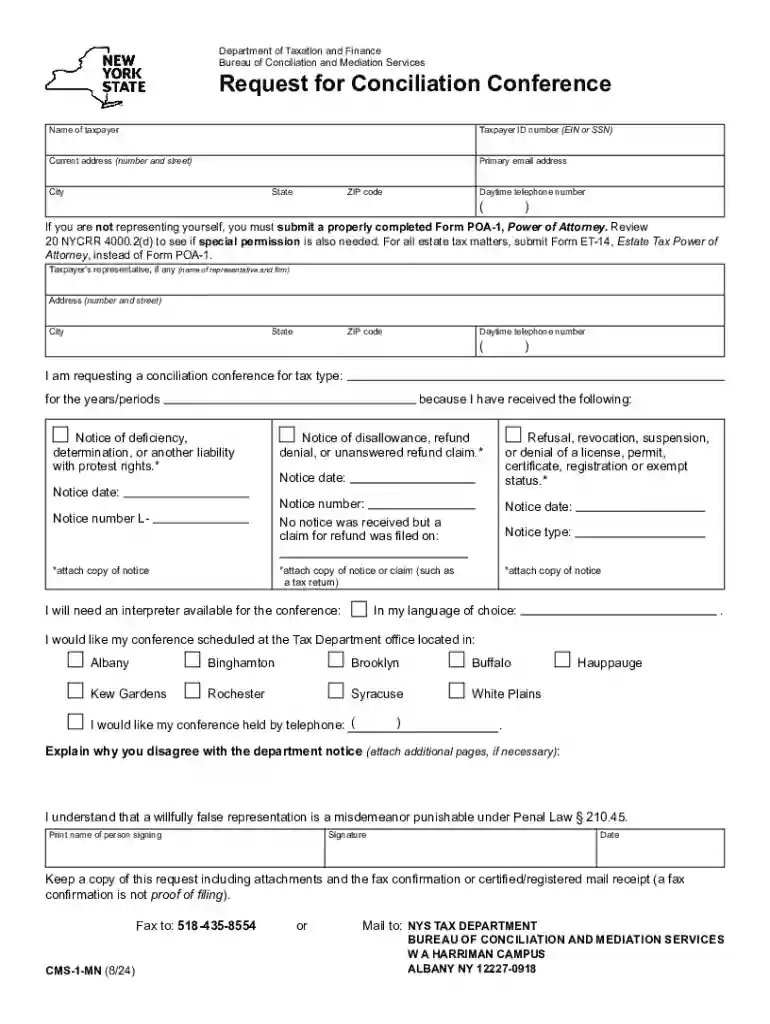
Form CMS-1-MN Request for Conciliation Conference Revised 8 24 2026

Get Form
Form CMS-1-MN Request for Conciliation Conference Revised 8 24 Preview on Page 1

Here's how it works

01. Edit your form online
Type text, add images, blackout confidential details, add comments, highlights and more.

02. Sign it in a few clicks
Draw your signature, type it, upload its image, or use your mobile device as a signature pad.

03. Share your form with others
Send it via email, link, or fax. You can also download it, export it or print it out.

Definition & Meaning

The Form CMS-1-MN Request for Conciliation Conference Revised 8 24 is a document primarily utilized by individuals or businesses contesting tax-related determinations made by the New York State Department of Taxation and Finance. This form serves as an official request for a conciliation conference, a preliminary, informal meeting intended to resolve disputes before proceeding to more formal hearings.

Purpose of the Form

  • Dispute Resolution: Initiates a process to amicably resolve disagreements with tax assessments, penalties, or determinations.
  • Preparation for Hearings: Provides an opportunity to potentially settle issues without escalating to tax appeals hearings.
  • Documentation: Encourages organized presentation of arguments and evidence related to the taxpayer's case.

How to Use the Form CMS-1-MN Request for Conciliation Conference Revised 8 24

Effectively using the Form CMS-1-MN requires specific steps and understanding of its components.

Filing the Form

  1. Complete All Sections: Ensure all required fields are filled, including taxpayer details and the reasons for contesting the tax determination.
  2. Submit the Form: Send the completed document to the appropriate department. Submission methods can include mail or electronic formats, depending on guidelines provided by the New York State Department of Taxation and Finance.
  3. Await Confirmation: After submission, you should receive confirmation and details on the scheduled conference.

Preparing for the Conference

  • Gather Evidence: Collect supporting documents, such as prior correspondence, financial statements, and other pertinent records.
  • Outline Arguments: Clearly define the basis for your appeal and prepare to discuss this with a conciliator.
  • Consult a Tax Professional: For complex cases, seeking advice from a tax advisor or attorney might be beneficial.

Who Typically Uses the Form CMS-1-MN Request for Conciliation Conference Revised 8 24

decoration image ratings of Dochub

Common Users

  • Individual Taxpayers: Those facing discrepancies in personal state tax assessments.
  • Business Entities: Corporations, LLCs, and partnerships disputing business taxes or penalties.
  • Tax Representatives: Professionals or attorneys acting on behalf of a client needing to resolve tax disputes.
decoration image

Examples of Usage

  • A self-employed individual disputing additional state income taxes.
  • A corporation contesting a tax audit finding that resulted in penalties.
  • An elderly taxpayer questioning adjustments made to their tax return.

Steps to Complete the Form CMS-1-MN Request for Conciliation Conference Revised 8 24

Completing the Form CMS-1-MN involves several key steps to ensure accuracy and compliance.

Detailed Steps

  1. Enter Personal and Contact Information: Provide full name, address, and other identifying details.
  2. State the Reason for Request: Clearly articulate why you are contesting the tax decision.
  3. Choose Scheduling Preferences: Indicate preferred dates and times for the conference.
  4. Select Desired Outcomes: Detail any specific outcomes or resolutions sought from the meeting.
  5. Sign and Date the Form: Ensure the form is duly signed by the taxpayer or their authorized representative.

Important Terms Related to Form CMS-1-MN Request for Conciliation Conference Revised 8 24

Understanding specific terminology is crucial for effective communication and completion of the form.

Key Terms

  • Conciliation Conference: An informal meeting to resolve disputes with the tax authority.
  • Tax Determination: The final decision made by the tax authority regarding taxation matters.
  • Authorized Representative: An individual, typically a tax professional or attorney, legally permitted to act on behalf of the taxpayer.

Legal Use of the Form CMS-1-MN Request for Conciliation Conference Revised 8 24

Compliance & Legal Reference

  • Adherence to Procedures: Follow state-specific guidelines for filing and attending conciliation conferences.
  • Taxpayer Rights: Users of the form are entitled to a fair hearing and consideration of their case.
  • Confidentiality: Information shared within the process is protected under privacy regulations.

Filing Deadlines / Important Dates

Timeliness is essential when submitting the Form CMS-1-MN to avoid defaulting on tax disputes.

Key Timeframes

  • Submission Deadline: Typically, there is a specific period post-receipt of a tax notice within which the form must be filed.
  • Conference Scheduling: The state may have a standard timeline for arranging the conciliation conference following form submission.

Required Documents

Supporting documentation strengthens the case and facilitates a more effective conference.

Typical Documents

  • Previous Tax Returns: Copies related to the disputed assessment.
  • Correspondence: Any prior communication with the state tax authority.
  • Financial Records: Evidence supporting the taxpayer's argument, such as bank statements or transaction records.
be ready to get more

Complete this form in 5 minutes or less

Get form

Got questions?

We have answers to the most popular questions from our customers. If you can't find an answer to your question, please contact us.
Contact us
The more prepared you are, the easier it will be to talk about your dispute. Step 1: Check the​ time and date for the conciliation. Step 2: Read the empl​oyers response. Step 3: Understand how the law applies to your case. Step 4: Think abo​​ut what you want to end the dispute.

Security and compliance

At DocHub, your data security is our priority. We follow HIPAA, SOC2, GDPR, and other standards, so you can work on your documents with confidence.


Learn more
ccpa2
pci-dss
gdpr-compliance
hipaa
soc-compliance