BT AND EMERGING PATHOGENS 2026

Get Form
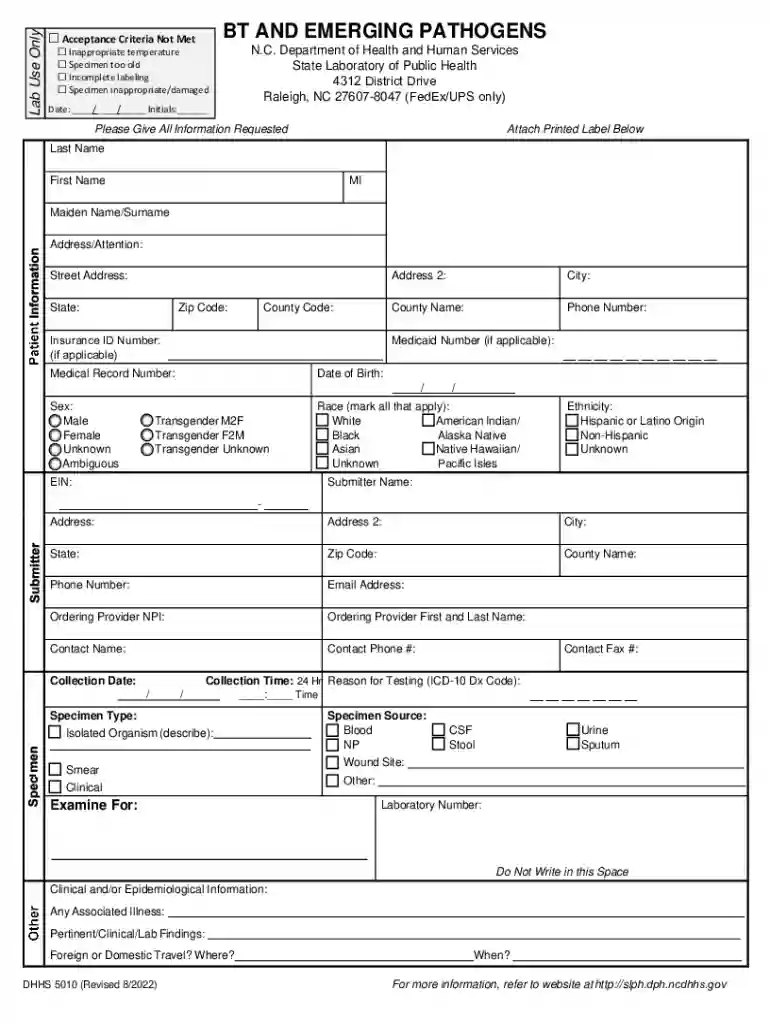
BT AND EMERGING PATHOGENS Preview on Page 1

Here's how it works

01. Edit your form online
Type text, add images, blackout confidential details, add comments, highlights and more.

02. Sign it in a few clicks
Draw your signature, type it, upload its image, or use your mobile device as a signature pad.

03. Share your form with others
Send it via email, link, or fax. You can also download it, export it or print it out.

Definition and Purpose

The "BT AND EMERGING PATHOGENS" form is used by the N.C. Department of Health and Human Services to manage critical public health concerns. It deals with bioterrorism (BT) and emerging infectious diseases by facilitating the submission of specimens for laboratory testing. The primary purpose is to ensure accurate tracking and testing of potential threats for effective public health responses.

Steps to Complete the BT AND EMERGING PATHOGENS Form

  1. Gather Required Information:

    • Collect patient data, including name, age, and contact information.
    • Obtain detailed submitter information, such as the healthcare provider’s contact details and facility identification.
  2. Document Specimen Details:

    • Specify the type and source of the specimen, such as blood or tissue.
    • Provide relevant clinical information to assist in proper analysis.
  3. Ensure Accuracy:

    • Check that all fields are completed accurately and completely to prevent delays in processing.
  4. Submit the Form:

    • Choose the appropriate submission method: online, by mail, or in person, according to departmental guidelines.

Key Elements of the BT AND EMERGING PATHOGENS Form

  • Patient Information Section:

    • Captures critical data needed for precise identification and contact tracing if required.
  • Specimen Section:

    • Details the specimen types, collection methods, and any relevant clinical information that impacts testing.
  • Submitter Information:

    • Provides contact details for healthcare professionals and institutions involved in specimen submission.

Importance of Using the BT AND EMERGING PATHOGENS Form

The form plays a crucial role in public health by ensuring the accurate capture and testing of specimens related to bioterrorist threats and emergent pathogens. Timely and accurate data submission supports effective outbreak control and disease management, reducing potential risks to public health.

Who Typically Uses the BT AND EMERGING PATHOGENS Form

  • Healthcare Providers:

    • Doctors and nurses responsible for collecting specimens from patients with suspected infections.
  • Laboratory Personnel:

    • Professionals coordinating the testing and analysis of submitted specimens.
  • Public Health Officials:

    • Individuals managing public health responses and case tracking related to outbreaks.
decoration image ratings of Dochub

Legal Use of the BT AND EMERGING PATHOGENS Form

Legally, the form must be used as instructed by the N.C. Department of Health and Human Services. It is a binding document that mandates accurate information submission to prevent legal and public health liability.

Examples of Using the BT AND EMERGING PATHOGENS Form

  • Bioterrorist Threats:

    • In cases of suspected bioterrorism, this form facilitates the rapid response needed to mitigate threats.
  • Emerging Infectious Diseases:

    • During outbreaks of new infectious diseases, the form aids in managing testing and data collection efforts.

Digital vs. Paper Version

The form is available in both digital and paper formats, ensuring accessibility. The digital version allows for easier data management and quicker submission but requires reliable internet access. The paper version suits facilities with limited digital infrastructure.

Eligibility Criteria for Using the Form

The form is primarily employed by licensed medical and health professionals involved in specimen collection and public health management. It is not intended for general public use but is crucial for specialists managing infectious threats.

decoration image
be ready to get more

Complete this form in 5 minutes or less

Get form

Got questions?

We have answers to the most popular questions from our customers. If you can't find an answer to your question, please contact us.
Contact us
The National Institute of Allergy and Infectious Diseases defines emerging infectious diseases/pathogens as those that have newly appeared in a population or have existed but are rapidly increasing in incidence or geographic range. Many of the emerging pathogens of greatest concern are pathogenic viruses.
Category C Potential Bioterrorism Agents and Emerging Pathogens.
Demographic factors. Population demographics are altered by population growth, migration, and differential mortality; the unique interaction of these factors has contributed to the emergence and re-emergence of infectious diseases.
Between 60% and 80% of emerging infections are derived from animal sources. Infectious disease emergence involves 2 main steps: An agent is introduced into a new host population. The agent is established and transmitted within the new host population.
Infectious diseases spread from person to person. An emerging infection may be a new disease like COVID-19. Or it may be a known disease that starts spreading again or doesnt respond to standard treatments. Reemerging infectious diseases come back after being mostly controlled.

Security and compliance

At DocHub, your data security is our priority. We follow HIPAA, SOC2, GDPR, and other standards, so you can work on your documents with confidence.

Learn more
ccpa2
pci-dss
gdpr-compliance
hipaa
soc-compliance

People also ask

For an emerging disease to become established at least two events have to occur (1) the infectious agent has to be introduced into a vulnerable population and (2) the agent has to have the ability to spread readily from person-to-person and cause disease.

Related links