01. Edit your form online
Type text, add images, blackout confidential details, add comments, highlights and more.

Type text, add images, blackout confidential details, add comments, highlights and more.

Draw your signature, type it, upload its image, or use your mobile device as a signature pad.

Send it via email, link, or fax. You can also download it, export it or print it out.
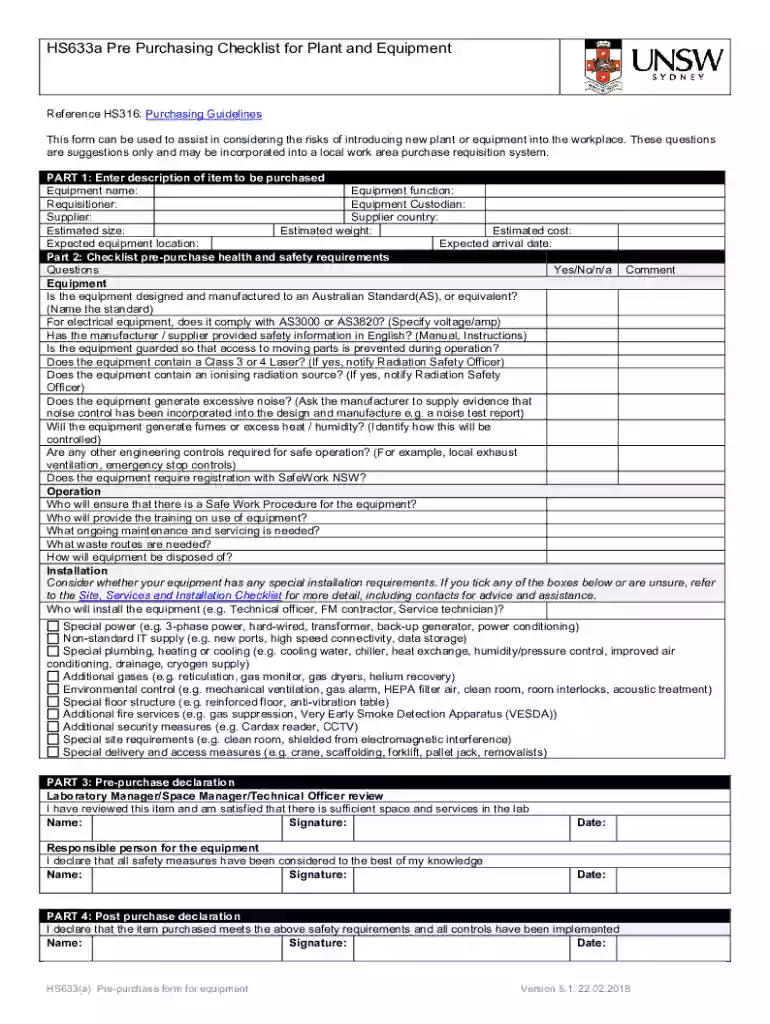
The HS633a Pre-Purchase Checklist for Equipment serves as a comprehensive guide aimed at evaluating health and safety risks associated with purchasing new equipment. This checklist is an essential tool for ensuring that all safety standards and requirements are adhered to before the acquisition, ensuring workplace safety and compliance. It assists companies in making informed decisions by providing a framework to assess the suitability and safety of new equipment.
Equipment Details: The checklist begins with detailed information about the equipment intended for purchase. This section ensures that all relevant specifications, including model, make, and intended use, are documented.
Safety Requirements: A critical component of the checklist is a detailed safety requirements section. It covers all necessary precautions and standards that the equipment must meet to be considered safe for workplace use.
Installation Considerations: This section provides guidelines on the installation process by identifying potential hazards and ensuring that installation is executed safely and in compliance with regulations.
Declarations and Compliance: Responsible personnel must provide declarations confirming that all safety checks have been performed and that the equipment complies with industry standards.
The HS633a Checklist is used to systematically evaluate new equipment acquisitions. By following the checklist, businesses can ensure comprehensive due diligence is performed.
Review Equipment Specifications: Begin by recording all relevant details about the equipment, such as make, model, and usage.
Conduct Safety Assessments: Evaluate the equipment against the detailed safety requirements in the checklist. Use industry standards as benchmarks for comparison.
Installation Planning: Plan the installation by mapping out processes and identifying any potential risks. Collaborate with installation engineers to ensure compliance with the checklist.
Complete Declarations: Ensure that responsible staff members complete and sign declaration sections, confirming that all safety protocols have been followed.
A construction firm evaluating a new crane would use the checklist to verify load capacities, safety features, and installation guidelines.
A manufacturing plant acquiring new machinery would assess operational hazards to ensure compliance with safety requirements before purchase.
The checklist can be accessed and downloaded from relevant regulatory or industry association websites. It is often part of workplace safety resources provided to businesses.
Official Websites: Regulatory bodies or trade associations often provide these checklists for industry compliance.
Industry Workshops: Safety seminars and workshops may distribute the checklist as part of their educational materials.
Completing the HS633a Checklist requires attention to detail and input from multiple stakeholders to assure that all aspects of safety and compliance are covered.
Gather Necessary Information: Collect detailed information and technical specifications about the equipment in question.
Engage with Experts: Consult with safety experts and installers to ensure all safety standards are understood and applicable.
Review Regulatory Standards: Familiarize stakeholders with specific regulatory and safety standards that relate to the equipment to ensure comprehensive assessment and compliance checks.
Perform Checks and Balances: Cross-reference all checklist items with equipment specifications to ensure no detail is overlooked.
Finalize and Sign Off: After thorough review, have designated personnel sign the checklist to verify that all safety considerations have been met.
Utilizing the HS633a Checklist is crucial for maintaining workplace safety and avoiding potential legal liabilities associated with the acquisition of unsafe or non-compliant equipment.
Risk Mitigation: Proactively identifies potential hazards, reducing the risk of accidents.
Compliance Assurance: Ensures that all equipment meets regulatory standards, aiding in regulatory inspections.
Streamlined Processes: Facilitates a structured approach to equipment evaluation, minimizing errors and oversight.
The checklist serves not only as a tool for risk management but also as a record for legal compliance, demonstrating due diligence in equipment procurement.
Regulatory Compliance: Supports compliance with industry standards and regulations, protecting businesses from legal issues.
Documented Evidence: Provides documented evidence of the safety measures taken, which could be crucial in legal disputes or audits.
Understanding the core components of the HS633a Checklist can significantly impact the efficiency and effectiveness of the equipment procurement process.
Risk Assessment: Central to the checklist, this section focuses on evaluating potential safety risks associated with new equipment.
Equipment Suitability: Evaluates whether the equipment is appropriate for the intended workplace environment and tasks.
Maintenance Requirements: Identifies ongoing maintenance needs to ensure continued compliance with safety standards.
Real-world applications of the HS633a Checklist vary across different industries but all aim to ensure safety and compliance.
Healthcare: Evaluating diagnostic or treatment machines to ensure they meet medical safety criteria.
Agriculture: Assessing tractors and heavy equipment for farm use to guarantee operational safety and efficiency.
Manufacturing: Reviewing assembly line machines for operational safety and compliance with occupational health standards.
Each section has been crafted to maximize utility and provide detailed insights into the form's application and benefits, ensuring comprehensive understanding and correct usage.
We've got more versions of the HS633a Pre-Purchase Checklist for Equipment HS633a Pre-Purchase Checklist for Equipment form. Select the right HS633a Pre-Purchase Checklist for Equipment HS633a Pre-Purchase Checklist for Equipment version from the list and start editing it straight away!
At DocHub, your data security is our priority. We follow HIPAA, SOC2, GDPR, and other standards, so you can work on your documents with confidence.