






Definition and Purpose
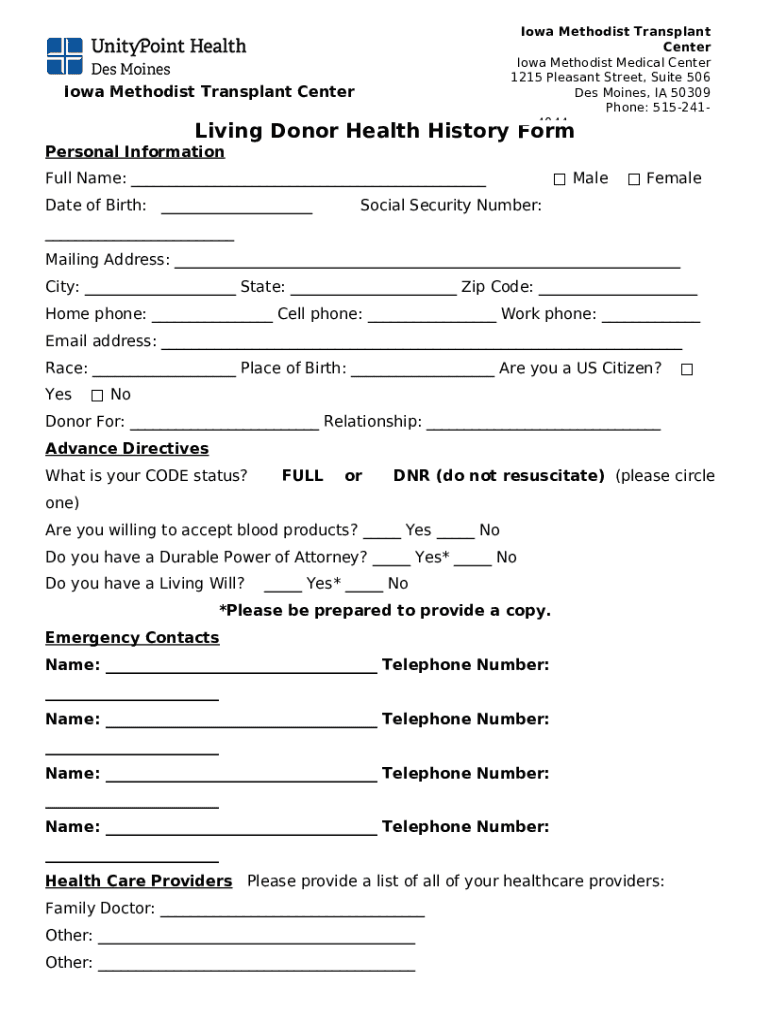
The "Kidney Transplant Health History Form - UnityPoint Health" is a specialized document designed for use by potential kidney donors. This form plays a crucial role in collecting essential personal, medical, and social information to assess the suitability of an individual for kidney donation. It provides medical professionals with detailed insights into the donor's health background, allowing them to evaluate any potential risks involved in the transplant process. The form typically includes sections that cover personal details, medical history, immunization records, and lifestyle factors.
Key Sections and Their Importance
- Personal Details: Captures basic information such as name, address, and contact details, which are essential for identification and further communication.
- Medical History: Includes previous illnesses, surgeries, and current medications to provide a comprehensive view of the donor’s physical health.
- Lifestyle and Social Factors: Assesses habits that might impact donor eligibility, such as smoking, alcohol consumption, and drug use.
How to Use the Kidney Transplant Health History Form - UnityPoint Health
To effectively utilize this form, potential donors should thoroughly complete each section, ensuring accuracy and honesty. Here is a step-by-step guide:
- Read Each Section Carefully: Begin with understanding what information is required in each segment.
- Gather Necessary Information: Collect all relevant documents like medical records and insurance details beforehand.
- Complete the Sections: Fill out personal information first, followed by detailed medical history and social habits.
- Review Before Submission: Double-check all entries for accuracy, ensuring no critical information is omitted.
Tips for Accurate Completion
- Double-Check Information: Especially contact details and medical history, to avoid any delays in processing.
- Seek Clarification: If unsure about any section, consult with medical professionals or UnityPoint Health for guidance.
Steps to Complete the Kidney Transplant Health History Form - UnityPoint Health
Completing this form involves several structured steps to ensure thoroughness and compliance with medical criteria. Here’s a detailed process:
- Collect Personal Documentation: Secure all necessary ID and insurance documents.
- Medical History Documentation: Accumulate past medical records, including past surgeries and current treatment regimens.
- Record Immunization Details: Gather vaccination records to complete this section accurately.
- Detail Social and Family Health History: Offer complete information regarding familial health traits and social habits.
- Finalize an Emergency Contact: Decide on an emergency contact and note their information on the form.
Practical Example
For a potential donor like John Doe, who has a history of hypertension, it's crucial to be transparent about his condition in the medical history section to allow for a thorough risk assessment.
Important Terms Related to Kidney Transplant Health History Form
Understanding the terminology used in the form can assist in accurate completion. Here are some essential terms:
- Donor Eligibility: Criteria that determine if a person is suitable for donation.
- Crossmatching: A test to check compatibility between donor and recipient.
- Chronic Conditions: Long-term health issues that may impact donation suitability.
Examples of Terms in Use
- Crossmatching might be indicated in the context of ensuring donor-receiver compatibility.
- Chronic Conditions could highlight issues like diabetes that need special attention in medical history.
Why You Should Complete the Kidney Transplant Health History Form
Completing this form is a critical step in the kidney donation process. It provides valuable information that ensures the safety of both donor and recipient and helps in the efficient planning and execution of the transplant procedure. This thorough documentation fosters a transparent relationship with healthcare providers, ensuring all parties are well-informed.
Benefits of Accurate Completion
- Ensures Safety: Facilitates a risk assessment to protect donor and recipient health.
- Streamlines Process: Quickens evaluation and approval times for donation.
- Enhances Communication: Provides a comprehensive health summary for medical staff.
Who Typically Uses the Kidney Transplant Health History Form
The primary users of this form are potential kidney donors looking to contribute to transplant programs. However, healthcare providers, including transplant coordinators and medical evaluators, also engage with the form to assess donor suitability.

Typical User Profile
- Potential Donors: Individuals considering donating a kidney due to familial ties or altruistic reasons.
- Healthcare Providers: Physicians and transplant coordinators involved in assessing and approving the donation process.
Legal Use of the Kidney Transplant Health History Form
This form carries significant legal and ethical implications, particularly concerning donor consent and confidentiality. Ensuring compliance with legal standards like the Health Insurance Portability and Accountability Act (HIPAA) is paramount to protect donor information and rights.
Ensuring Compliance
- Consent: Potential donors must provide informed consent after fully understanding the risks and benefits.
- Confidentiality: All submitted information must be handled in strict confidence, aligned with legal standards.
Key Elements of the Kidney Transplant Health History Form
Understanding the foundational aspects of the form enables better comprehension and completion. Here are some of the critical components:
Core Sections
- Personal Identification: Basic details necessary for donor registration.
- Medical and Family History: In-depth health history essential for assessing transplant suitability.
- Emergency Contact Information: Key for any unforeseen circumstances during the transplant process.
Practical Application
- Family History helps assess genetic predispositions to medical conditions.
- Lifestyle Factors allow for a comprehensive health risk analysis.