




01. Edit your form online
Type text, add images, blackout confidential details, add comments, highlights and more.

Type text, add images, blackout confidential details, add comments, highlights and more.

Draw your signature, type it, upload its image, or use your mobile device as a signature pad.

Send it via email, link, or fax. You can also download it, export it or print it out.
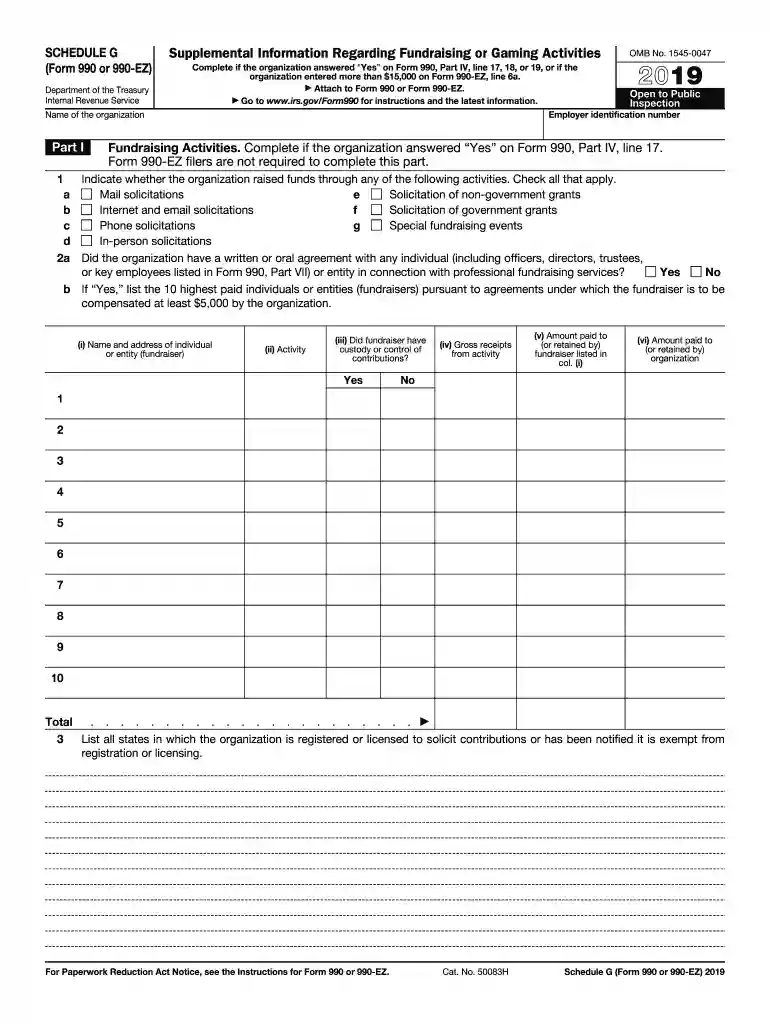
The 2019 Schedule G is a supplemental form required by the IRS for organizations that engage in certain fundraising and gaming activities. It provides detailed information on how funds are raised and managed. Organizations filing Form 990 or 990-EZ must include this schedule if they receive over $15,000 from activities such as gaming or fundraising events. This form ensures transparency in reporting income and expenses related to these activities.
Understanding the critical elements of Schedule G aids in accurate reporting for any qualifying organization.
Part I - Fundraising Events: This section requires details on gross receipts, contributions, and expenses related to specific events. It helps in identifying the net income earned and the costs incurred.
Part II - Gaming: Here, organizations report income and expenditure from gaming activities. The data assists the IRS in monitoring gaming operations for fairness and compliance.
Part III - Professional Fundraisers: This part involves listing any professional fundraisers paid to raise money. Details about total income retained by these fundraisers are necessary for ensuring transaction transparency.
Schedule G is primarily used by nonprofit organizations engaged in significant fundraising or gaming activities. Understanding the typical users helps contextualize the form's practical application.


Completing Schedule G involves several precise steps, ensuring accuracy and compliance.
Schedule G’s accurate completion is essential to maintain an organization’s legal standing and tax-exempt status.
Understanding terminology specific to Schedule G is critical for accuracy.
Adhering to IRS guidelines is essential for legitimate filings and maintaining tax-exempt status.
Meeting filing deadlines is fundamental for compliance and avoiding penalties.
Non-compliance with filing requirements for Schedule G can have financial repercussions.
We've got more versions of the 2019 schedule g form. Select the right 2019 schedule g version from the list and start editing it straight away!
| Versions | Form popularity | Fillable & printable |
|---|---|---|
| 2024 | 4.2 Satisfied (23 Votes) | |
| 2023 | 4.8 Satisfied (29 Votes) | |
| 2022 | 4.7 Satisfied (29 Votes) | |
| 2021 | 4.8 Satisfied (80 Votes) | |
| 2020 | 4.3 Satisfied (106 Votes) | |
| 2019 | 4.3 Satisfied (139 Votes) | |
| 2018 | 4.4 Satisfied (153 Votes) | |
| 2017 | 4.4 Satisfied (276 Votes) | |
| 2016 | 4.4 Satisfied (141 Votes) | |
| 2015 | 4.3 Satisfied (24 Votes) | |
| 2014 | 4 Satisfied (21 Votes) | |
| 2013 | 4 Satisfied (50 Votes) | |
| 2012 | 4.3 Satisfied (72 Votes) | |
| 2011 | 4 Satisfied (41 Votes) | |
| 2010 | 4.3 Satisfied (45 Votes) |
At DocHub, your data security is our priority. We follow HIPAA, SOC2, GDPR, and other standards, so you can work on your documents with confidence.
Part I. Fundraising Activities. Complete if the organization answered Yes on Form 990, Part IV, line 17. Form 990-EZ filers are not required to completeRead more
19. Did the organization report more than $15,000 of gross income from gaming activities on Part VIII, line 9a? If Yes, complete Schedule G, Part III . . . .Read more
Schedule G Draft. UC Agriculture and Natural Resources. Budget by Program and vs FY2019-20. Budget. FY2018-19 Budget vs FY2019-20. Budget. UC ANR BudgetRead more


