




01. Edit your form online
Type text, add images, blackout confidential details, add comments, highlights and more.

Type text, add images, blackout confidential details, add comments, highlights and more.

Draw your signature, type it, upload its image, or use your mobile device as a signature pad.

Send it via email, link, or fax. You can also download it, export it or print it out.
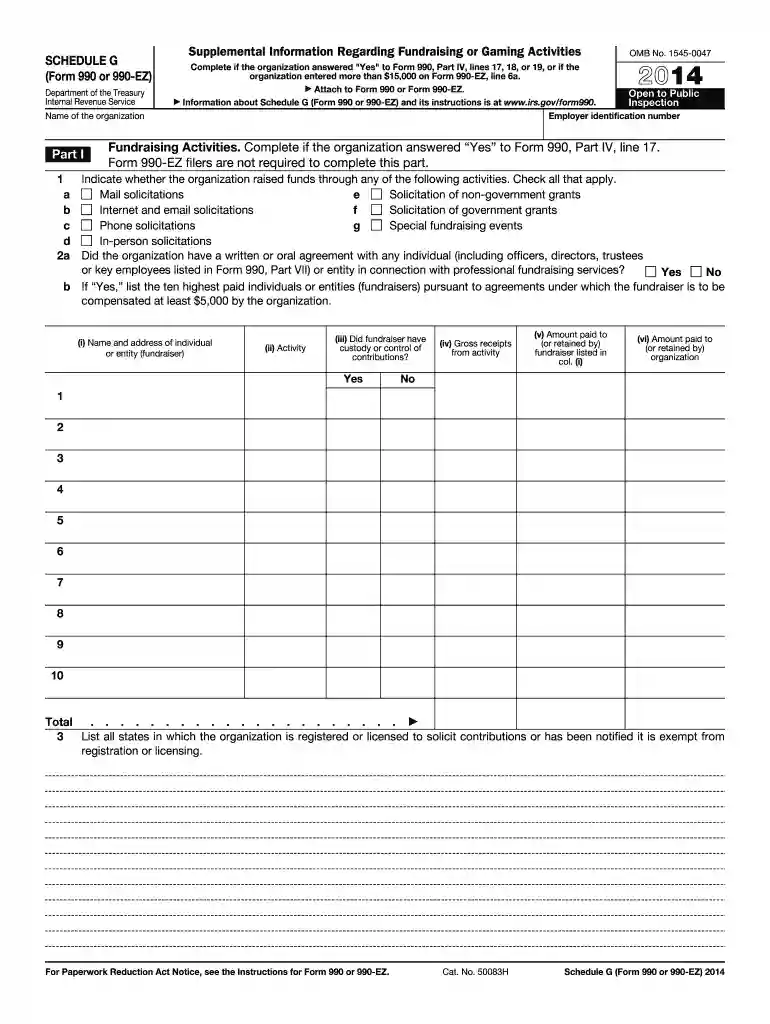
The 2014 IRS Schedule G form is a supplementary document used by organizations to report detailed information about their fundraising and gaming activities. This form is part of the Form 990 and 990-EZ filings, which are used by tax-exempt organizations to provide the IRS with information about their operations and finances. Schedule G specifically focuses on fundraising events, agreements with professional fundraisers, and revenue from gaming activities. Completing this schedule is essential for organizations engaged in significant fundraising efforts, as it ensures transparency and compliance with IRS requirements.
Organizations should first determine whether they meet the thresholds for filing Schedule G, which typically involve certain levels of receipts from fundraising events or gaming activities. If applicable, the organization must gather all relevant financial data, including gross receipts, direct expenses, and net income from each fundraising event or gaming operation. The form includes sections for detailing each type of activity separately, allowing the IRS to assess the organization's financial practices. It is crucial to keep detailed records throughout the year to facilitate accurate reporting on Schedule G.
The 2014 IRS Schedule G form can be accessed from the IRS website, where it is available for download in PDF format. Organizations can use IRS forms' libraries or software solutions such as DocHub to import, complete, and manage this form electronically. Once downloaded, the form can be filled out manually or digitally, ensuring that all sections are completed accurately before submission. Tax preparation software like TurboTax may also offer integrated functionality to assist in completing Schedule G as part of the overall Form 990 filing process.
Determine Eligibility: Ensure your organization is required to file Schedule G by checking thresholds related to gross receipts from fundraising events or gaming.
Gather Information: Collect all data regarding your fundraising events and gaming operations, including total revenue and associated costs.
Complete Part I: Provide details on fundraising events such as gross receipts, direct expenses, and net income for each significant event.
Complete Part II: If applicable, enter information regarding professional fundraisers, including contracts and service fees.
Complete Part III: Report on gaming activities, detailing gross income, payouts, and other expenses related to gaming operations.
Review and Submit: Double-check all entries for accuracy, and submit the form along with Form 990 or 990-EZ by your organization's tax filing deadline.
Filing the 2014 IRS Schedule G form provides multiple benefits beyond regulatory compliance. First, it fosters transparency by publicizing the financial aspects of an organization’s fundraising efforts and gaming activities. This transparency can heighten donor trust and organizational credibility. Additionally, it enables the IRS to better understand the financial operations and ensure that tax-exempt organizations are adhering to legal requirements. Lastly, detailed record-keeping demanded by Schedule G can assist organizations in refining their fundraising strategies and optimizing operational efficiency.
The form is structured to capture comprehensive data through its main parts:
Part I: Focuses on fundraising events overall, capturing both financial and non-financial information about events that raised significant funds.
Part II: Details on contractual agreements with professional fundraisers, requiring information on compensation and performance metrics.
Part III: Documents aspects of gaming activities, providing insight into income from games like Bingo or raffles and correlating expenses.
Understanding these elements ensures complete and accurate reporting, reducing the possibility of errors that could lead to penalties.
Schedule G must be filed with Form 990 or 990-EZ by the 15th day of the 5th month after the end of the organization's accounting period. For organizations following a calendar year, the deadline is typically May 15. Failure to file this form on time or provide correct information can result in significant penalties. These include financial fines assessed daily or per missing form. Discontinuity in filing can also jeopardize an organization's tax-exempt status, impacting its operations and potential funding opportunities.
State regulations may impose additional requirements and disclosures beyond the federal Schedule G form. Various states align their policies closely with federal guidelines, while others necessitate additional documentation or impose unique charitable solicitation regulations. Organizations should review state-specific laws to ensure compliance with both federal and state requirements, particularly when operating fundraising or gaming activities in multiple jurisdictions. Consulting a tax professional familiar with both state and federal regulations can help in navigating these complexities effectively.
We've got more versions of the 2014 irs schedule g form form. Select the right 2014 irs schedule g form version from the list and start editing it straight away!
| Versions | Form popularity | Fillable & printable |
|---|---|---|
| 2024 | 4.2 Satisfied (23 Votes) | |
| 2023 | 4.8 Satisfied (29 Votes) | |
| 2022 | 4.7 Satisfied (29 Votes) | |
| 2021 | 4.8 Satisfied (80 Votes) | |
| 2020 | 4.3 Satisfied (106 Votes) | |
| 2019 | 4.3 Satisfied (139 Votes) | |
| 2018 | 4.4 Satisfied (153 Votes) | |
| 2017 | 4.4 Satisfied (276 Votes) | |
| 2016 | 4.4 Satisfied (141 Votes) | |
| 2015 | 4.3 Satisfied (24 Votes) | |
| 2014 | 4 Satisfied (21 Votes) | |
| 2013 | 4 Satisfied (50 Votes) | |
| 2012 | 4.3 Satisfied (72 Votes) | |
| 2011 | 4 Satisfied (41 Votes) | |
| 2010 | 4.3 Satisfied (45 Votes) |
At DocHub, your data security is our priority. We follow HIPAA, SOC2, GDPR, and other standards, so you can work on your documents with confidence.
May 2, 2017 Medicaid waiver payments. Notice 2014-7 provides that certain Medicaid waiver payments are excludable from income for federal income taxRead more
Dec 12, 2013 Form. (2013). Schedule G - Investment Income of a Section 501(c)(7), (9), or (17) Organization. Schedule I - Exploited Exempt Activity IncomeRead more
Schedule G (Form 990 or 990-EZ) is used by an organization that files Form 990 or. Form 990-EZ to report professional fundraising services, fundraising events,Read more


