




01. Edit your 2022 schedule g online
Type text, add images, blackout confidential details, add comments, highlights and more.

Type text, add images, blackout confidential details, add comments, highlights and more.

Draw your signature, type it, upload its image, or use your mobile device as a signature pad.

Send form 990 schedule g 2022 via email, link, or fax. You can also download it, export it or print it out.
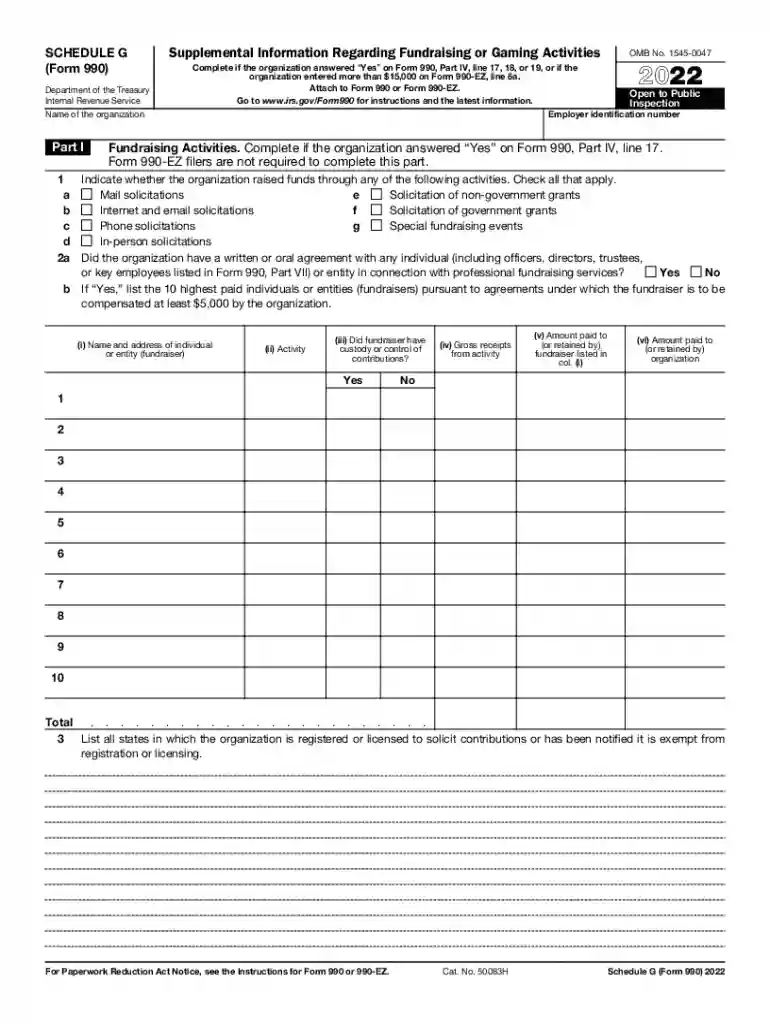
Schedule G (Form 990) is a supplemental tax form that the IRS requires from organizations involved in significant fundraising or gaming activities. This document captures detailed information about the organization's methods of fundraising, their expenses, and the income derived from such activities. It includes specific sections that detail the types of fundraising activities conducted, the direct expenses associated with these activities, and other particulars related to gaming operations, such as licensing information and revenue-sharing agreements with third parties.
Accurate reporting on Schedule G is critical because it ensures compliance with IRS regulations. The form helps verify that an organization is appropriately managing its revenues and expenses, which is essential for maintaining its tax-exempt status. Misreporting or omissions can lead to penalties, increased scrutiny, or even the loss of tax-exempt status.
The instructions for Schedule G provide step-by-step guidance on how to complete each section of the form. They are designed to clarify the information required and to help organizations correctly categorize and report their activities. Users should refer to the instructions to ensure that all relevant data is appropriately documented, conforming to the IRS guidelines.
Utilizing the instruction manual helps avoid common errors that could result in financial penalties.
Gather Required Information: Compile details on all significant fundraising and gaming activities, including income, direct expenses, and contracts with third-party fundraisers.
Complete Fundraising Activity Section: Fill in the types of activities, such as auctions or dinners, and specify associated costs and income.
Detail Gaming Operations: Include any licensing information, net and gross income, and distributions to other organizations.
Review with Attached Schedules: Ensure alignment and consistency with other related schedules in Form 990 to reflect a comprehensive financial position.
Technical Verification: Double-check calculations and other numerical entries for accuracy before submission.
Understanding these components ensures thorough compliance with IRS expectations.
Organizations that must file Schedule G include those that report over $15,000 in professional fundraising services or receive more than $15,000 in income from gaming activities. Only organizations meeting these thresholds are obligated to complete this schedule as part of their Form 990 filing.


Failing to file Schedule G correctly can result in significant penalties from the IRS, including fines and possible audit investigations. The loss of tax-exempt status is a severe consequence that underscores the importance of following instructions and ensuring accuracy in reporting.
Meeting deadlines is crucial for maintaining good standing with the IRS.
Schedule G can be completed using various tax preparation software solutions, including popular platforms like TurboTax and QuickBooks. These digital systems offer integrated filing features, allowing for submissions electronically, which can streamline the filing process and reduce errors.
Organizations choosing electronic submissions should ensure compatibility with IRS e-file systems to avoid processing delays.
We've got more versions of the 2022 schedule g form. Select the right 2022 schedule g version from the list and start editing it straight away!
| Versions | Form popularity | Fillable & printable |
|---|---|---|
| 2024 | 4.2 Satisfied (23 Votes) | |
| 2023 | 4.8 Satisfied (29 Votes) | |
| 2022 | 4.7 Satisfied (29 Votes) | |
| 2021 | 4.8 Satisfied (80 Votes) | |
| 2020 | 4.3 Satisfied (106 Votes) | |
| 2019 | 4.3 Satisfied (139 Votes) | |
| 2018 | 4.4 Satisfied (153 Votes) | |
| 2017 | 4.4 Satisfied (276 Votes) | |
| 2016 | 4.4 Satisfied (141 Votes) | |
| 2015 | 4.3 Satisfied (24 Votes) | |
| 2014 | 4 Satisfied (21 Votes) | |
| 2013 | 4 Satisfied (50 Votes) | |
| 2012 | 4.3 Satisfied (72 Votes) | |
| 2011 | 4 Satisfied (41 Votes) | |
| 2010 | 4.3 Satisfied (45 Votes) |
At DocHub, your data security is our priority. We follow HIPAA, SOC2, GDPR, and other standards, so you can work on your documents with confidence.
Schedule G (Form 990) is used by an organization that files Form 990 or Form 990-EZ to report professional fundraising services, fundraising events, and gaming.Read more
IRS.gov/PTIN or by filing Form W-12, IRS Paid Preparer Tax. Identification Schedule G (Form 990). Supplemental. Information Regarding Fundraising or.Read more
Enter the gross receipts connected to the services provided by the fundraiser listed in column (i) and received by the organization, or by the fundraiser on theRead more


