Form U-1b 1340 Application for Payment of Unclaimed Funds-2026

Get Form
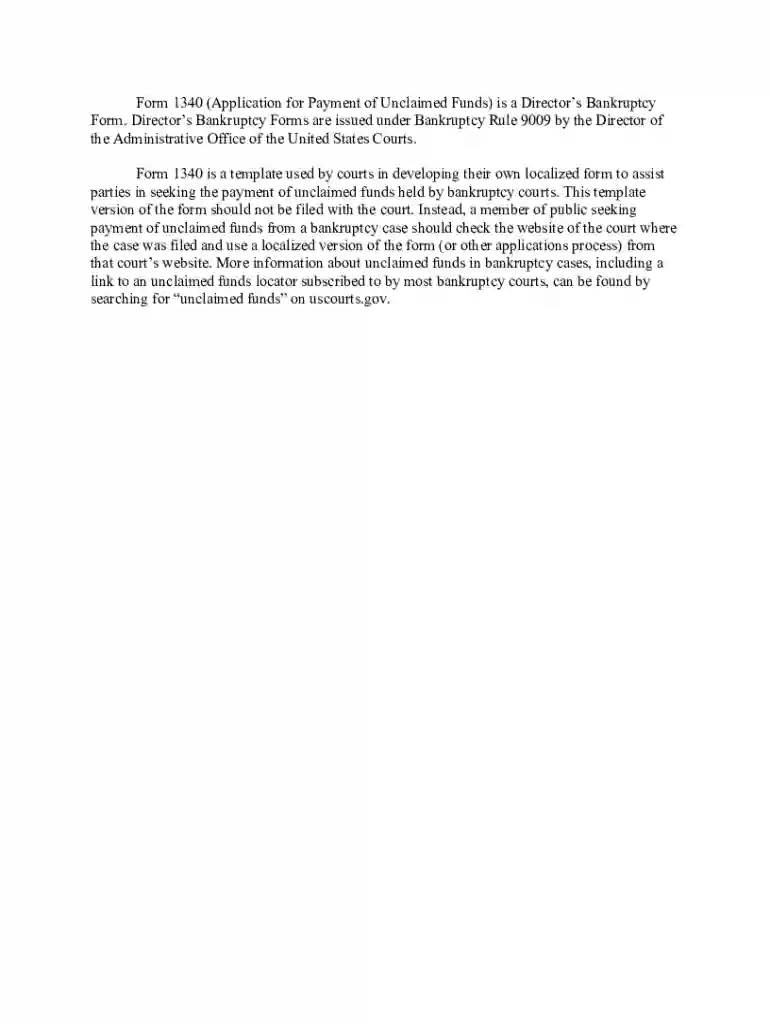
Form U-1b 1340 Application for Payment of Unclaimed Funds Preview on Page 1

Here's how it works

01. Edit your form online
Type text, add images, blackout confidential details, add comments, highlights and more.

02. Sign it in a few clicks
Draw your signature, type it, upload its image, or use your mobile device as a signature pad.

03. Share your form with others
Send it via email, link, or fax. You can also download it, export it or print it out.

Definition & Meaning

Form U-1b 1340, known as the Application for Payment of Unclaimed Funds, is a standardized document used by individuals or entities to claim funds held by bankruptcy courts. These funds typically arise from cases where creditors or individuals have not claimed their entitled payments during concluded bankruptcy proceedings.

This form is issued under Bankruptcy Rule 9009, serving as a crucial tool for claimants who need to provide structured information and necessary documentation to facilitate the release of these funds. Its primary function is to ensure that interested parties can efficiently reclaim the money that is rightfully theirs, preventing indefinite retention by state or federal entities.

How to Use the Form U-1b 1340 Application for Payment of Unclaimed Funds

Using Form U-1b 1340 involves a multi-step process designed to ensure all relevant information and documentation are accurately provided. It begins with downloading the specific form from the relevant court's website. Applicants must then carefully fill out each section, detailing claim information, providing personal and payment details, and attaching required supporting documents.

  • Claim Information: Clearly state the basis for the claim, including details of the bankruptcy case number and the amount of funds being claimed.
  • Personal Details: Include all pertinent personal information, such as contact details and identification numbers, to establish claimant identity.
  • Supporting Documents: Attach all necessary evidence supporting the claim, such as court orders, identification documents, or power of attorney if applicable.

Each section is crucial for verifying the legitimacy of the claim and ensuring that funds are appropriately disbursed.

Steps to Complete the Form U-1b 1340 Application for Payment of Unclaimed Funds

  1. Obtain the Form: Access the form from the bankruptcy court handling the case. Ensure you have the current version that reflects any recent procedural updates.
  2. Enter Claim Details: Fill out the claim information section, providing the case number and details of the unclaimed funds.
  3. Provide Applicant Information: Include the name, address, and contact information of the claiming party.
  4. Attach Required Documentation: Submit supporting documents as evidence of your claim. This may include identification, court orders, or proof of representation.
  5. Notarize the Application: Some applications may require notarization, which adds an additional layer of verification.
  6. Submit the Form: Depending on the court's procedures, submit the form either online, by mail, or in person. Each method might require specific steps or additional documentation.

Following this sequence ensures a comprehensive application that stands a better chance of approval.

Who Typically Uses the Form U-1b 1340 Application for Payment of Unclaimed Funds

Various parties use Form U-1b 1340 to claim unclaimed funds. These include:

  • Creditors: Individuals or businesses who extended credit to a debtor in bankruptcy and have outstanding funds due.
  • Heirs or Legal Representatives: Family members or legal representatives of a deceased individual entitled to funds.
  • Businesses: Companies that might have provided services or goods under a contract annulled by the bankruptcy.
  • Government Agencies: Occasionally used by agencies claiming fines, taxes, or fees owed.

Understanding who might use this form helps illustrate its broad application across different legal and financial contexts.


decoration image ratings of Dochub

Key Elements of the Form U-1b 1340 Application for Payment of Unclaimed Funds

The form comprises several critical elements designed to standardize the claim process:

  • Claimant Information: Requires detailed information about the claimant, ensuring correct identification.
  • Amount Claimed: Specifies the exact amount of the unclaimed funds being pursued.
  • Bankruptcy Details: Must include the case number and relevant bankruptcy court information.
  • Supporting Documentation: Lists all necessary documents needed to support the claim, such as previous payment records or legal notices.
  • Declarations: Includes a legal affidavit where the claimant declares the truthfulness of the information provided.

These elements are designed to provide a complete picture of the claim, facilitating accurate and efficient processing by court officials.

Legal Use of the Form U-1b 1340 Application for Payment of Unclaimed Funds

Legally, Form U-1b 1340 is a binding document. Submission implies that all information provided is accurate and that the claimant has a legitimate right to the claimed funds. Legal ramifications exist for those who submit false information, including potential fraud charges.

The use of the form is governed by bankruptcy laws, which require applicants to strictly adhere to submission guidelines to maintain the integrity of the claims process. Claimants must also notify the United States Attorney of the claim, ensuring governmental oversight and compliance with federal procedures.

Eligibility Criteria

Eligibility to submit Form U-1b 1340 is based on several criteria which include:

  • Identification as a Legitimate Claimant: The individual or entity filing must have a genuine, legally recognized interest in the funds.
  • Proof of Outstanding Balance: Demonstrating that there are funds due, often supported by bankruptcy documentation or previous financial statements.
  • Timely Filing: Submitting the application within the timeframe set by the relevant court.
  • Supporting Documentation: Providing adequate proof of entitlement, such as court rulings or agreements pertinent to the funds.

Ensuring eligibility before submission helps avoid application rejection and streamlines the claim processing.

decoration image

Form Submission Methods (Online / Mail / In-Person)

Filing the Form U-1b 1340 can be done through various methods that may vary by court:

  • Online: Some courts offer electronic filing systems, requiring scanned copies of the form and supporting documents.
  • Mail: Applicants can submit via postal mail, enclosing all necessary paperwork in the correct format.
  • In-Person: Direct submission to the court's office, often requiring an appointment or waiting period for processing.

Understanding the preferred method of submission for the specific court can significantly impact the efficiency and success of claiming the funds.

be ready to get more

Complete this form in 5 minutes or less

Get form

Got questions?

We have answers to the most popular questions from our customers. If you can't find an answer to your question, please contact us.
Contact us
0:14 1:14 The state will hold on to the property until the rightful owner comes forward in some cases heirsMoreThe state will hold on to the property until the rightful owner comes forward in some cases heirs may be able to claim property that belong to a deceased family member.
Yes, you can claim unclaimed money from deceased relatives. However, there are some caveats to be aware of. First and foremost, you must be able to identify that unclaimed money in the name of your deceased relative exists. Second, you must verify that youre legally entitled to this unclaimed money.
MissingMoney.com is the official Unclaimed Property website of the National Association of State Treasurers Step 1: Search. Use the search form to look for unclaimed property. Step 2: File a Claim. Follow the instructions to file a claim. Step 3: Get Paid! Once verified you will receive your unclaimed property.
You can visit the concerned bank to claim an unclaimed deposit. To find out the details of an unclaimed deposit, you can visit the UDGAM portal.

Security and compliance

At DocHub, your data security is our priority. We follow HIPAA, SOC2, GDPR, and other standards, so you can work on your documents with confidence.
Learn more
ccpa2
pci-dss
gdpr-compliance
hipaa
soc-compliance