
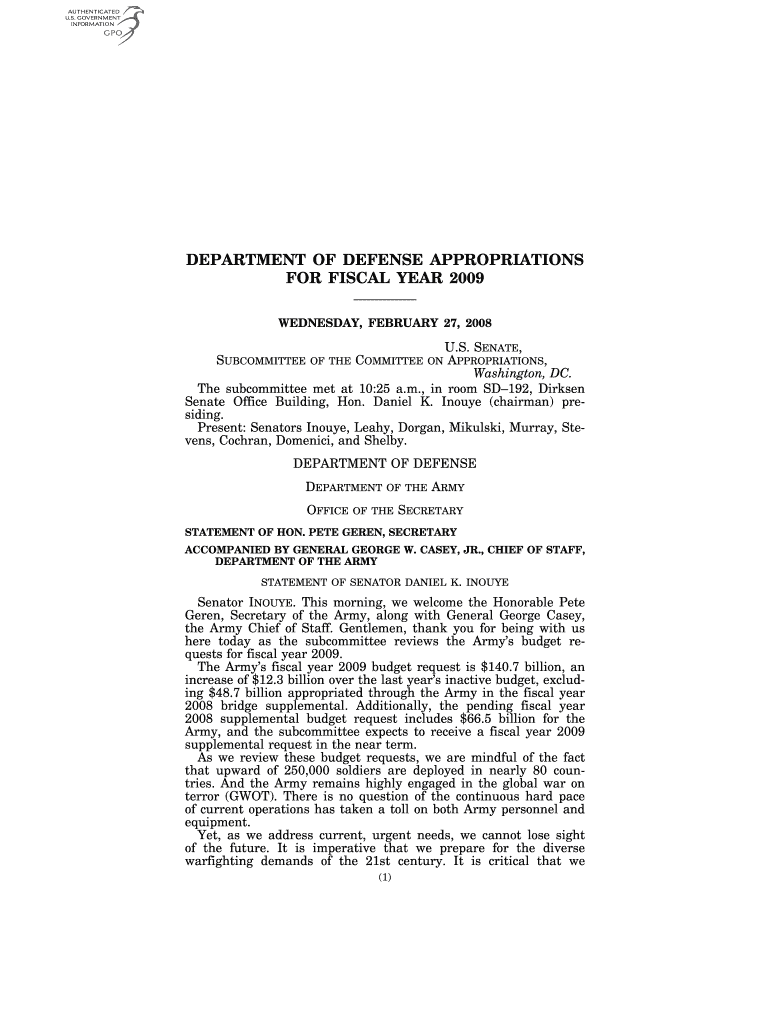







Definition & Meaning
The "Department of Defense Appropriations for Fiscal Year 2009" refers to the allocation of funds by the U.S. government to support the operations and programs of the Department of Defense (DoD) for the fiscal year 2009. This appropriations bill outlines the budgetary distribution and spending priorities for the Army, Navy, Air Force, and other military operations, focusing primarily on the needs arising from overseas engagements, infrastructure modernization, and support for military personnel and their families.
Key Components
- Budget Allocation: Determines financial support for various military initiatives.
- Operational Focus: Emphasizes ongoing operational demands in Iraq and Afghanistan.
- Support Services: Includes funding for healthcare, mental health services, and family support programs.
How to Use the DEPARTMENT OF DEFENSE APPROPRIATIONS FOR FISCAL YEAR 2009
Understanding this appropriations document is crucial for stakeholders within the Department of Defense, including military personnel, policymakers, and financial planners. It informs resource allocation, program development, and operational planning. Individuals involved in these processes should familiarize themselves with the document to align their activities with legislative mandates.
Practical Applications
- Policy Formulation: Guides decision-making regarding defense priorities.
- Resource Management: Helps in budgeting for military programs and initiatives.
- Strategic Planning: Plays a role in assessing operational capabilities and readiness.
Steps to Complete the DEPARTMENT OF DEFENSE APPROPRIATIONS FOR FISCAL YEAR 2009
Specific stakeholders, such as government officials and military leaders, must follow a structured process to utilize the appropriations document adequately. While the document itself is not a fillable form, understanding its components involves several steps similar to document analysis.
- Review the Document: Examine the overall structure, focusing on key financial figures and allocations.
- Identify Relevant Sections: Pinpoint sections applicable to your branch or department.
- Align with Strategic Goals: Ensure appropriations support strategic military objectives.
- Coordinate with Peers: Work with other stakeholders to ensure comprehensive understanding and utilization.
- Implement Appropriations: Execute planned activities and procurements as guided by the budget.
Who Typically Uses the DEPARTMENT OF DEFENSE APPROPRIATIONS FOR FISCAL YEAR 2009
Primarily, this document is used by high-ranking officials within the Department of Defense. These include military leaders, financial analysts, and budget officers responsible for the execution and oversight of military programs and operations.


Typical Users
- Military Personnel: Commanders and strategic planners involved in resource allocation and strategic planning use this document.
- Government Officials: Members of defense committees and subcommittees reference this for legislative decision-making.
- Financial Analysts: Professionals analyzing the financial efficiency and allocation of defense resources.
Legal Use of the DEPARTMENT OF DEFENSE APPROPRIATIONS FOR FISCAL YEAR 2009
The appropriations document serves a legal function by detailing the legally mandated budgetary allocations for defense. It follows protocols established by public laws and legislation governing defense appropriations.
Legal Framework
- Compliance with Legislation: Adheres to laws governing defense spending.
- Authorized Expenditures: Establishes legally permissible expenditures for defense programs.
- Oversight Mechanism: Provides a record for auditing and accountability purposes.
Key Elements of the DEPARTMENT OF DEFENSE APPROPRIATIONS FOR FISCAL YEAR 2009
The document contains several critical elements essential for its understanding and execution. Each component plays a vital role in the overall dissemination and utilization of the defense budget.
Elements to Consider
- Section Breakdown: Detailed allocation of funds across various military departments and programs.
- Expenditure Guidelines: Rules and limitations on how funds can be spent.
- Performance Metrics: Standards and criteria for evaluating the success of funded programs.
Examples of Using the DEPARTMENT OF DEFENSE APPROPRIATIONS FOR FISCAL YEAR 2009
This document can be applied in numerous ways, each integral to executing military operations and efficiently using the allocated budget.
Real-World Scenarios
- Military Procurement: Guidance for purchasing equipment and materials.
- Program Development: Framework for initiating and expanding military training programs.
- Cross-agency Collaboration: Facilitating coordinated operations between different branches of the military.
Filing Deadlines / Important Dates
For appropriations documents like this, there are critical timelines that must be adhered to by those involved in budgeting and finance within the military.
Important Dates
- Fiscal Year Start: October 1, 2008.
- Fiscal Year End: September 30, 2009.
Being aware of these dates ensures timely implementation and compliance with budgetary provisions.
Required Documents
To effectively utilize and implement the guidelines and funding outlined in the appropriations document, various internal documents are necessary.
Essential Documents
- Budget Reports: Detail planned and actual expenditures.
- Operational Plans: Outline strategic objectives and the application of resources.
- Audit Records: Document financial oversight activities and compliance.




