
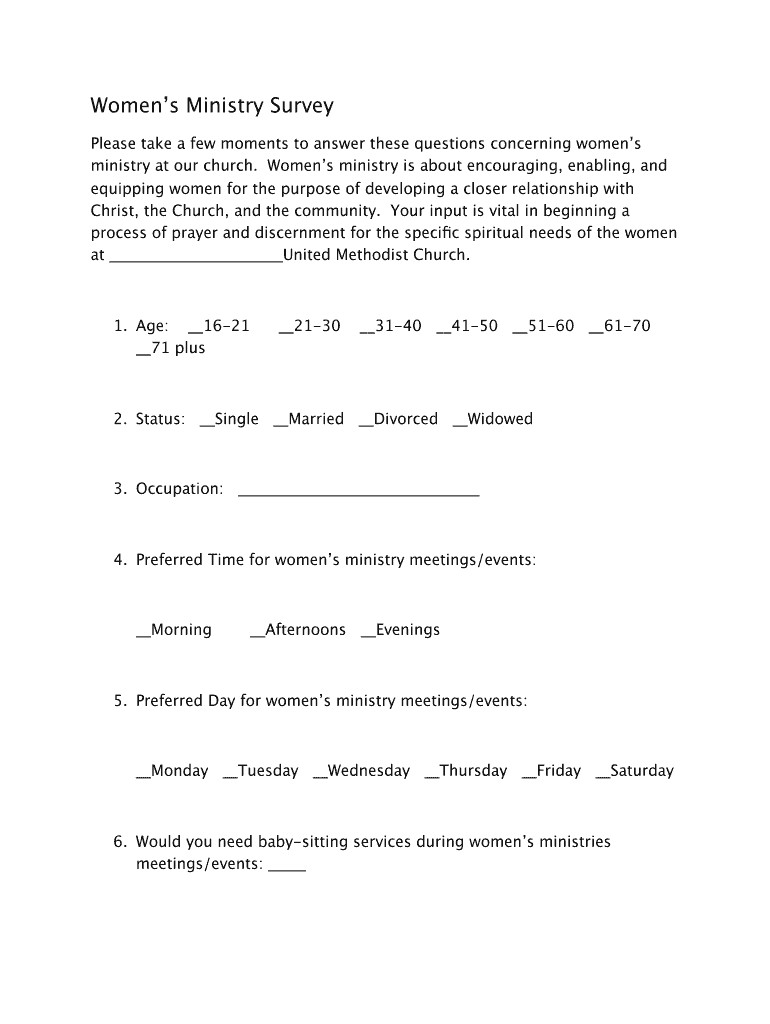







Definition and Purpose of the Womens Ministry Survey
The Womens Ministry Survey is a specific tool designed to gather insights and feedback from women within a church congregation, particularly within a United Methodist Church setting. Its purpose is to gauge the needs and preferences of the female members in order to enhance the offerings of the church's women's ministry programs. By conducting this survey, church leaders aim to understand various aspects such as demographics, participation barriers, and desired support systems that can enrich the spiritual and communal life of their female congregants. This survey acts as a bridge between the ministry's activities and the actual expectations of its members.
How to Use the Womens Ministry Survey Effectively
To maximize the effectiveness of the Womens Ministry Survey, it is essential to follow a structured process. Start by clearly defining the objectives of the survey – what specific information are you hoping to gather? Once clear goals are outlined, distribute the survey to a representative sample of the church's female congregation. Encourage honest and thorough responses by ensuring anonymity and offering multiple response options, such as online forms or printable surveys. After collecting the data, analyze it to identify common themes, barriers to participation, and frequently requested programs or activities. The results should then guide the planning and implementation of future women's ministry offerings, ensuring they align with the needs of the congregation.
Steps to Complete the Womens Ministry Survey
Completing the Womens Ministry Survey involves several straightforward steps designed to facilitate comprehensive data gathering:
- Access the Survey: Obtain the survey through church bulletins, the church's official website, or direct distribution during gatherings.
- Read Instructions Carefully: Before beginning, read all instructions to understand how to answer each type of question.
- Provide Honest Responses: Answer each question based on personal experiences and preferences, ensuring accuracy and authenticity.
- Review Completed Survey: Double-check answers for completeness, ensuring no sections are left unanswered unless optional.
- Submit Survey: Follow the specified submission method, whether it be online, via email, or in-person at designated collection points.
Who Typically Uses the Womens Ministry Survey
The Womens Ministry Survey is primarily utilized by church leaders, such as pastors and ministry coordinators, who are responsible for planning and managing women's programs within the congregation. It is also valuable to volunteer coordinators, church board members, and any other stakeholders involved in the strategic direction of the women's ministry. The survey serves as a resource for understanding the interests and challenges of the female church members, enabling these leaders to tailor activities, support groups, and spiritual retreats to better serve the community.


Key Elements of the Womens Ministry Survey
Several critical elements constitute the Womens Ministry Survey, ensuring it captures the most relevant data:
- Demographic Information: Collects basic respondent details such as age, marital status, and length of church membership.
- Participation Barriers: Identifies obstacles that prevent women from engaging in the ministry's programs (e.g., scheduling conflicts, childcare needs).
- Program Preferences: Explores desired activities, workshops, and topics that women wish to see in the ministry's offerings.
- Feedback on Current Offerings: Gathers opinions on existing programs to assess satisfaction and areas needing improvement.
Legal and Ethical Considerations
When implementing the Womens Ministry Survey, it is important to consider legal and ethical factors to protect participants' privacy and ensure compliance with applicable regulations. Surveys should be conducted in accordance with data protection laws, such as ensuring anonymity and securing collected data. Participants should be informed about how their responses will be used and assured that their privacy will be respected. Ethical considerations also involve presenting the survey invitation in an inclusive manner, ensuring all women of the congregation feel welcome and encouraged to participate.
Examples of Using the Womens Ministry Survey
In practice, the Womens Ministry Survey has been effectively used in various church settings to directly impact programming. For instance, one congregation discovered through their survey that younger women felt disconnected from weekly Bible studies designed for an older demographic. As a result, the church introduced a monthly evening group focusing on modern spiritual challenges, leading to increased participation. Another example involves identifying a demand for career counselling workshops to support working women in the church, which in turn fostered a community of professional support and mentorship.
Digital vs. Paper Version of the Survey
The Womens Ministry Survey can be administered in both digital and paper formats, each with its benefits. A digital version, typically conducted via online forms, offers convenience and accessibility, allowing respondents to participate from anywhere with internet access. It also simplifies data collection and analysis by aggregating data electronically. Conversely, a paper version of the survey may be preferred by those who find comfort in traditional pen-and-paper methods, or in congregations with limited digital access. Choosing the appropriate format depends on the congregation's demographic and technological access.
Software Compatibility
When conducting the Womens Ministry Survey digitally, ensuring compatibility with commonly used software can enhance participation and data management. Platforms such as Google Forms offer a user-friendly option for creating and distributing surveys, with real-time data analysis capabilities. Other tools like SurveyMonkey or Microsoft Forms provide additional features like customizable question types and secure data handling, making them reliable choices for managing larger surveys. Selecting software that integrates seamlessly with the church's existing digital infrastructure simplifies the survey process and facilitates efficient result interpretation.




