Full-Time Telework Arrangement Annual Review 2026

Get Form
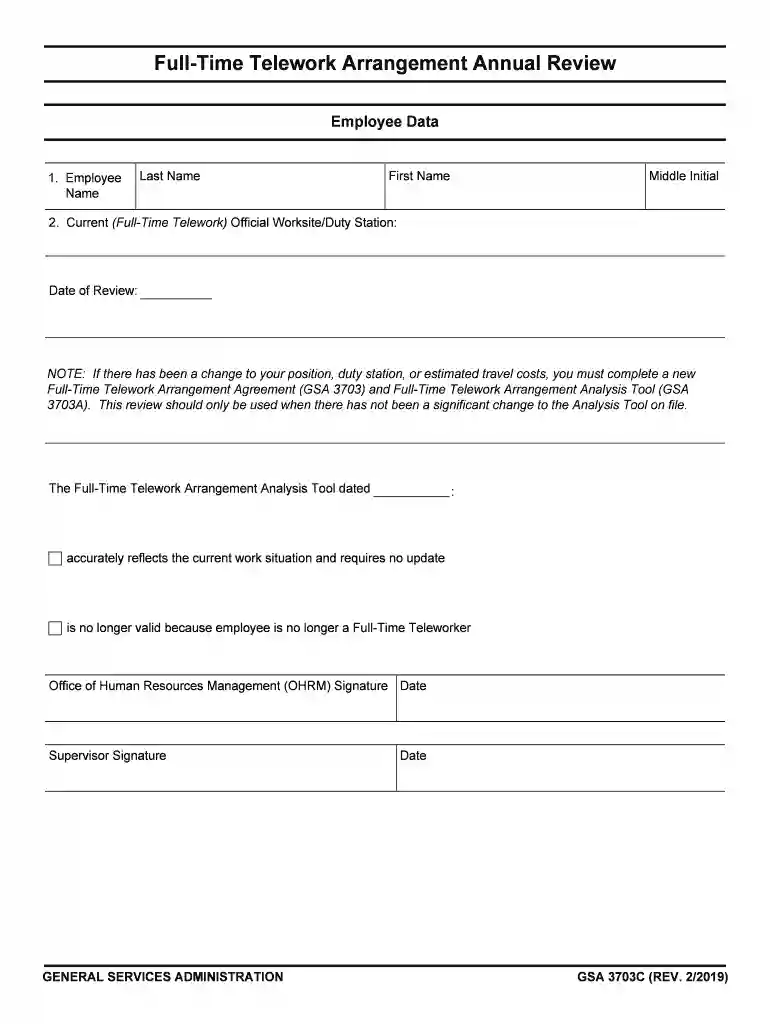
Full-Time Telework Arrangement Annual Review Preview on Page 1

Here's how it works

01. Edit your form online
Type text, add images, blackout confidential details, add comments, highlights and more.

02. Sign it in a few clicks
Draw your signature, type it, upload its image, or use your mobile device as a signature pad.

03. Share your form with others
Send it via email, link, or fax. You can also download it, export it or print it out.

Definition & Meaning

The "Full-Time Telework Arrangement Annual Review" is a formal document used by organizations to assess and evaluate the telework performance and status of employees who work remotely full-time. This document is crucial in maintaining a structured telework environment and ensuring that both employee and employer expectations are being met. It typically requires updates only if there are significant changes to the employee's role, duty station, or associated travel costs.

Components of the Review

  • Employee Data: Includes critical details such as the employee's name, department, position, and contact information.
  • Work Situation Confirmation: Confirms the current teleworking conditions, including hours of work, primary responsibilities, and any changes in work location.
  • Signatures: Requires approval and acknowledgment from both the employee and representatives from the Office of Human Resources Management and the supervisor.

Key Elements of the Full-Time Telework Arrangement Annual Review

The review consists of several critical sections that ensure comprehensive evaluation and documentation of the telework arrangement.

Employee Information Section

  • Name and Title: Ensures accurate identification of the individual under review.
  • Department and Manager: Identifies the organizational structure and reporting line relevant to the telework arrangement.

Telework Details

  • Current Duty Station: Indicates the official location associated with the teleworking employee, which can affect travel cost assessments.
  • Telework Schedule: Details the agreed-upon working hours and days, facilitating alignment between the employee and manager.

Steps to Complete the Full-Time Telework Arrangement Annual Review

The completion of this review involves several structured steps to ensure accuracy and thoroughness.

1. Gather Required Information

  • Personal and Professional Details: Collect all necessary data regarding the employee's position and telework status.
  • Updated Telework Objectives: Document current objectives and achievements since the last review.

2. Assess Telework Arrangement

  • Current Responsibilities: Evaluate if the workload and job responsibilities have altered significantly.
  • Duty Station and Travel Costs: Verify any changes in the employee's duty station or related travel expenditures.

3. Obtain Required Signatures

  • Employee Acknowledgment: Ensure the employee signs to confirm understanding and agreement with the review content.
  • Manager and HR Approval: Secure signatures from the manager and HR to validate the assessment and approve continued telework.

How to Use the Full-Time Telework Arrangement Annual Review

This review is an instrumental tool for both employees and employers.

For Employees

  • Performance Feedback: Provides employees with insights into their telework performance and areas of improvement.
  • Clarification of Expectations: Ensures there's a mutual understanding of role expectations and telework policies.

For Employers

  • Structural Documentation: Enables a structured approach to managing telework arrangements.
  • Policy Enforcement: Reinforces telework policies and procedures, ensuring consistent application across the organization.

Legal Use of the Full-Time Telework Arrangement Annual Review

Employers must adhere to legal and organizational guidelines when using this form.

Confidentiality and Compliance

  • Data Protection: Adheres to data protection laws by securing sensitive employee information.
  • Equal Employment Opportunity: Ensures that telework evaluations do not discriminate and comply with employment laws.

Examples of Using the Full-Time Telework Arrangement Annual Review

Case Study 1: Role Change Due to Telework

An employee recently transitioned to a new project involving collaboration with international teams. The review captured this change, including updates in work hours to accommodate different time zones, ensuring all parties remained aligned.

Case Study 2: Travel Cost Adjustment

Following a permanent move to a new city by an employee, the review adjusted their travel cost arrangements to reflect new transportation expenses incurred for occasional in-office meetings.

Important Terms Related to Full-Time Telework Arrangement Annual Review

Understanding key terms ensures clear communication and effective use of the review form.

Critical Definitions

  • Telework: Working from a location outside of the traditional office environment on a full-time basis.
  • Duty Station: The employee's official work location, which may differ from their teleworking site.
  • Travel Costs: Expenses incurred by the employee for work-related travel, relevant to determining compensation adjustments.

Who Typically Uses the Full-Time Telework Arrangement Annual Review

This form is commonly utilized by various professionals within an organization.

decoration image ratings of Dochub

Employees and Managers

  • Remote Employees: Individuals who perform their job from remote locations on a full-time basis.
  • Supervisors and HR Personnel: Managers and HR departments use this review for performance assessment and telework policy adherence.
be ready to get more

Complete this form in 5 minutes or less

Get form

Got questions?

We have answers to the most popular questions from our customers. If you can't find an answer to your question, please contact us.
Contact us
In 2025, the President directed agencies to end remote work, with certain exceptions. The National Defense Authorization Act for Fiscal Year 2024 includes a provision for GAO to report on the use of remote work by federal agencies.
In January 2025, the President directed executive agencies to require that all employees, including remote workers, work from an agency location full time.
In fact, most of the major motives underpinning organizational mandates to bring back workers to the office full-time are influenced by factors, including politics, culture, subjective opinions and bias, that are not positively linked to employee morale and productivity, or a logical objection to remote or hybrid
Yes. The Telework Enhancement Act of 2010 allows for termination of a telework agreement if an employee does not comply with the terms of the written agreement, or, if the performance of the employee falls below a certain standard (usually, fully successful).
Duration: Telework agreements generally are approved for up to two years, but they may not extend past an employees Not to Exceed Date the date that an employees appointment expires. Eligibility: Telework is not an entitlement and not all employees are eligible to telework.

Security and compliance

At DocHub, your data security is our priority. We follow HIPAA, SOC2, GDPR, and other standards, so you can work on your documents with confidence.

Learn more
ccpa2
pci-dss
gdpr-compliance
hipaa
soc-compliance

People also ask

Effective teleworker management requires strong communication and collaboration practices. Set guidelines regarding response times, shared calendars and documents, and preferred communication methods for various situations. Transparent communication tools and team norms like shared calendars can be useful.
Telework refers to a work flexibility arrangement, approved in advance by a supervisor, that allows an employee to work from an approved alternative worksite other than the employees official duty location for an approved number of days each pay period.

Related links