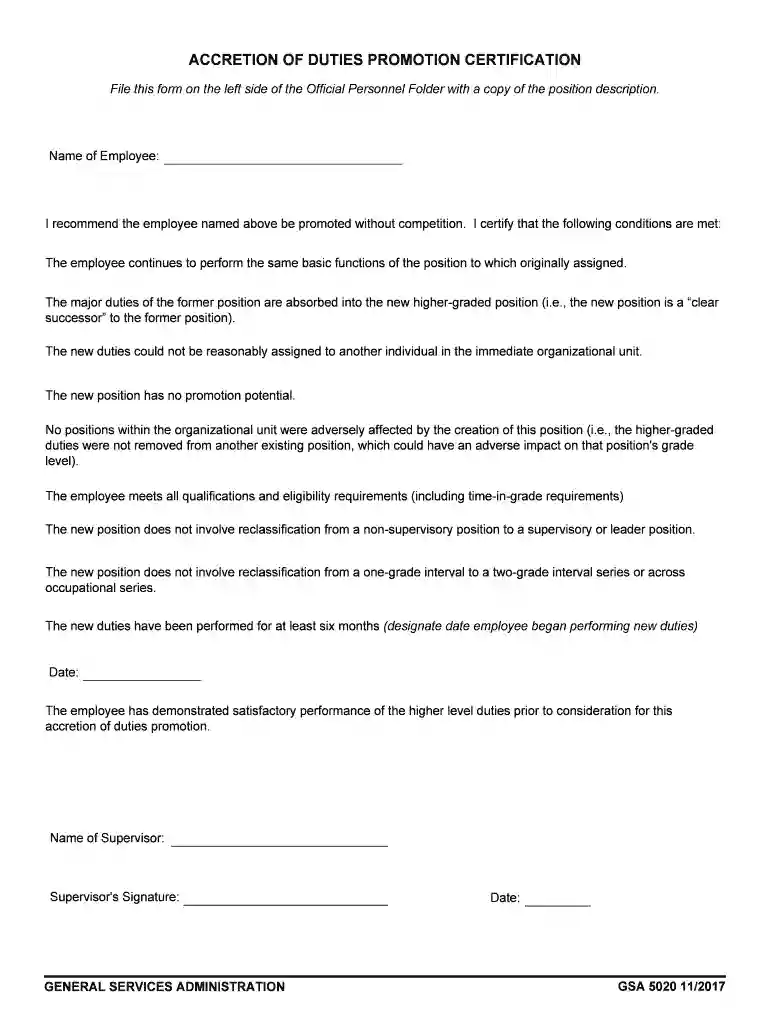
Accretion of duties promotion certification - GSA 2026

Get Form
accretion of duties promotion certification - GSA Preview on Page 1

Here's how it works

01. Edit your form online
Type text, add images, blackout confidential details, add comments, highlights and more.

02. Sign it in a few clicks
Draw your signature, type it, upload its image, or use your mobile device as a signature pad.

03. Share your form with others
Send it via email, link, or fax. You can also download it, export it or print it out.

Definition & Meaning

The accretion of duties promotion certification in the context of the General Services Administration (GSA) plays a crucial role in non-competitive promotion processes. It refers to a formal acknowledgment that an employee has undertaken additional responsibilities without an explicit change to their job description. This often leads to a re-evaluation of their grade and job title, potentially resulting in a promotion. The process validates that the employee has naturally expanded their role by absorbing substantial new duties indicative of a higher role. It is integral in federal employment for ensuring career growth aligns with increased job complexity.

Importance for Career Progression

The certification is essential for federal employees seeking career advancement within their existing roles. It provides an official mechanism to recognize an employee's enhanced contributions without needing a competitive selection process. This ensures that as employees grow their skill set and take on more challenging work, their job grading accurately reflects their current responsibilities.

How to Use the Accretion of Duties Promotion Certification - GSA

Utilizing the accretion of duties promotion certification effectively involves understanding the conditions necessary for eligibility and navigating the application process. Employees should comprehensively document their expanded duties and demonstrate how these align with higher grading criteria.

Documentation and Proof of Duties

It is imperative to maintain an accurate record of additional responsibilities undertaken over time. This document should include details of new tasks, changes in workflow, and any instances of leadership or specialized skills developed. Providing a comparison against initial duties helps illustrate the evolution of the employee’s role.

How to Obtain the Accretion of Duties Promotion Certification - GSA

To secure the accretion of duties certification, employees must demonstrate that specific criteria have been met. The process typically involves an assessment by HR professionals or supervisors familiar with the employee’s work.

Certification Process and Authority

  1. Initiation: The process generally starts when an employee or their supervisor recognizes a significant change in duties.
  2. Documentation Submission: Employees submit documentation of their new responsibilities along with performance evaluations.
  3. Supervisor Endorsement: The supervisor reviews the employee’s submission and provides an endorsement, supporting the claim of duty increase.
  4. HR Review: Human Resources reviews all submitted materials to ensure compliance with promotion standards and regulations.

Steps to Complete the Accretion of Duties Promotion Certification - GSA

Completing the certification process requires adherence to specific steps to ensure thorough review and approval. The following outlines these essential steps:

  1. Self-Assessment: Conduct a self-evaluation comparing current duties to the initial job description.
  2. Gather Evidence: Collect and organize documentation supporting the accretion of new duties.
  3. Supervisor Consultation: Meet with a supervisor to discuss changes and ensure alignment on responsibilities added.
  4. Formal Request Submission: Submit a formal application along with all collected documentation to HR for evaluation.
  5. Review Feedback: Respond to any requests for additional information or clarification from HR.
  6. Final Approval: Await the decision, which culminates in the certification issuance if all criteria are met.

Key Elements of the Accretion of Duties Promotion Certification - GSA

Several fundamental components define the accretion of duties promotion certification, ensuring it remains a structured and fair process.

Criteria for Promotion

  • Continuity of Duties: Employees must have performed their original duties consistently while integrating new responsibilities.
  • Substantive Changes: The new tasks must represent a significant increase in responsibility reflecting a higher-grade position.
  • Performance Duration: Employees generally need to demonstrate at least six months of satisfactory performance in their expanded role.

Eligibility Criteria

The eligibility for this certification often hinges on the nature of the additional duties and the extent to which they exceed the current role’s scope.


decoration image ratings of Dochub

Specific Eligibility Considerations

  • Job Complexity: The added responsibilities should significantly contribute to the complexity and impact of the role.
  • Position Re-evaluation: There should be a formal re-evaluation of the employee’s position against the establishment’s classification standards.
  • No Historical Promotions: Typically, employees should not have received a competitive promotion in the recent past.

Examples of Using the Accretion of Duties Promotion Certification - GSA

Understanding how the accretion of duties can affect promotions is vital. Employees in varying roles across federal agencies have successfully utilized this certification to advance their careers.

Real-World Application Scenarios

  • Case Study 1: An administrative assistant who took on project management tasks, overseeing significant projects, thereby transitioning into a higher managerial role.
  • Case Study 2: A technical specialist who began leading a team of developers, providing oversight and technical guidance in addition to their primary responsibilities.

These scenarios illustrate the kinds of changes in responsibility that can justify the issuance of the accretion of duties promotion certification.

be ready to get more

Complete this form in 5 minutes or less

Get form

Got questions?

We have answers to the most popular questions from our customers. If you can't find an answer to your question, please contact us.
Contact us
10 U.S. Code 619: The minimum time-in-grade (TIG) requirements for promotion of officers on the active-duty list (ADL) are as follows: O1: 18 months. O2: 2 years. O3 through O5: 3 years.
An accretion of duties is the addition of duties and responsibilities to an encumbered position which may increase the grade of the position whereby a promotion may be achieved non-competitively.
Promotions from Private (E-2) to Private First Class (E-3) are generally automatic, and normally require 12 months of time in service and four months time-in-grade as a Private (E-2).
GS employees may advance to higher grades by promotion at certain intervals (generally after at least a year), as determined by OPM regulations and qualification standards and agency policies, up to the full promotion potential advertised in the job announcement.
Time in grade is a requirement for a specified amount of time that an employee must spend in a grade before they are eligible for promotion (5 CFR 300.604).

Security and compliance

At DocHub, your data security is our priority. We follow HIPAA, SOC2, GDPR, and other standards, so you can work on your documents with confidence.

Learn more
ccpa2
pci-dss
gdpr-compliance
hipaa
soc-compliance
be ready to get more

Complete this form in 5 minutes or less

Get form

People also ask

To be eligible for a time limited promotion to higher-graded duties of a higher graded position, an employee must meet the minimum qualification standards and time-in-grade requirements prescribed by the OPM. This regulatory provision does not change or impact these requirements.
The two-step promotion rule states that a GS employee promoted to a position in a higher grade is entitled to basic pay at the lowest rate of the higher grade that exceeds his or her existing rate of basic pay by not less than two step increases of the grade from which promoted.

Related links