




01. Edit your form online
Type text, add images, blackout confidential details, add comments, highlights and more.

Type text, add images, blackout confidential details, add comments, highlights and more.

Draw your signature, type it, upload its image, or use your mobile device as a signature pad.

Send it via email, link, or fax. You can also download it, export it or print it out.
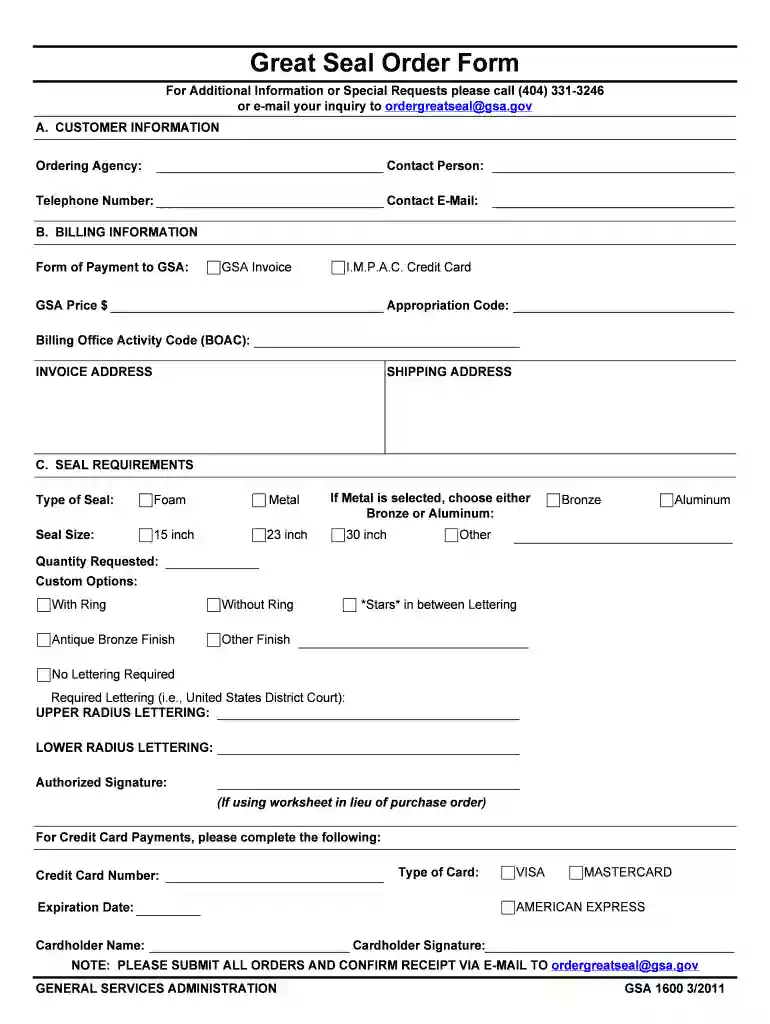
The Great Seal Order Form is a specific document used to order seals from the General Services Administration (GSA). This form primarily serves government-affiliated organizations or agencies needing official seals for various applications. The form ensures proper detailing and record-keeping of seal requests, enabling the efficient processing and delivery of the desired seals.
Using the Great Seal Order Form involves specific steps to ensure correct and complete submission. Each section requires distinct information:
Customer Information: Begin by filling out the organization's name, contact person, and address. This helps the GSA identify and communicate with the requestor.
Billing Details: Provide comprehensive billing information, including billing address and any special billing instructions. This section ensures that billing processes are carried out correctly.
Seal Requirements: Indicate the specific type, size, and finish of the seal. It is crucial to specify these details to receive the correct seal configuration.
Payment Options: Select the appropriate payment method from the options available. Include any necessary payment details, like account numbers or authorizations, to prevent delays.
Completing the Great Seal Order Form requires careful attention to detail. Follow these steps for a successful submission:
Download or Procure the Form: Obtain the form from the official GSA website or their office.
Fill Out Each Section: Accurately complete the form, ensuring that all required fields are filled.
Review for Accuracy: Double-check the information for correctness, particularly in sensitive sections like billing and seal specifications.
Submit the Form: Depending on availability and preference, submit the form either electronically or as a physical document by mailing it to the designated GSA office.
Await Confirmation: After submission, monitor your contact email or mail address for confirmation of processing or additional instructions from the GSA.
Understanding the core components of the Great Seal Order Form is crucial for its proper execution. These elements include:
Customer Information: Crucial for identification and communication between the ordering party and the GSA.
Billing Instructions: Ensures that payments are processed accurately and in a timely manner.
Seal Specifications: This includes the type, size, and finish of the seal, which determines the manufacturing process.
Payment Details: Helps facilitate smooth financial transactions.
The integration of these elements ensures that the order is processed efficiently and the required seal is dispatched as per specifications.
The Great Seal Order Form is subject to strict legal guidelines to prevent misuse. Primarily used by government agencies, the seal must comply with specific legal regulations that govern its usage. Any deviation or misuse could result in severe penalties, underlining the importance of understanding the legal context in which these seals are applied.
The primary users of the Great Seal Order Form include government agencies, departments, and other entities that require official seals for documentation or ceremonial purposes. These users rely on proper compliance and submission to fulfill their requirement for a seal that is recognized officially.


While the form is generally standardized, certain state-specific rules may impact how the form is processed. For example, Georgia may have different regulations or additional requirements when compared to another state. It is imperative for users to consult local state guidelines or legal advisors to ensure compliance with jurisdiction-specific stipulations.
The form allows three primary methods of submission:
Online Submission: Fast and immediate, allowing for quick processing.
Mail Submission: Traditional, useful for those who prefer physical documentation.
In-Person Submission: Available in certain regions, permitting direct handover and immediate acknowledgment of receipt.
Each method has its benefits and potential challenges, making it important for users to select the most suitable option based on their context and needs.
We've got more versions of the Great Seal Order Form form. Select the right Great Seal Order Form version from the list and start editing it straight away!
| Versions | Form popularity | Fillable & printable |
|---|---|---|
| 2011 | 4.8 Satisfied (206 Votes) |
At DocHub, your data security is our priority. We follow HIPAA, SOC2, GDPR, and other standards, so you can work on your documents with confidence.



The form, Application for Manufacture or Use of the Great Seal of the State of Florida, Form DS-19, effective 4-4-06, is incorporated by reference herein
May 29, 2026 Great Seal Order Form Information Form Number: GSA1600. Canceled on April 6, 2026 with no replacement. Search for another form PDF versions of


