01. Edit your form online
Type text, add images, blackout confidential details, add comments, highlights and more.

Type text, add images, blackout confidential details, add comments, highlights and more.

Draw your signature, type it, upload its image, or use your mobile device as a signature pad.

Send it via email, link, or fax. You can also download it, export it or print it out.
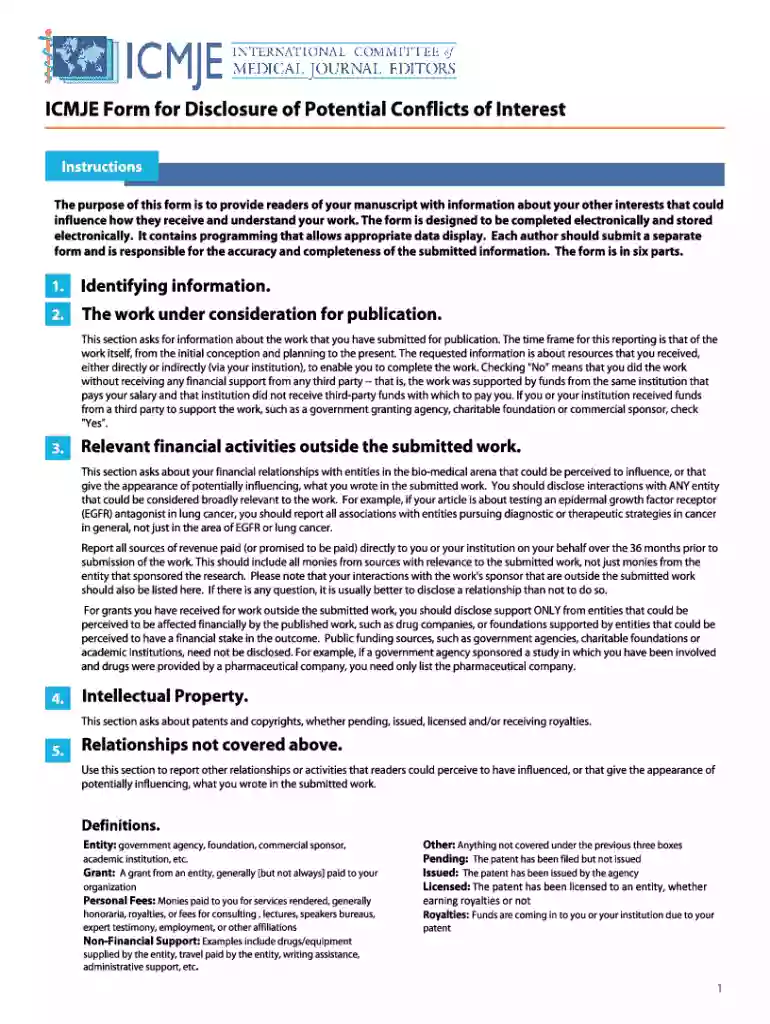
The ICMJE Form for Disclosure of Potential Conflicts of Interest, often referred to as the "ICMJE COI Form," is a document that obligates authors to reveal any financial relationships that could potentially influence their scientific manuscripts. This requirement ensures transparency and fosters integrity in scholarly publications. The document comprises six different sections, each aimed at uncovering several types of conflicts. They range from direct financial ties to less obvious influences, covering intellectual property and other relationships.
The ICMJE COI Form helps maintain transparency, critical to the credibility of scientific research. By disclosing potential conflicts, authors provide peer reviewers, editors, and readers with the full context of their investigation. This transparency mitigates biases in research findings, enabling a more objective interpretation of data.
Completing the ICMJE COI Form involves several steps designed to ensure comprehensive disclosure. Authors need to carefully read each section of the document, accurately fill out their details, and focus particularly on financial disclosures.
While filling out the ICMJE COI Form, several common errors can compromise the integrity of the disclosure:
The ICMJE COI Form is typically required by a broad range of contributors in the academic and scientific communities. It is predominantly utilized by authors preparing manuscripts for submission to journals that adhere to ICMJE standards.


Several real-world cases exemplify the use of the ICMJE COI Form. For instance, when medical researchers publish groundbreaking clinical trial results, the form ensures they disclose any affiliations with pharmaceutical sponsors. Similarly, a university scientist might reveal consultancy fees from industry partners related to their research field.
The ICMJE COI Form covers distinct sections designed to capture a comprehensive range of influences:
Each section demands a specific type of information, emphasizing the diverse potential influences on a research manuscript. Financial activities demand close attention to detail, ensuring all sources of funding and compensation are clear, minimizing the risk of conflicts leading to skewed research outcomes.
Submitting the ICMJE Form carries significant legal weight because it documents a commitment to transparency. Incomplete or dishonest disclosure can have severe repercussions, including publication retraction, loss of credibility, and potential legal action.
Organizations and individuals may face legal and reputational risks for non-compliance. Each submission must be well-documented and verifiable, with authors being held accountable for the integrity of their declarations.
The ICMJE Form is vital for anyone submitting work to a related journal, as it enhances the transparency and trust in the research process. Meeting its requirements aligns authors with international publishing standards that assert ethical conduct in research and publication.
To acquire the ICMJE COI Form, authors can typically download it from the respective journal's submission platform or directly from the ICMJE website. Once completed, the form needs to be submitted as part of the initial manuscript submission package.
We've got more versions of the ICMJE Form for Disclosure of Potential Conflicts of Interest - Springer form. Select the right ICMJE Form for Disclosure of Potential Conflicts of Interest - Springer version from the list and start editing it straight away!
At DocHub, your data security is our priority. We follow HIPAA, SOC2, GDPR, and other standards, so you can work on your documents with confidence.