
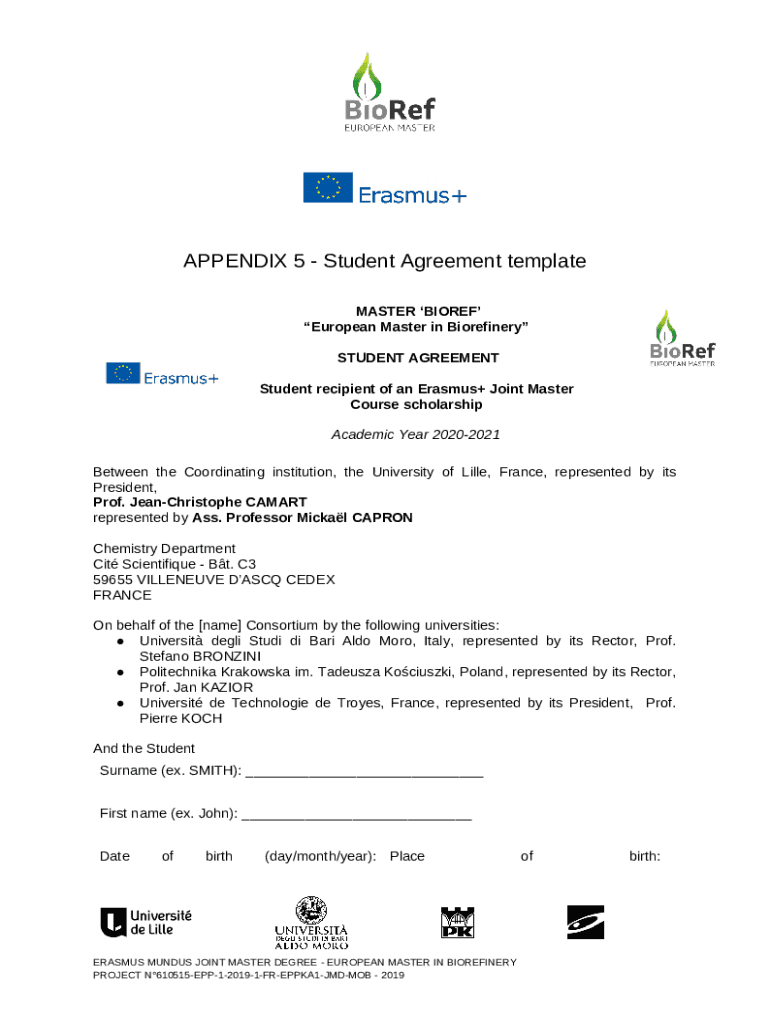







Definition & Meaning
A "Student Agreement Template" is a structured document designed to formalize the relationship between students and academic institutions, detailing mutual commitments, expectations, and obligations. This document is particularly crucial in scenarios like the Erasmus+ Joint Master Course in Biorefinery (BIOREF), where multiple academic entities and students partake in exchange programs. It typically covers essential elements such as academic performance, tuition arrangements, scholarship provisions, and terms for conflict resolution. By clearly articulating these aspects, the template serves as a safeguard for both parties, ensuring transparency and accountability throughout the academic tenure.
Key Elements of the Student Agreement Template
The Student Agreement Template encompasses several essential components that establish the framework of the student-institution relationship:
- Commitments and Responsibilities: Specifies the duties and obligations of both the student and the institution, including academic participation and code of conduct adherence.
- Financial Arrangements: Details tuition fees, payment schedules, and any financial assistance, such as scholarships or grants, provided to the student.
- Program Requirements: Outlines academic curriculum requirements, including course workload, examination criteria, and minimum performance standards.
- Dispute Resolution: Defines procedures for resolving conflicts that may arise during the term of the agreement, ensuring fair and equitable treatment for all parties involved.
- Termination Conditions: Specifies the grounds under which the agreement may be terminated, protecting both the institution’s interests and the student’s rights.
How to Use the Student Agreement Template
Utilizing the Student Agreement Template involves a series of coordinated steps designed to ensure accuracy and completeness:
- Review Institutional Requirements: Begin by assessing the specific requirements and standards set by the institution, ensuring alignment with the template's provisions.
- Gather Necessary Information: Compile all relevant data, including personal identification details, academic records, and financial information pertinent to the agreement.
- Customize the Template: Adapt the template to include tailored details applicable to the student's course and personal circumstances without altering the core structure.
- Consult Legal Advisors: Seek expert legal advice to verify the document's compliance with educational regulations and institutional policies, ensuring its enforceability.
- Finalize and Execute: After obtaining consensus from all involved stakeholders, finalize the document, ensuring clear consent through signatures from both student and institution representatives.
Steps to Complete the Student Agreement Template
Completing the Student Agreement Template is a methodical process that requires accuracy and attention to detail. Here are the essential steps:
- Identify Required Sections: Scan the template to identify obligatory sections that must be filled in, such as student identification and course details.
- Input Accurate Data: Carefully enter all necessary information, verifying its accuracy to prevent future discrepancies.
- Validate Scholarship Information: Ensure all scholarship terms are accurately reflected in the document, detailing the amounts and conditions of the financial support.
- Review and Revise: Conduct a thorough review of the filled template, making revisions where necessary to enhance clarity and ensure comprehensive coverage.
- Secure Approvals: The completed document should be reviewed by academic and financial administrators to confirm its accuracy and receive their approval.
Legal Use of the Student Agreement Template
The Student Agreement Template is a legally binding document once duly executed. It serves various legal functions:
- Enforceability: Provides a clear framework for legally enforcing the agreed terms, protecting both student and institutional rights.
- Documentation of Obligations: Officially records commitments, serving as evidence in case of disputes or disciplinary actions.
- Regulatory Compliance: Ensures that the agreement complies with educational standards and regulations required by governing bodies.
Who Typically Uses the Student Agreement Template
This template is commonly used by:
- Academic Institutions: Universities and colleges offering structured courses use this template to formalize engagements with their students.
- Students and Scholars: Both undergraduate and postgraduate students involved in specialized programs or financial aid structures.
- Legal and Administrative Personnel: Those responsible for drafting, reviewing, and managing official documentation within educational entities.

Examples of Using the Student Agreement Template
Real-world scenarios illustrate the diverse applications of the Student Agreement Template:
- International Exchange Programs: Students participating in international programs, such as Erasmus+, use the template to define terms of participation and financial support.
- Scholarship Recipients: For students receiving scholarships, the document outlines eligibility criteria and the conditions under which financial aid may be retained or revoked.
- Joint Academic Programs: In collaborations between multiple universities, the template helps stipulate how credits, academic achievements, and financial responsibilities are shared among institutions.
Digital vs. Paper Version
The Student Agreement Template can be executed in both digital and paper formats, depending on institutional preferences:
- Digital Version: Enables streamlined editing, immediate distribution, and integration with digital signing platforms like DocHub, improving efficiency and reducing processing time.
- Paper Version: Traditional hard copies can be used for record-keeping and situations requiring physical signatures, ensuring reliability and familiarity within certain administrative processes.
Software Compatibility
The Student Agreement Template is compatible with various document processing software, facilitating seamless manipulation and signing:
- DocHub: Comprehensive tool for editing, annotating, and digitally signing agreements, providing additional features such as real-time collaboration and integration with cloud services.
- Google Workspace: Direct compatibility allows importing and exporting of documents through Google Drive, supporting efficient modification and distribution tasks.
- Microsoft Office Suite: Offers extensive compatibility with formats such as DOC and DOCX, enabling offline editing and standardization across educational institutions.




