




01. Edit your domestic partnership online
Type text, add images, blackout confidential details, add comments, highlights and more.

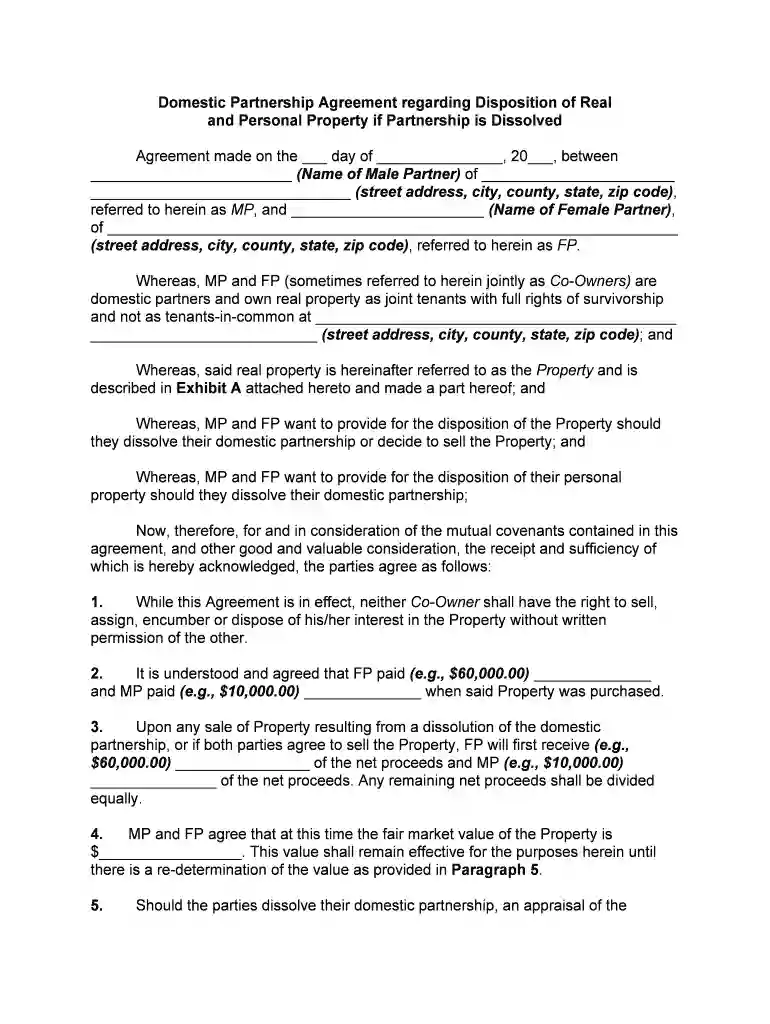
Type text, add images, blackout confidential details, add comments, highlights and more.

Draw your signature, type it, upload its image, or use your mobile device as a signature pad.

Send domestic partnership agreement via email, link, or fax. You can also download it, export it or print it out.
A domestic partnership is a legal or personal relationship between two individuals who share a domestic life but are not joined by marriage or a civil union. It is most commonly recognized by a legal framework that provides certain rights and responsibilities to the partners, similar to those afforded to married couples. Domestic partnerships may provide benefits such as access to a partner’s health insurance, rights to family leave, and rights associated with inheritance.
A domestic partnership agreement is a legally binding document that outlines the terms of the partnership, similar to a prenuptial agreement for married couples. It is utilized to set expectations in various areas of the partnership, including finances, property management, and responsibilities.
The process of obtaining a domestic partnership varies by state but typically involves applying through a local government office.
Completing a domestic partnership form requires accuracy and attention to detail to ensure it is processed without delays.
Each state in the U.S. has unique rules and recognition standards for domestic partnerships.
Domestic partnerships have legal implications that impact various aspects of life beyond personal relationships.
Understanding the key elements of a domestic partnership can help in setting realistic expectations and ensuring both parties are on the same page.
Both partners must meet specific eligibility requirements to enter into a domestic partnership. These requirements can vary widely based on jurisdiction.


Age: Partners must typically be at least 18 years old.
Residency: Proof of cohabitation may be required.
Single Status: Partners cannot be legally married to someone else.
Documentation: Legal documents such as identity proof and affidavits may be required to substantiate claims of the relationship.
We've got more versions of the domestic partnership form. Select the right domestic partnership version from the list and start editing it straight away!
| Versions | Form popularity | Fillable & printable |
|---|---|---|
| 2020 | 4.9 Satisfied (31 Votes) |
At DocHub, your data security is our priority. We follow HIPAA, SOC2, GDPR, and other standards, so you can work on your documents with confidence.
A Domestic Partnership is a legal relationship permitted under the laws of the State and City of New York for couples that have a close and committed personalRead more
Domestic partners refers to two persons engaged in a commitment (generally, a civil union) that is legally equivalent to marriage.
The phrase domestic partnership is a legal term to describe adults who perform activities seen in a typical relationship, such as living together and being


