




01. Edit your form online
Type text, add images, blackout confidential details, add comments, highlights and more.

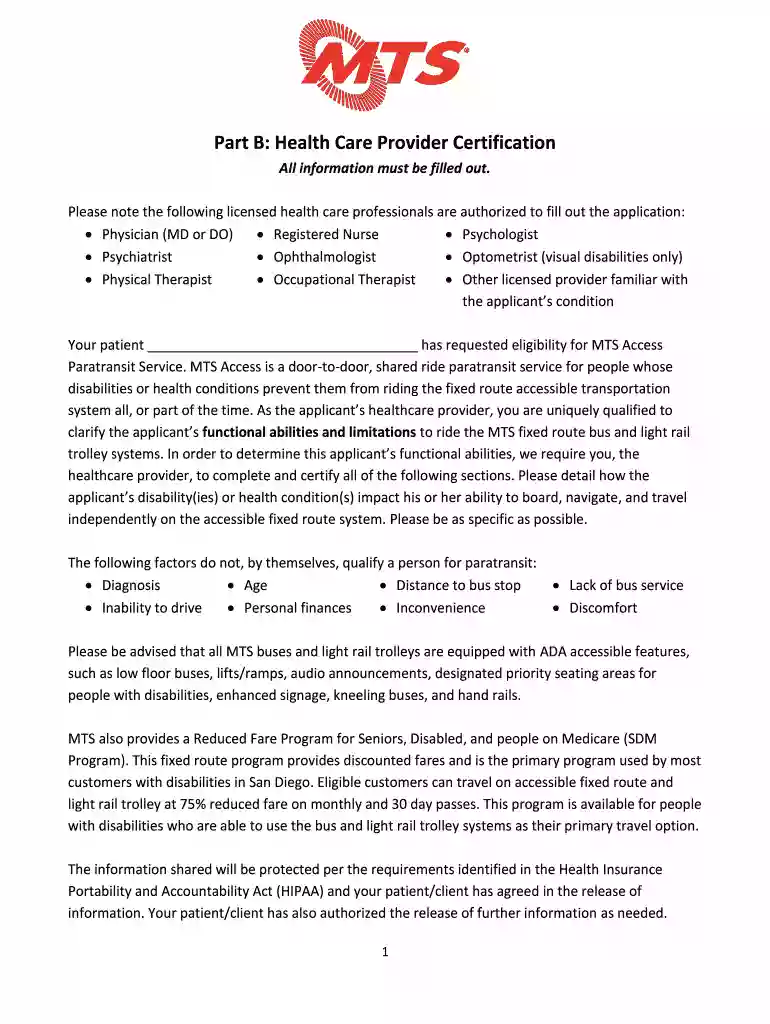
Type text, add images, blackout confidential details, add comments, highlights and more.

Draw your signature, type it, upload its image, or use your mobile device as a signature pad.

Send it via email, link, or fax. You can also download it, export it or print it out.
The "Part B: Health Care Provider Certification - MTS Access" is a critical component of the application process for individuals seeking MTS Access Paratransit Service. This service is designed for people whose physical or cognitive disabilities prevent them from using standard public transportation. The form serves to authenticate the applicant’s health condition and its impact on their mobility, documenting the specifics of their impairment as conveyed by a licensed health care provider.
The health care provider must detail the functional abilities and limitations of the applicant, ensuring that all responses align with the service criteria. This certification validates the need for paratransit services and ensures that resources are appropriately allocated to eligible individuals.
Identify the Appropriate Health Care Professional: The form must be completed by a licensed health care provider familiar with the applicant’s medical condition. Suitable professionals include doctors, psychiatrists, physical therapists, or other licensed specialists.
Provide Detailed Medical Information: The health care provider is responsible for accurately documenting the applicant's medical condition, functional capacity, and how these impact their mobility. It's crucial to include specific examples, such as difficulty walking certain distances or the inability to navigate stairs.
Verify the Necessity for Paratransit Services: The provider needs to affirm why the applicant’s condition justifies the need for paratransit services instead of utilizing conventional transit options. This verification must be based on medical evidence and observations.
Sign and Date the Form: The final step involves signing and dating the form to certify that the information provided genuine and correct.
To qualify for MTS Access Paratransit services through the Part B Certification, applicants must demonstrate that their disability significantly limits their ability to use fixed-route transportation. Specifically, eligibility hinges on:
Physical and Cognitive Limitations: Conditions that impact mobility, such as blindness, cognitive impairments, paralysis, or severe arthritis, may qualify. These limitations must be documented by a health care provider.
Environmental Barriers: Aside from physical impairments, consideration is given to environmental factors, like extreme temperatures, which might exacerbate the applicant's condition and hinder transportation access.


Applicant’s Personal and Medical Information: Essential demographic details, including name, date of birth, and contact info, paired with a comprehensive account of their disability.
Functional Assessment: A detailed evaluation of the applicant's capabilities with regard to walking, balancing, and understanding travel instructions.
Impact of Medical Condition: A thorough explanation of how the medical condition affects the applicant’s ability to use conventional transport systems.
Required Documentation: Supporting documents or medical records that reinforce the completed answers need to be attached where applicable.
Submission Options: Applicants can submit the completed form through various channels:
Confirmation of Receipt: It’s advisable to request a confirmation either through a return email or a mail receipt to ensure the form has been received for processing.
Health care providers must adhere to relevant U.S. legal standards, including:
Accuracy in Reporting: Providing false information can result in legal consequences for both the provider and the applicant.
Confidentiality Compliance: Ensuring that patient information remains confidential and is shared only with relevant authorities as outlined in HIPAA regulations.
Consider a scenario where an applicant is partially mobile but unable to use steps due to rheumatoid arthritis. Such scenarios must be clearly documented, emphasizing the difficulty and corresponding transportation needs.
Another example includes cognitive impairments where understanding routes or managing route changes poses a significant challenge. Providers need to specify these in the form to draw a clear correlation between the condition and the need for paratransit services.
While the general requirements for Part B: Health Care Provider Certification apply uniformly across the United States, certain states might have additional stipulations based on local transit regulations. It's crucial for applicants and providers to consult state-specific guidelines. For instance, some states might require additional forms or specific supporting documents certifying the applicant's condition.
The certification form can be completed digitally or on paper. The digital version allows easier edits and faster sharing between the provider and the applicant but requires access to a computer and the internet. Conversely, the paper form might be preferred by those less familiar with technology or lacking digital access, but it may take longer due to mail transit times. Each version serves the same purpose and must be accurately completed to avoid processing delays.
We've got more versions of the Part B: Health Care Provider Certification - MTS Access form. Select the right Part B: Health Care Provider Certification - MTS Access version from the list and start editing it straight away!
At DocHub, your data security is our priority. We follow HIPAA, SOC2, GDPR, and other standards, so you can work on your documents with confidence.


