






Definition & Meaning
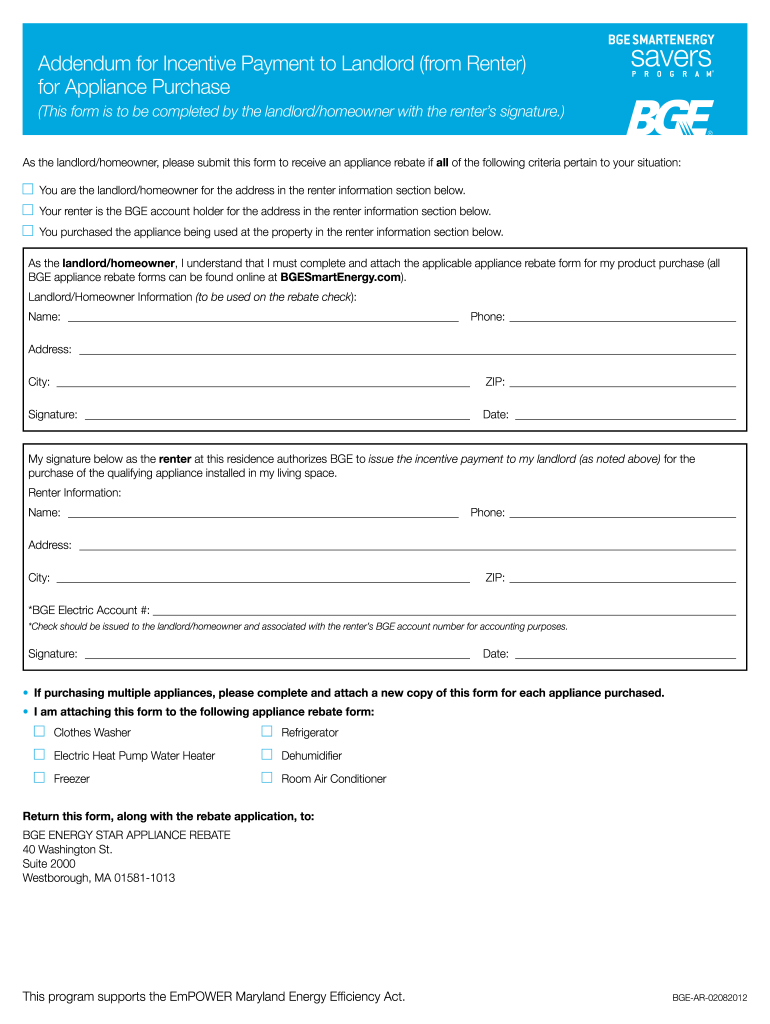
An "addendum landlord from renter appliance" refers to a supplemental document that provides additional terms to an existing rental agreement concerning the purchase of qualifying appliances. In this form, landlords can formally request an incentive payment from the utility company BGE when specific energy-efficient appliances are installed within rental properties. The addendum requires both the renter's and landlord's signatures to confirm details like the renter's status as the BGE account holder and the landlord's purchase of the appliance.
Purpose and Context
- Used for incentivizing energy efficiency in rental properties.
- Ensures compliance with utility agreements for rebates.
- Acknowledges mutual responsibilities of both tenant and landlord.
Example Use Case
A landlord in Maryland installs an energy-efficient refrigerator in a tenant's apartment. To benefit from a rebate, they submit this addendum, obtaining confirmation from the tenant about appliance installation and account details.
How to Use the Addendum Landlord from Renter Appliance
To effectively utilize the addendum, landlords must gather necessary information and follow a systematic process to ensure eligibility for reimbursement and maintain tenant satisfaction.
Essential Steps
- Verification: Confirm that the appliance qualifies for the BGE incentive program.
- Documentation: Complete the addendum with accurate details like appliance type, purchase date, and installation address.
- Tenant Collaboration: Have the tenant acknowledge and sign that they are the BGE account holder.
- Submission: Attach the completed addendum to the necessary rebate application and submit to BGE within the stipulated timeframe.
Considerations
- Ensure appliance meets BGE's qualification criteria to avoid rebate denial.
- Maintain open communication with tenants to ease the verification and submission process.
Steps to Complete the Addendum Landlord from Renter Appliance
Completing this form involves careful attention to detail and adherence to guidelines set by BGE.
Step-by-Step Guide
- Gather Details: Obtain purchase receipts, appliance specifications, and tenant information.
- Fill Out the Form:
- Enter landlord and tenant contact details.
- Provide specifics about the appliance, including model and serial number.
- Indicate the BGE account number linked to the rental property.
- Signatures: Obtain signatures from both the landlord and tenant to validate the information.
- Attach Supporting Documents: Include the original purchase receipt and rebate application.
- Review and Submit: Double-check for accuracy before submitting.
Common Mistakes to Avoid
- Incomplete or incorrect BGE account numbers.
- Missing tenant signatures which may invalidate the request.
- Delayed submission risking rebate ineligibility.
Key Elements of the Addendum Landlord from Renter Appliance
Understanding the major components of the form helps ensure that all necessary information is captured accurately.
Core Components
- Landlord Information: Name, contact details, and property address.
- Tenant Confirmation: Verification of the tenant as the BGE account holder.
- Appliance Details: Type, model, and serial number for eligibility verification.
- Signatures: Required for both landlord and renter to authenticate the agreement.
Auxiliary Information
- Rebate terms and conditions under BGE program guidelines.
- Potential deadline dates for submission and incentive approval timeframe.
Legal Use of the Addendum Landlord from Renter Appliance
The addendum is a legally binding document that forms an integral part of the tenant-landlord agreement.
Legal Implications
- Ensures mutual acknowledgment of appliance installation and account responsibility.
- Serves as a record for legal proceedings in case of disputes over appliance use or rebate claims.
- Complies with state regulations regarding landlord-tenant agreements and utility rebates.
State Specifics
- While the form may be used in any jurisdiction, it often addresses utility incentive programs specific to Maryland, reflecting BGE's operational territory.
Who Typically Uses the Addendum Landlord from Renter Appliance
Identifying the primary users of this form helps to understand its application and the roles involved.


Primary Users
- Landlords: Seeking rebates to offset costs of installing energy-efficient appliances in rental units.
- Tenants: Participating as account holders to verify appliance installations.
- Property Managers: Facilitating administration between landlords and tenants for multiple properties.
Secondary Users
- Utility Companies: Verifying installations of qualifying appliances for program accuracy.
- Legal Advisors: Assisting with drafting and reviewing property agreements inclusive of such addendums.
Important Terms Related to Addendum Landlord from Renter Appliance
Familiarity with pertinent terminology facilitates easier completion and understanding of the form.
Key Terminology
- BGE: Baltimore Gas and Electric, the utility offering the rebate.
- Rebate Application: The primary document for claiming an incentive for appliance installations.
- Account Holder: The individual responsible for the utility account, often the tenant in rental arrangements.
Additional Related Terms
- Energy Star Certification: A qualification that many appliances must meet to be eligible for BGE incentives.
- Tenant-Landlord Agreement: The overarching contract of which this addendum forms a part.
Examples of Using the Addendum Landlord from Renter Appliance
Real-world scenarios exemplify the practical application of this form.
Illustrative Scenarios
- Scenario 1: A landlord upgrades to an Energy Star-certified HVAC system in their rental property and submits the addendum to BGE, resulting in a successful rebate application.
- Scenario 2: A tenant questions the utility bill increase post-installation of an appliance. The signed addendum serves as proof of mutual agreement on appliance upgrades and changes.
Outcome Observations
- Prompt submission often leads to smooth processing and rebate acquisitions.
- Enhanced tenant satisfaction due to improved appliances contributing to lower utility bills.
Software Compatibility and Digital vs. Paper Version
Understanding compatibility with digital tools and preferences for document formats ensures broader usability.
Digital Access
- Online Submission: The form can be submitted through platforms compatible with PDF edits, like DocHub, facilitating easier digital management.
- Software Features: DocHub supports forms with electronic signatures, allowing faster processing and storage.
Paper Alternatives
- Availability for print and manual completion in instances where electronic submission isn't preferred.
- Helpful for traditional users or those in less digitized environments.
By covering these detailed sections, users can maximize their understanding and efficient handling of the "addendum landlord from renter appliance", ensuring compliance and optimized rebate processes.