
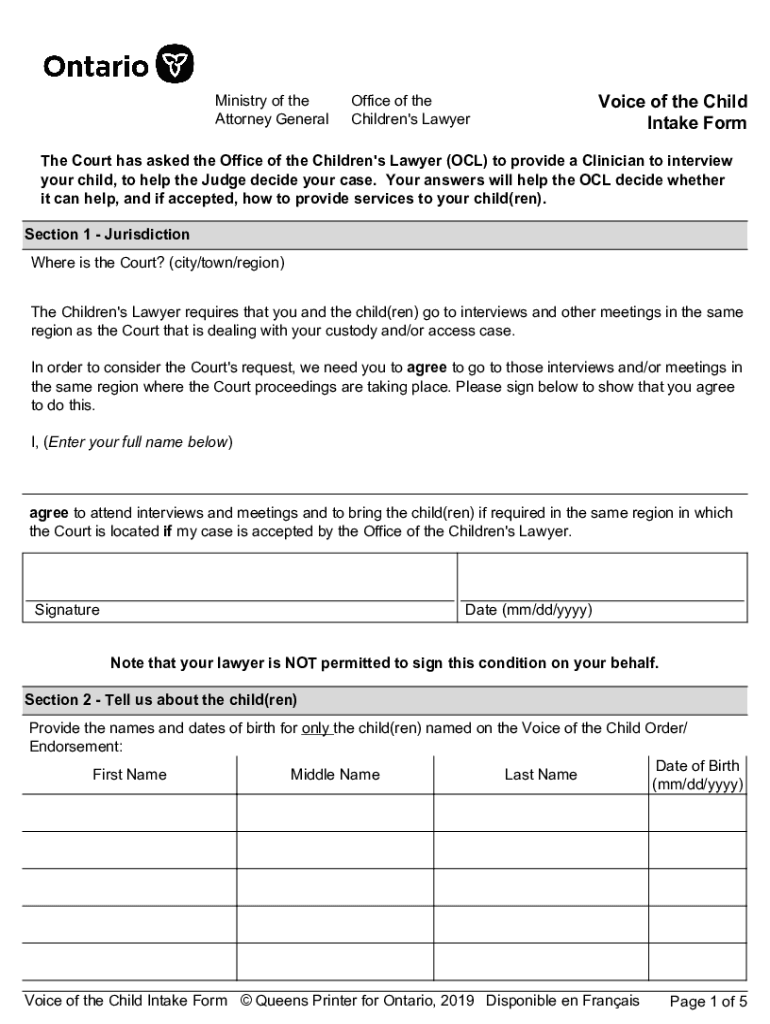







Definition and Meaning
The Voice of the Child Intake Form, used by Ontario Court Services, is a crucial document in legal proceedings concerning custody and access cases. This form is primarily utilized to collect detailed information about the children involved, ensuring their needs and perspectives are represented during the legal process. By documenting the child's background, family dynamics, current court proceedings, and any special needs, this form assists the Office of the Children's Lawyer (OCL) in crafting a supportive strategy for each child.
How to Use the Voice of the Child Intake Form
Understanding the steps to accurately complete the Voice of the Child Intake Form is essential for ensuring all necessary details are captured. Initially, gather comprehensive information about the child, including personal, familial, and educational details. Complete sections that cover the child's interactions with parents, siblings, and any significant adults in their lives. It’s beneficial to also capture any pertinent medical or psychological information that could impact the court’s decisions regarding custody and access.
Completing Family Dynamics Sections
- Identify key family members involved in the child's life.
- Describe the living arrangements and any changes in custody patterns.
- Highlight any instances of conflict or cooperation within the family that could affect the child.
Detailing Current Court Proceedings
- Outline the nature of the legal proceedings affecting the child.
- Include dates and outcomes of any previous court decisions related to custody or access.
- Document any ongoing legal actions and their potential impact on the child.
How to Obtain the Voice of the Child Intake Form
The Voice of the Child Intake Form can be obtained through multiple channels. It is available directly from Ontario Court Services offices or can be requested via their official website. For those in the U.S., accessing the form might involve contacting Canadian authorities through legal representatives. It's crucial to ensure that the most current version of the form is used to comply with any recent updates to court procedures.
Key Elements of the Voice of the Child Intake Form
The form contains several crucial sections designed to comprehensively outline the needs and status of the child:
- Child's Background: Personal and educational details, including age, school performance, and any special education needs.
- Family History: Information about the child's family, including parents, siblings, and extended family involvement.
- Health Needs: Any medical issues, allergies, or psychological evaluations that are relevant to custody decisions.
- Current Legal Context: Details about ongoing custody disputes, visitation arrangements, and any legal orders currently in place.
Important Terms Related to the Form
- Custody: Legal right to make decisions about the child's welfare.
- Access: Visitation rights of non-custodial parents or guardians.
- OCL: Office of the Children's Lawyer, responsible for representing children's interests in legal matters.
Steps to Complete the Voice of the Child Intake Form
Completing the form involves a series of methodical steps to ensure accuracy and completeness:
- Collect Information: Gather all necessary documents pertaining to the child's background and family.
- Fill Personal Details: Start with sections regarding the child's biodata and educational information.
- Complete Family Dynamics: Provide a thorough account of family interactions and living arrangements.
- Detail Health and Special Needs: Clearly document any medical or psychological needs.
- Outline Legal Context: Include current and past court proceedings relevant to the child's welfare.
- Review and Verify: Double-check all entries for accuracy and completeness before submission.
Who Typically Uses the Voice of the Child Intake Form
Primarily, the form is used by child welfare professionals, legal representatives, and family court officials. It also serves as a guide for non-custodial parents aiming to understand and present the child's perspective effectively in court. The OCL uses the information to inform their legal advocacy on behalf of the child.


Legal Use of the Voice of the Child Intake Form
In legal settings, the Voice of the Child Intake Form is instrumental in:
- Ensuring that the child's voice is considered in custody and access decisions.
- Providing the court with a structured, detailed account of the child's current situation.
- Assisting legal professionals in advocating for arrangements that serve the child's best interests.
Examples of Using the Voice of the Child Intake Form
Consider a scenario where a custody dispute arises between a child's separated parents. The form enables each party to provide critical insights into the child's relationship with each parent, detailing how different living arrangements might affect their wellbeing. Legal professionals can use this information to propose custody arrangements that prioritize the child's stability and development.
Real-World Application
- A social worker uses the form to document a meeting with the child, capturing insights that guide the court's decision-making.
- A legal guardian inputs health and education records into the form to highlight specific needs that must be addressed in custody agreements.
State-Specific Rules for the Voice of the Child Intake Form
While the form itself is standardized across Ontario, the manner in which it is utilized can vary based on state-specific legal guidelines in the U.S. Any hormonal influences on custody and access disputes require awareness of these differences to ensure the form is used effectively and in compliance with involved jurisdictions.




