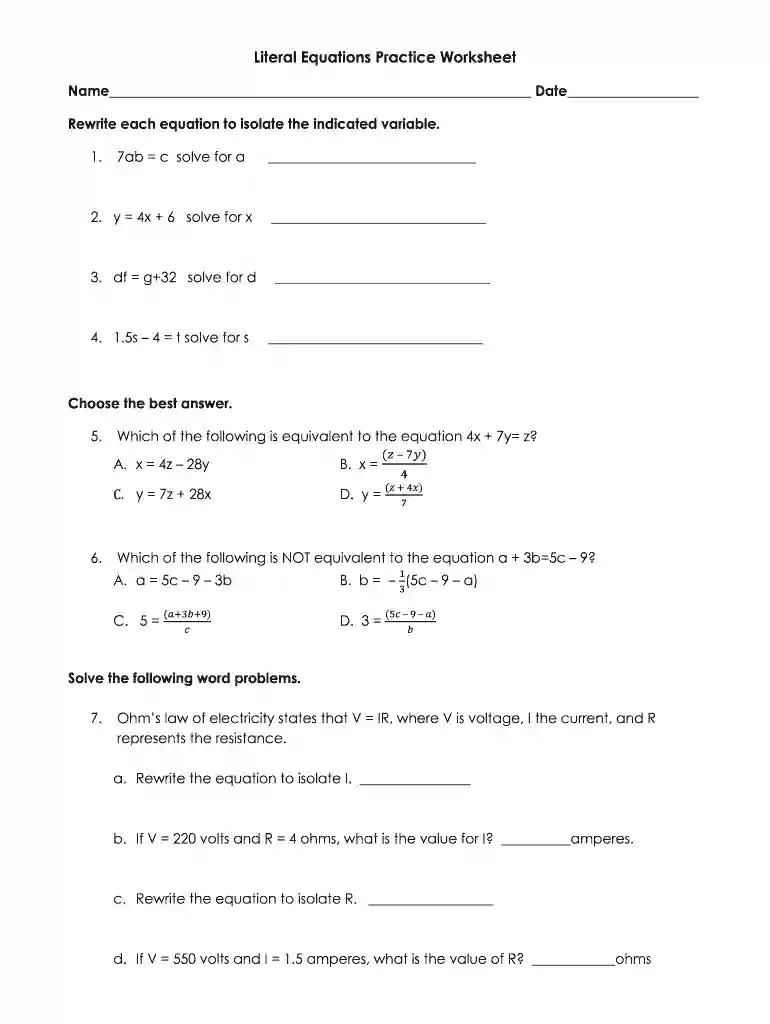
Literal equations practice worksheet answers 2026

Get Form
literal equations practice worksheet Preview on Page 1

Here's how it works

01. Edit your literal equations practice worksheet online
Type text, add images, blackout confidential details, add comments, highlights and more.

02. Sign it in a few clicks
Draw your signature, type it, upload its image, or use your mobile device as a signature pad.

03. Share your form with others
Send literal equations practice via email, link, or fax. You can also download it, export it or print it out.

Definition & Meaning

A literal equations practice worksheet is a mathematical tool used to enhance students' skills in solving equations where the goal is to isolate specific variables. This type of worksheet often involves algebraic manipulation to rewrite equations in different forms, making it an essential part of learning in algebra courses. These worksheets challenge students to apply their understanding of equivalent equations and algebraic identities, enabling them to solve for specific variables in a variety of contexts, such as in equations derived from science or economics.

Key Elements of Literal Equations Practice Worksheets

Literal equations practice worksheets typically include several key components:

  • Equation Varieties: Problems may range from simple linear equations to more complex ones involving multiple variables.
  • Application Scenarios: Inclusion of real-world examples, such as using Ohm’s Law for physics problems or cost calculations in economics, helps demonstrate the practical application of solving literal equations.
  • Step-by-Step Problems: Structured problems that build complexity gradually, helping students develop their problem-solving skills systematically.
  • Answer Section: A dedicated part of the worksheet providing detailed solutions to each problem. This helps students verify their work and understand the correct methods for isolating variables.

How to Use the Literal Equations Practice Worksheet Answers

Using literal equations practice worksheet answers effectively requires understanding the logic behind each problem solution. Here’s how students can make the most of it:

  1. First Attempt: Try solving each equation on your own before consulting the answers to encourage independent problem-solving.
  2. Verify Solutions: Compare your answers with the provided solutions to identify areas of strength and aspects that require further practice.
  3. Study Mistakes: Analyze any discrepancies between your solutions and the answer sheet to understand common pitfalls or misconceptions.
  4. Practice Revision: Regularly revisit completed worksheets, using the answer guide as a tool for review and reinforcing your understanding of the material.

Examples of Using the Literal Equations Practice Worksheet Answers

Scenario 1: Solving a Resistance Equation

  • Problem: Use Ohm’s Law, (V = IR), where you need to solve for (R).
  • Solution: Rearrange to (R = \frac{V}{I}).
  • Answer Verification: The worksheet answer confirms (R = \frac{V}{I}), validating the method of isolating the resistance variable.

Scenario 2: Calculating Total Cost

  • Problem: Re-work the equation (C = mx + b) to find (x).
  • Solution: Rearrange to (x = \frac{C-b}{m}).
  • Answer Verification: Confirmed by consulting the worksheet and ensuring proper steps in algebraic manipulation are followed.

Steps to Complete the Literal Equations Practice Worksheet Answers

  1. Understand the Instructions: Read through each problem carefully, noting the specific variable to solve for.
  2. Set Up the Equations: Identify known and unknown variables; use algebraic operations to isolate the target variable.
  3. Perform Algebraic Manipulations: Follow mathematical rules to rearrange the equation, employing addition, subtraction, multiplication, division, or factoring as necessary.
  4. Check Work: After solving each equation, cross-reference with the worksheet answers to ensure accuracy and understanding.
  5. Practice: Use additional problems or variations not covered by the worksheet to reinforce skills.

Why You Should Use Literal Equations Practice Worksheet Answers

Utilizing literal equations practice worksheet answers offers several benefits:

  • Enhanced Understanding: Deepens comprehension of algebraic principles by illustrating correct solutions.
  • Self-Assessment: Provides a benchmark to measure learning progress and identify areas for improvement.
  • Confidence Building: Reinforces successful problem-solving strategies, boosting confidence in handling complex problems.
  • Preparation for Advanced Topics: Lays groundwork for tackling higher-level mathematics subjects, like calculus or statistics.

Who Typically Uses Literal Equations Practice Worksheet Answers

  • Students: Primarily used by high school or college students enrolled in algebra courses seeking to improve their equation-solving skills.
  • Educators: Teachers use these worksheets to provide structured practice and verify students' understanding of algebraic concepts.
  • Tutors: Private tutors may utilize worksheets to tailor sessions to specific student needs, focusing on areas of difficulty.
  • Self-Learners: Individuals engaged in independent study to expand their mathematics knowledge or prepare for standardized tests.

Important Terms Related to Literal Equations Practice Worksheet Answers

  • Algebraic Manipulation: The process of rewriting equations to isolate a variable, typically involving arithmetic operations.
  • Equivalent Equations: Different forms of an equation that possess the same solution.
  • Variable Isolation: The act of solving an equation for one variable in terms of others.
  • Real-World Applications: Using mathematical equations to solve practical problems from disciplines like physics, economics, or engineering.

Software Compatibility

For those considering digital resources, DocHub provides flexibility in handling your document needs. While literal equations practice worksheets are mainly offline educational tools, digital versions could be compatible with platforms like DocHub, allowing easy annotation and distribution among students. This compatibility streamlines educational processes, facilitating collaborative learning and convenient access to worksheet answers.

be ready to get more

Complete this form in 5 minutes or less

Get form

Got questions?

We have answers to the most popular questions from our customers. If you can't find an answer to your question, please contact us.
Contact us
y=4 is not a literal equation because it contains only one variable, y, and does not express a relationship between multiple variables.
Steps to solve literal equations are: Identify the variable that you want to have alone. Treat all other variables/letters as numbers. Add, subtract, or multiply by a variable. You can also divide by a variable as long as it is never zero. Use all of the rules of algebra that we use to solve algebraic equations.
Literal equations can be tough because less numbers are used. However, you solve these equations exactly the same way, you may just have more variables in your final answer.
The answer is no. The classic example is the general quintic equation. The equation x5 x + 1 = 0 is a specific equation whose solutions cannot be expressed in terms of a formula using only addition, subtraction, multiplication, division, powers, and roots.
0:08 1:44 We now have P equals on the right X - Z the equation is now solve for P. And we are finished.MoreWe now have P equals on the right X - Z the equation is now solve for P. And we are finished.

Security and compliance

At DocHub, your data security is our priority. We follow HIPAA, SOC2, GDPR, and other standards, so you can work on your documents with confidence.

Learn more
ccpa2
pci-dss
gdpr-compliance
hipaa
soc-compliance

People also ask

Literal equations can be tough because less numbers are used. However, you solve these equations exactly the same way, you may just have more variables in your final answer. I know that in your Math studies, you have come across numerous formulas. Most of these formulas have probably involved geometry!

Related links