




01. Edit your form online
Type text, add images, blackout confidential details, add comments, highlights and more.

Type text, add images, blackout confidential details, add comments, highlights and more.

Draw your signature, type it, upload its image, or use your mobile device as a signature pad.

Send it via email, link, or fax. You can also download it, export it or print it out.
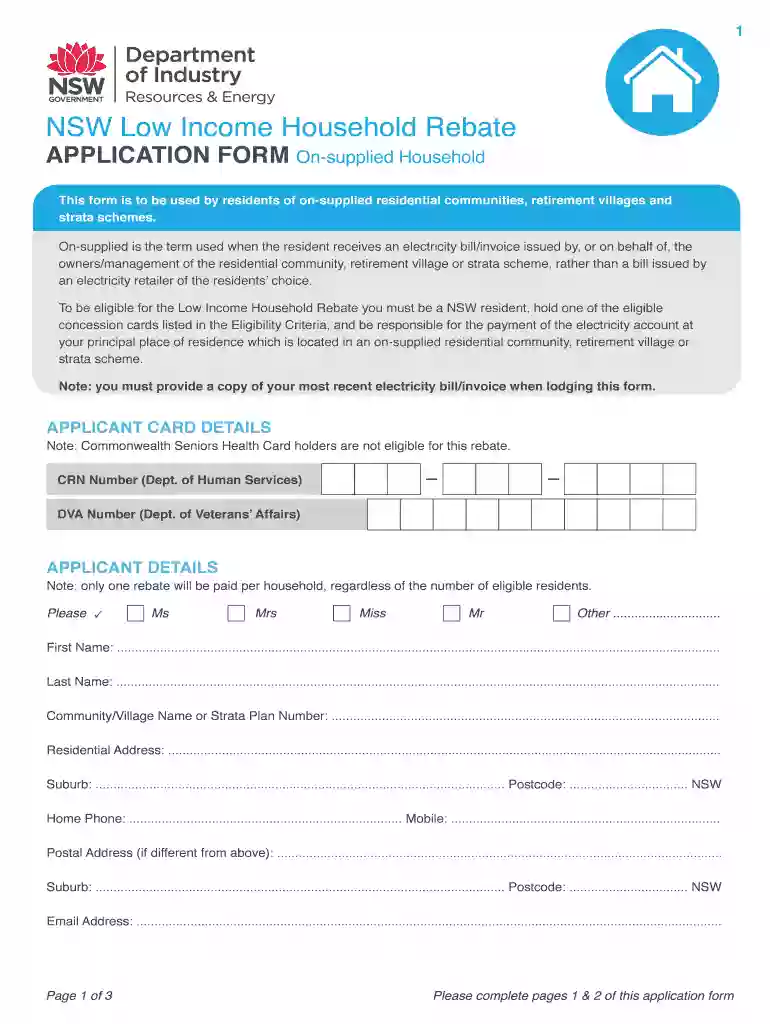
The NSW Low Income Household Rebate Application Form is specifically designed for residents living in on-supplied residential communities, retirement villages, and strata schemes in New South Wales, Australia. This form aims to provide financial relief on electricity bills to eligible low-income households, making it crucial for those seeking assistance in energy costs.
To qualify for the NSW Low Income Household Rebate, applicants must meet specific requirements. Key eligibility criteria include:
These criteria ensure that assistance is directed toward households that need financial relief with their energy expenses.


The application form can be obtained through multiple channels to accommodate varied preferences:
Providing multiple access points ensures that applicants can choose the method most convenient for them.
Completing the application form requires careful attention to detail:
Following these steps ensures a complete and accurate submission, reducing the chances of delays.
Critical components of the form include:
These elements are designed to gather essential information necessary for processing applications accurately and efficiently.
Submitting necessary documents alongside the application is crucial:
Submissions without these documents risk rejection, underscoring the importance of completeness in application packs.
The application process involves submission and waiting for approval:
Understanding the timeline helps manage expectations and plan accordingly.
Regulations may vary across different Australian states, but for New South Wales:
These specific rules ensure that the rebate aligns with state needs and priorities, providing adequate support to those qualifying.
Submission methods are flexible to cater to different needs:
Ensuring multiple submission avenues enhances accessibility, making sure applicants can choose appropriately based on their circumstances.
At DocHub, your data security is our priority. We follow HIPAA, SOC2, GDPR, and other standards, so you can work on your documents with confidence.
by M Dell 2015 The low income household rebate provides around $235-258 a year to eligible households and can be combined with the family energy rebate.
by EJ Callander 2023 Cited by 48 The amount paid by households on health care in Australia was estimated to be $3200 in 2014, with out‐of‐pocket fees per health care service rising over time.Read more


