Hazard Identification, Risk Assessment and Control Plan template 2026

Get Form
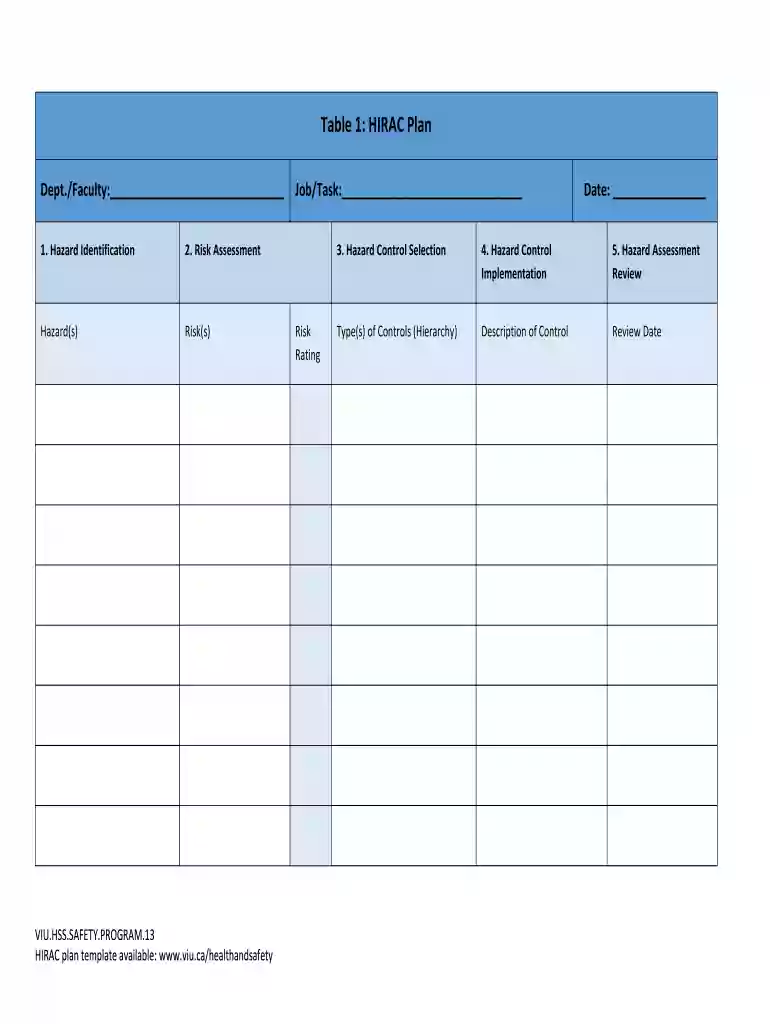
Hazard Identification, Risk Assessment and Control Plan template Preview on Page 1

Here's how it works

01. Edit your form online
Type text, add images, blackout confidential details, add comments, highlights and more.

02. Sign it in a few clicks
Draw your signature, type it, upload its image, or use your mobile device as a signature pad.

03. Share your form with others
Send it via email, link, or fax. You can also download it, export it or print it out.

Definition and Meaning

The Hazard Identification, Risk Assessment, and Control (HIRAC) plan template is a structured document designed to help organizations systematically identify workplace hazards, assess the associated risks, and implement appropriate control measures. This template serves as a critical tool in ensuring safety in work environments by outlining the steps necessary to recognize potential dangers and mitigate them effectively. By adhering to a structured HIRAC plan, businesses can work towards creating safer workplaces, thereby reducing the probability of accidents or incidents.

Key Components of HIRAC

  • Hazard Identification: This involves recognizing potential sources of harm or situations that could cause injury or illness in the workplace.
  • Risk Assessment: Evaluating the likelihood and potential impact of identified hazards to prioritize actions.
  • Control Measures: Developing strategies to eliminate or minimize risks, including engineering controls, administrative changes, and personal protective equipment.

How to Use the Hazard Identification, Risk Assessment and Control Plan Template

Using the HIRAC plan template involves a series of well-defined steps to ensure comprehensive risk management. The template serves as a guide, ensuring all necessary aspects of hazard identification and risk assessment are addressed systematically.

Step-by-step Guide

  1. Initial Review: Familiarize yourself with the workplace processes and layout.
  2. Identify Hazards: List all potential hazards within each work process or environment.
  3. Assess Risks: For each hazard, determine the risk level using a risk matrix considering both likelihood and severity.
  4. Implement Controls: Select and apply appropriate control measures based on the risk level. Prioritize measures that eliminate risks at their source.
  5. Monitor and Review: Continually monitor the efficacy of control measures and adjust as necessary.

Steps to Complete the Hazard Identification, Risk Assessment and Control Plan Template

Completing the HIRAC plan template involves detailed attention to each section of the form. The process ensures that all potential worksite hazards are effectively managed.

Detailed Process

  1. Gather Information: Collect data on workplace operations, previous incident reports, and safety protocols.
  2. Team Collaboration: Engage employees from different departments to provide insights during hazard identification.
  3. Document Findings: Clearly record all identified hazards and associated risks in the template.
  4. Prioritize Risks: Assign risk levels to hazards and prioritize based on potential impact.
  5. Develop Action Plans: Outline specific steps and resources required for implementing each control measure.
  6. Assign Responsibilities: Identify personnel responsible for implementing and monitoring control measures.

Key Elements of the Hazard Identification, Risk Assessment and Control Plan Template

The HIRAC plan template contains several critical sections that guide an organization through the process of creating a safer work environment.

Critical Sections

  • Hazard Description: Detailed account of each identified hazard.
  • Risk Evaluation: Analysis of risk levels associated with each hazard.
  • Control Strategies: Proposed methods to mitigate identified risks.
  • Implementation Timeline: Schedule for the application of control measures.
  • Monitoring and Evaluation: Plans for ongoing assessment of the control measures’ effectiveness.

Who Typically Uses the Hazard Identification, Risk Assessment and Control Plan Template

The HIRAC plan template is crucial for various industries and organizational roles. It is widely used across sectors where workplace safety is a critical concern.


decoration image ratings of Dochub

Potential Users

  • Safety Officers: Responsible for workplace health and safety compliance.
  • Managers and Supervisors: Implement control measures and ensure team adherence.
  • Human Resources Personnel: Coordinate training and safety policy development.
  • Employees: Contribute insights into potential hazards and compliance with safety protocols.

Why You Should Use the Hazard Identification, Risk Assessment and Control Plan Template

Utilizing the HIRAC plan template provides multiple benefits to an organization, primarily focusing on maintaining a safe workplace and protecting employees.

Benefits Overview

  • Regulatory Compliance: Ensures alignment with occupational safety regulations and standards.
  • Accident Prevention: Proactively identifies and mitigates potential hazards, reducing accident likelihood.
  • Cost Efficiency: Minimizes expenses related to workplace incidents and insurance claims.
  • Enhanced Safety Culture: Encourages a proactive approach to workplace safety among employees and management.

Important Terms Related to the Hazard Identification, Risk Assessment and Control Plan Template

Understanding the terminology related to the HIRAC process is crucial for accurate implementation and communication across the organization.

Terminology Breakdown

  • Hazard: A potential source of harm or adverse health effect to individuals in the workplace.
  • Risk: The combination of the likelihood of an occurrence of a hazardous event and its consequences.
  • Control Measure: Actions or processes applied to reduce or eliminate health and safety risks.

Legal Use of the Hazard Identification, Risk Assessment and Control Plan Template

The legal framework surrounding the HIRAC process is significant, ensuring employer compliance with health and safety laws.

Legal Compliance Guidelines

  • Occupational Safety and Health Administration (OSHA) Requirements: Ensure that HIRAC processes meet or exceed OSHA standards for workplace safety.
  • Record Keeping: Maintain documentation of the HIRAC plan and associated actions as evidence of compliance.
  • Employee Rights: Facilitate an environment where workers are informed of potential hazards and involved in safety discussions.

These comprehensive guidelines ensure the effective application of the HIRAC plan template within an organization, promoting a culture of safety and compliance.

be ready to get more

Complete this form in 5 minutes or less

Get form

Got questions?

We have answers to the most popular questions from our customers. If you can't find an answer to your question, please contact us.
Contact us
5 Step Approach to Hazard Identification and Risk Assessment (HIRA): Step 1: Look for Hazards. Step 2: Decide who might be harmed, and how. Step 3: Evaluate the risks and decide if current precautions are adequate or need improvement. Step 4: Record your findings. Step 5: Review your assessment and revise it if necessary.
While both processes emphasize the importance of safety, the key difference lies in their focus JSA is task-specific and often focused on procedural safety, while risk assessment looks at an organizations holistic safety profile, including systemic issues and overall risk management strategies.
A risk assessment is a thorough look at your workplace to identify those things, situations, processes, etc. that may cause harm, particularly to people. After the identification of a hazard, it should be reviewed to determine how likely and severe the potential harm is.
Hazard Identification, Risk Assessment and Control (HIRAC) is a critical element of any safety and health program. It is the proactive continuous improvement and communication of hazards to prevent or control workplace injuries, illnesses, and incidents.

Security and compliance

At DocHub, your data security is our priority. We follow HIPAA, SOC2, GDPR, and other standards, so you can work on your documents with confidence.

Learn more
ccpa2
pci-dss
gdpr-compliance
hipaa
soc-compliance