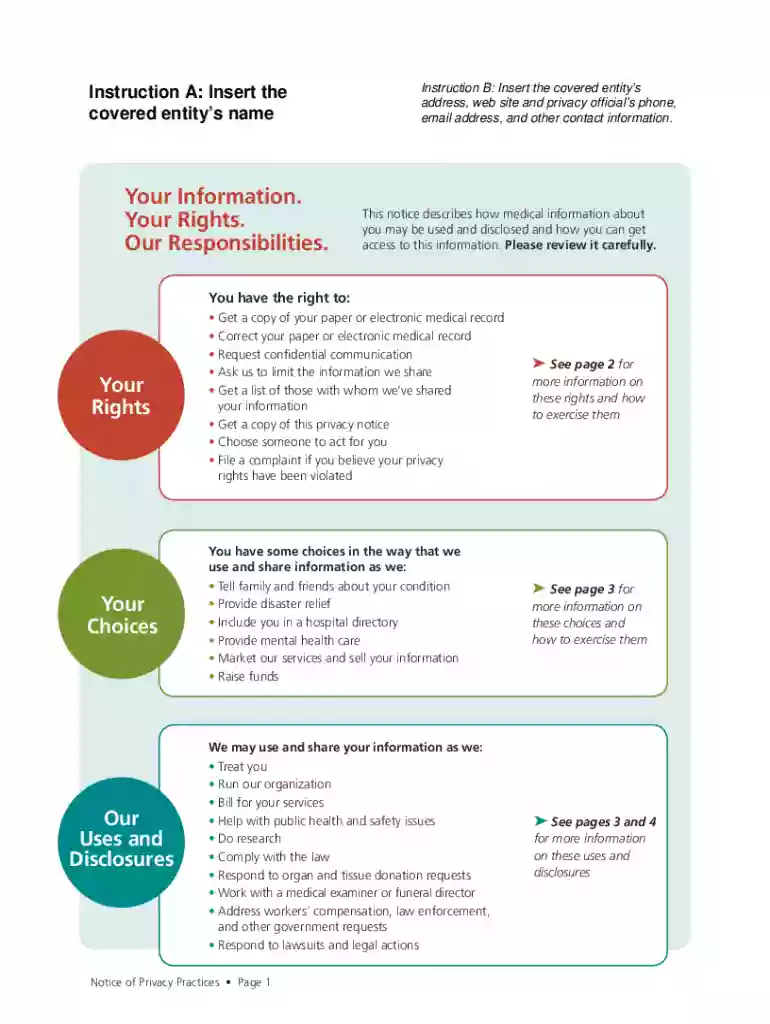
MODEL NOTICES OF PRIVACY PRACTICES QUESTIONS AND - hhs 2026

Get Form
MODEL NOTICES OF PRIVACY PRACTICES QUESTIONS AND - hhs Preview on Page 1

Here's how it works

01. Edit your form online
Type text, add images, blackout confidential details, add comments, highlights and more.

02. Sign it in a few clicks
Draw your signature, type it, upload its image, or use your mobile device as a signature pad.

03. Share your form with others
Send it via email, link, or fax. You can also download it, export it or print it out.

Definition & Meaning

Model Notices of Privacy Practices (NPP) are templates designed to help covered entities comply with the Health Insurance Portability and Accountability Act (HIPAA) by informing patients about their privacy rights and how their health information may be used or disclosed. These notices serve as a communication tool to ensure transparency between healthcare providers and patients about privacy practices, thereby fulfilling legal obligations and enhancing trust.

Purpose and Importance

  • Transparency: Provides clear information about the use and disclosure of personal health information.
  • Compliance: Helps entities adhere to HIPAA regulations, avoiding legal issues.
  • Patient Rights: Educates patients about their rights concerning their medical data.

How to Use the MODEL NOTICES OF PRIVACY PRACTICES QUESTIONS AND - HHS

Understanding how to effectively implement the NPP ensures both compliance and clarity for patients. Covered entities should tailor the model notice to reflect their specific practices while ensuring all requisite information is included.

Implementation Steps

  1. Customization: Modify the model notice to match the specific practices and policies of your organization.
  2. Distribution: Provide the notice to new patients upon their first service visit and make a copy available at each subsequent appointment.
  3. Acknowledgment: Request a signed acknowledgment from patients confirming they have received the notice.

How to Obtain the MODEL NOTICES OF PRIVACY PRACTICES QUESTIONS AND - HHS

Obtaining the model notices is a straightforward process that can be managed online, saving entities time and resources.

Access Routes

  • Official Website: Visit the Health and Human Services (HHS) website to download the latest version of the model notices.
  • Organization's Compliance Officer: Often, the compliance officer will have access to or knowledge about where to obtain these notices.

Steps to Complete the MODEL NOTICES OF PRIVACY PRACTICES QUESTIONS AND - HHS

Completing the notice requires attention to detail and understanding of both the entity's practices and HIPAA guidelines.

Completion Process

  1. Review HIPAA Requirements: Familiarize yourself with the essential components required by HIPAA for the notice.
  2. Fill Personalization: Include your organization’s specific practices and contact information in the designated sections.
  3. Verify Legal Accuracy: Consult with legal counsel to ensure the completed notice meets all federal and state laws.

Who Typically Uses the MODEL NOTICES OF PRIVACY PRACTICES QUESTIONS AND - HHS

Various healthcare providers and entities utilize these notices to maintain compliance and communicate effectively with patients.


decoration image ratings of Dochub

Common Users

  • Hospitals: To inform patients upon admission.
  • Clinics and Physician Offices: For patient check-ins and ongoing care.
  • Pharmacies: When handling prescriptions and patient consultations.
decoration image

Key Elements of the MODEL NOTICES OF PRIVACY PRACTICES QUESTIONS AND - HHS

A thorough understanding of key elements ensures the model notice covers all necessary information.

Vital Components

  • Description of Uses and Disclosures: Clarifies how health information may be used and shared.
  • Patient Rights Section: Outlines rights such as access to records and requesting corrections.
  • Legal Obligations: Details the entity's responsibilities under HIPAA.

State-Specific Rules for the MODEL NOTICES OF PRIVACY PRACTICES QUESTIONS AND - HHS

While the model notices provide a federal guideline, state-specific rules may add additional requirements for compliance.

Considerations

  • State Privacy Laws: Some states have stricter privacy laws that may require more information or advanced privacy practices.
  • Regular Updates: Entities must stay informed about changes in state laws that affect privacy practices.

Legal Use of the MODEL NOTICES OF PRIVACY PRACTICES QUESTIONS AND - HHS

Understanding the legal context is crucial for the proper deployment and utilization of the notices.

Legal Framework

  • HIPAA Compliance: Ensures adherence to federal laws protecting patient health information.
  • Breach Notifications: Provides a clear procedure for notifying patients of any data breach.

Examples of Using the MODEL NOTICES OF PRIVACY PRACTICES QUESTIONS AND - HHS

Real-world applications help solidify understanding and practical implementation.

Practical Scenarios

  • Hospital Admission: Use the notice to educate patients during the check-in process.
  • Online Portals: Offer the notice through patient portals where patients can view or download their privacy practices.

Important Terms Related to MODEL NOTICES OF PRIVACY PRACTICES QUESTIONS AND - HHS

Familiarity with related terminology enhances comprehension of the notice's contents and implications.

Key Terms

  • PHI (Protected Health Information): Any information about health status or healthcare provision.
  • Breach Notification Rule: Mandates that entities notify patients in the event of a data breach.

Penalties for Non-Compliance

Failure to properly implement and adhere to NPP requirements can result in significant penalties, highlighting the importance of compliance.

Consequences

  • Fines: Entities may face heavy fines for non-compliance with HIPAA regulations.
  • Reputational Damage: Loss of patient trust and reputation can be more damaging in the long term than financial penalties.
be ready to get more

Complete this form in 5 minutes or less

Get form

Got questions?

We have answers to the most popular questions from our customers. If you can't find an answer to your question, please contact us.
Contact us
The HIPAA Privacy Rule requires a covered health care provider with direct treatment relationships with individuals to give the notice to every individual no later than the date of first service delivery to the individual and to make a good faith effort to obtain the individuals written acknowledgment of receipt of
Additionally, in order to be HIPAA compliant the HIPAA Notice of Privacy Practices must include a statement explaining that the covered entity is required by law to protect the privacy of PHI, that the covered entity will notify the individual if a breach occurs that compromises the privacy of PHI, and that it will
552a(e)(3), agencies are required to provide what is commonly referred to as a Privacy Act Statement to all persons asked to provide personal information about themselves, which will go into a system of records (i.e., the information will be stored and retrieved using the individuals name or other personal
The Privacy Rule protects all individually identifiable health information held or transmitted by a covered entity or its business associate, in any form or media, whether electronic, paper, or oral. The Privacy Rule calls this information protected health information (PHI).
The Notice of Privacy Practices form must be given to patients. The notice must describe how the covered entity (CE) may and may not use protected health information (PHI), and what the patients rights and obligations with respect to the PHI are.

Security and compliance

At DocHub, your data security is our priority. We follow HIPAA, SOC2, GDPR, and other standards, so you can work on your documents with confidence.

Learn more
ccpa2
pci-dss
gdpr-compliance
hipaa
soc-compliance
be ready to get more

Complete this form in 5 minutes or less

Get form

People also ask

Once a covered entity knows or by reasonable diligence should have known (referred to as the date of discovery) that a breach of PHI has occurred, the entity has an obligation to notify the relevant parties (individuals, HHS and/or the media) without unreasonable delay or up to 60 calendar days following the date
The Privacy Act of 1974, as amended to present, including Statutory Notes (5 U.S.C. 552a), Protects records about individuals retrieved by personal identifiers such as a name, social security number, or other identifying number or symbol.

Related links