




01. Edit your form online
Type text, add images, blackout confidential details, add comments, highlights and more.

Type text, add images, blackout confidential details, add comments, highlights and more.

Draw your signature, type it, upload its image, or use your mobile device as a signature pad.

Send it via email, link, or fax. You can also download it, export it or print it out.
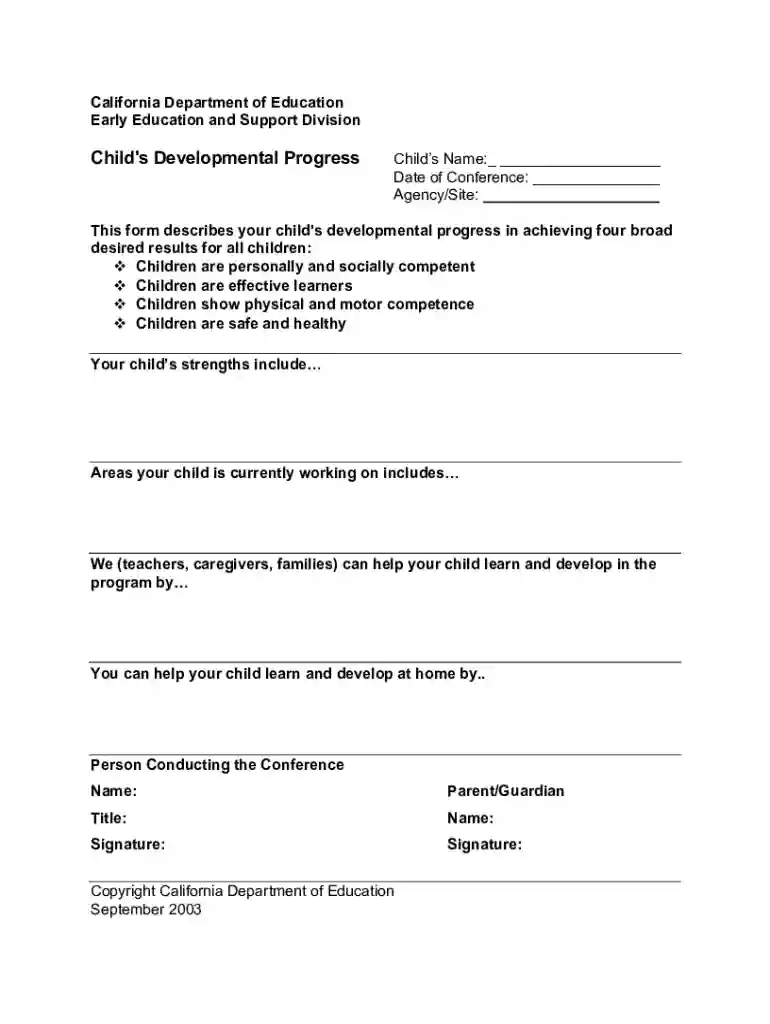
The Child's Development Progress Form is a valuable tool used by educators and caregivers to assess and document a child's growth and developmental milestones across various domains. This form aims to provide a comprehensive view of a child's progress in cognitive, emotional, social, and physical development. It is typically utilized in early childhood education settings to monitor and support a child's learning and development over time. The form helps create a structured approach to understanding each child's unique needs and strengths.
The form typically includes sections that evaluate different areas of a child's development:
Personal and Social Competence: Focuses on a child's ability to interact with peers and adults, display empathy, and participate in group activities.
Cognitive and Learning Skills: Assesses problem-solving abilities, attention span, and curiosity about the world.
Physical and Motor Skills: Evaluates gross and fine motor skills, including coordination, balance, and hand-eye coordination.
Safety and Health Awareness: Looks at a child's understanding and practice of safety rules and healthy habits.
These elements ensure a holistic review of a child's developmental trajectory and provide valuable insights for parents and educators.
Typically available through educational institutions such as preschools and early learning centers, the Child's Development Progress Form can also be accessed via local education departments. Some forms may be downloadable from official websites for personal use. When obtaining the form, ensure it complies with the relevant educational standards and guidelines of your state or region.
Completing the form involves several crucial stages:
Gather Observational Data: Collect detailed observations of the child's interactions and activities over a specific period.
Evaluate Developmental Areas: Assess each area of development using specified criteria or indicators provided in the form.
Document Strengths and Areas of Improvement: Clearly list areas where the child excels and those needing more support.
Consult with Other Caregivers: Collaborate with other educators or caregivers for a comprehensive evaluation.
Review and Finalize the Form: Double-check all entries for accuracy and completeness before final submission.
Using this form benefits educators and caregivers in multiple ways:
Tailored Educational Strategies: The form provides insights that help customize learning activities to a child's strengths and needs.
Early Intervention Opportunities: Identifies developmental delays or challenges that may require additional support or intervention.
Parental Involvement: Offers a structured way for parents to engage with educators about their child's development and discuss progress.
This form is primarily used by:
Early Childhood Educators: To assess and support learning in preschool settings.
Caregivers: In daycare centers to monitor developmental milestones.
Special Education Coordinators: For planning individualized support for children with additional needs.
Professionals using the form typically have some training in early childhood development, enabling them to complete evaluations accurately and thoughtfully.


Understanding key terminology is essential for accurate form completion:
Milestones: Significant points of development that show a child's growth, such as speaking their first word or taking their first steps.
Domains of Development: Areas including social, cognitive, physical, and emotional growth that provide a comprehensive picture of progress.
Indicators: Specific behaviors or skills used to measure development in each domain.
Familiarity with these terms assists educators and caregivers in accurately assessing a child’s development.
This form must adhere to legal and ethical standards related to child privacy and data handling. Typically guided by state and federal laws, the use of this form includes:
Confidentiality: Ensuring all recorded information is securely stored and only shared with relevant parties.
Parental Consent: Required for any evaluations conducted and for sharing results with third parties.
Adhering to these guidelines ensures the form is used responsibly and ethically, maintaining trust between parents and educational institutions.
At DocHub, your data security is our priority. We follow HIPAA, SOC2, GDPR, and other standards, so you can work on your documents with confidence.
Childs Developmental Progress (DOC) is designed to assess the progression of skills used forms by California Department of Education subsidized child care
Learn about developmental milestones, screening, and what to do if there is a concern. Download to track developmental milestones from 2 months through 5 years


