




01. Edit your balanced and unbalanced forces online
Type text, add images, blackout confidential details, add comments, highlights and more.

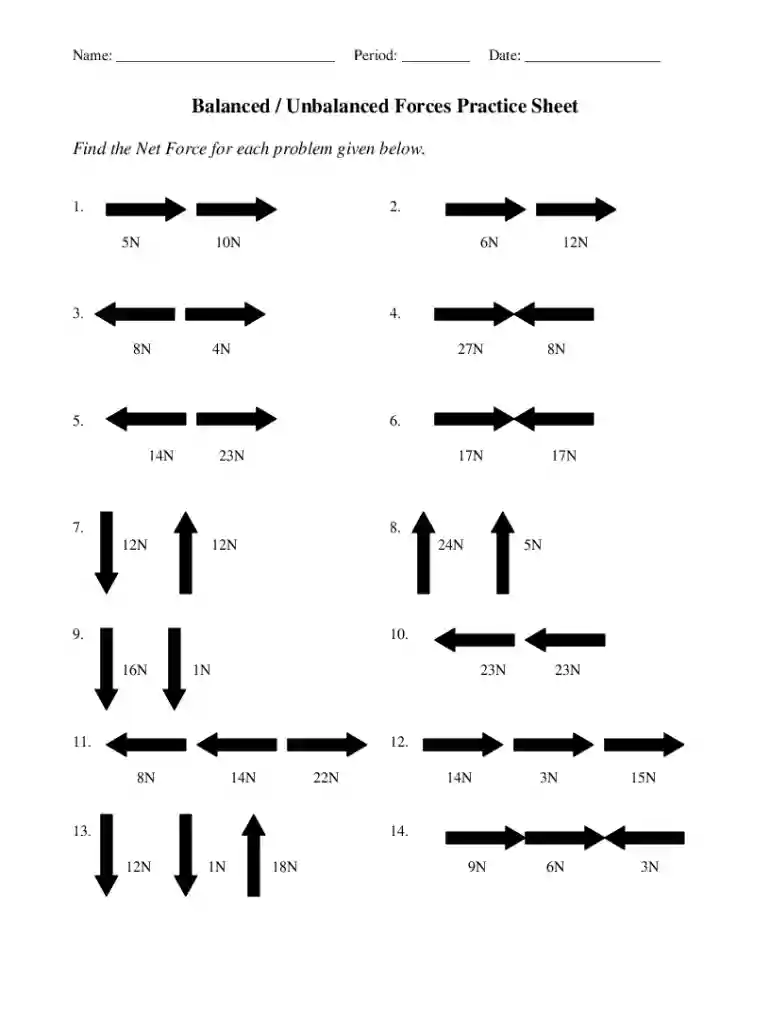
Type text, add images, blackout confidential details, add comments, highlights and more.

Draw your signature, type it, upload its image, or use your mobile device as a signature pad.

Send it via email, link, or fax. You can also download it, export it or print it out.
Balanced and unbalanced forces are crucial concepts in physics, particularly in understanding motion.
Balanced Forces: When two or more forces acting on an object are equal in size and opposite in direction, they are considered balanced. This results in no change in the object's state of motion. For instance, a book resting on a table experiences gravitational force pulling it down, balanced by the upward normal force from the table. As a result, the book remains stationary.
Unbalanced Forces: In contrast, unbalanced forces occur when the forces acting on an object are not equal. This imbalance causes the object to accelerate in the direction of the net force. A common example is a car accelerating when the forward force from the engine exceeds the resistive forces such as friction and air resistance.
Understanding these forces is essential for completing the "balanced and unbalanced forces worksheet 1 docx," as students learn to differentiate between scenarios where objects are in equilibrium versus those in motion.
The "balanced and unbalanced forces worksheet 1 docx" serves as a practical exercise for students to apply their understanding of forces in real-world contexts.
Identify Forces: Begin by reading the scenarios provided in the worksheet. Identify all the forces acting on the objects involved. This could involve weight, normal force, tension, and friction, among others.
Calculate Net Force: For each scenario, calculate the net force by considering the direction and magnitude of each force. If the forces balance, the net force is zero; if not, determine which force is greater and in what direction the object will move.
Draw Force Diagrams: For visualization, create free-body diagrams by representing the object and all acting forces with arrows. This helps clarify the relationships between the various forces involved.
Through these steps, students enhance their analytical skills and deepen their understanding of physics principles.
Obtaining the "balanced and unbalanced forces worksheet 1 docx" is straightforward.
Downloading: Visit the appropriate educational resource website where such worksheets are provided. Typically, these documents are free to download.
Printing Options: After downloading, you can print the worksheet for in-class use or homework to facilitate hands-on learning.
Shareable Links: If you are a teacher, consider sharing the document with students via email or a learning management system.
Being proactive in acquiring classroom materials enriches the learning experience and aids in comprehension.
Completing the worksheet involves a series of logical steps aimed at reinforcing the concepts learned.
Read Each Question Carefully: Take time to understand what is being asked and identify the forces involved in each scenario.
List the Forces: Write down each force acting on the object along with its direction. A clear list helps in visualizing the problem better.
Calculate the Net Force: Use the formula for net force, which takes into account both magnitude and direction. This may involve adding or subtracting forces depending on their alignment.
Determine Movement: Based on whether the forces are balanced or unbalanced, conclude the object's motion. If unbalanced, indicate the direction of acceleration.
Visual Representation: Drawing force diagrams can greatly assist in the understanding and final analysis, highlighting critical aspects of the forces in play.
Each of these steps promotes a structured approach to problem-solving in physics.
The "balanced and unbalanced forces worksheet 1 docx" includes several core components that enhance its educational value.
Various Scenarios: It encompasses a range of scenarios that challenge students to think critically about force interactions in both stationary and moving objects.
Problem-Solving Questions: The worksheet features problems that require students to determine net forces and directions, strengthening their physics comprehension.
Illustrative Diagrams: It might include spaces for students to draw force diagrams, encouraging them to visualize the concepts actively and engage with the material.
Answer Key: Some versions may provide an answer key for self-assessment, aiding in the learning process by allowing instant feedback.
Recognizing and utilizing these key elements is essential for maximizing the educational benefits of the worksheet.
Utilizing the "balanced and unbalanced forces worksheet 1 docx" can significantly enhance students' learning experiences.
Classroom Activities: Teachers can assign the worksheet after teaching the concepts of balanced and unbalanced forces, reinforcing lessons learned through practical application.
Group Work: Facilitate collaborative learning by having students work in pairs or small groups to discuss and solve the problems, which promotes communication and teamwork.
Homework Assignments: Assign the worksheet as homework to allow students to practice independently, solidifying their understanding of the concepts.
Incorporating diverse teaching methods utilizing the worksheet ensures comprehensive coverage of the topic while engaging students in various ways.
Understanding key terms is vital when discussing balanced and unbalanced forces.
Net Force: The overall force acting on an object after all individual forces are combined.
Equilibrium: A state where all forces are balanced, resulting in no acceleration.
Friction: A force that opposes motion, impacting the net force calculations in many scenarios.
Mass and Weight: Mass is the amount of matter in an object, while weight is the gravitational force acting on that mass.
Acceleration: The rate of change of velocity of an object, directly related to unbalanced forces.
Familiarity with these terms enhances clarity and comprehension of the material presented in the worksheet.
At DocHub, your data security is our priority. We follow HIPAA, SOC2, GDPR, and other standards, so you can work on your documents with confidence.


