




01. Edit your form online
Type text, add images, blackout confidential details, add comments, highlights and more.

Type text, add images, blackout confidential details, add comments, highlights and more.

Draw your signature, type it, upload its image, or use your mobile device as a signature pad.

Send it via email, link, or fax. You can also download it, export it or print it out.
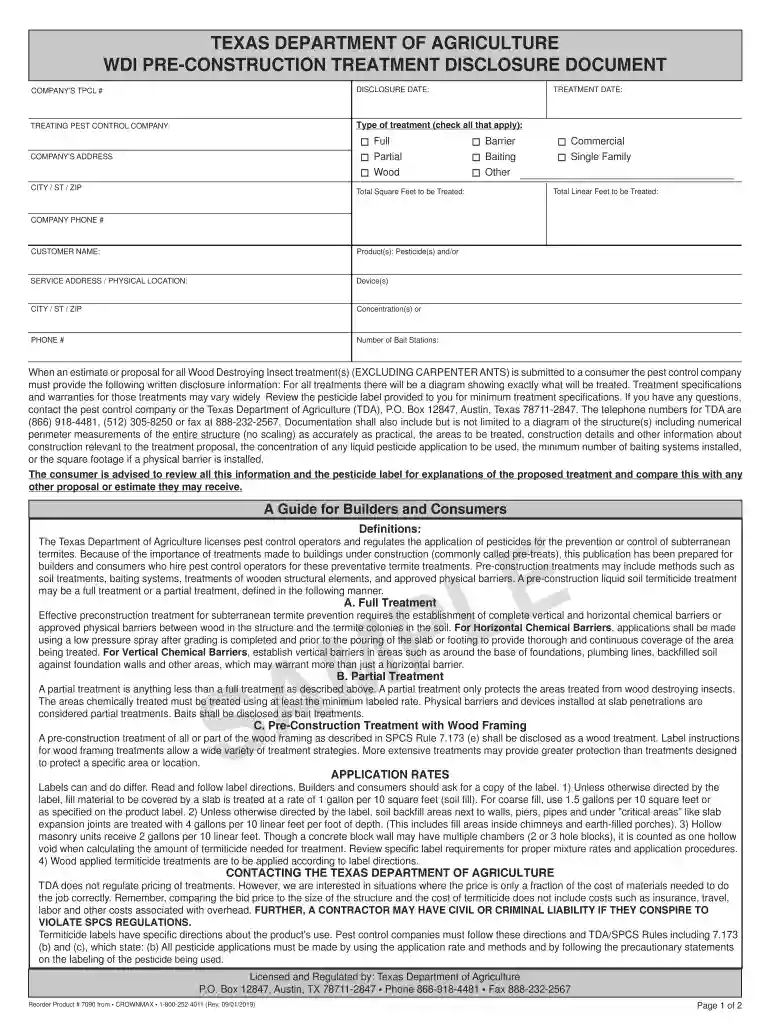
The Texas Department of Agriculture WDI Post-Construction form is a vital document used to document treatments for wood-destroying insects following construction, primarily focusing on termites. This form is essential for pest control companies and builders in ensuring that proper measures have been taken to prevent and treat potential termite infestations in newly constructed buildings. By completing this document, stakeholders affirm compliance with regulations and verify the effectiveness of treatment methods for protecting structural integrity.
To effectively use the WDI Post-Construction form, follow these essential steps:
Identify Necessary Parties: Determine the pest control company responsible for treatments and the construction entity to ensure proper documentation.
Complete Treatment Information: Record detailed information about the treatments applied, including methods used such as full or partial soil treatments, wood treatments, and any other preventative measures.
Provide Compliance Details: Ensure all recorded treatments align with state regulations and guidelines for post-construction interventions.
Sign and Distribute: Once complete, ensure all necessary parties, such as the pest control operator and construction manager, sign the documentation. Provide copies to relevant stakeholders, including property owners and regulatory bodies.
The WDI Post-Construction form can be obtained through several means:
Follow these detailed steps to complete the form effectively:
Gather Required Information: Collect data regarding the property, including address and owner details, along with pest treatment specifics.
Enter Treatment Details: Clearly specify the types of treatments applied, such as chemical barriers or bait systems, including the application date and product used.
Verify Compliance: Cross-check that all treatments and documentation meet Texas state regulations and standards for pest control post-construction.
Review and Sign: Confirm accuracy with all involved parties, ensuring that each signs the document to validate the information.
Submit for Approval: Forward the completed form to relevant regulatory bodies or stakeholders, as required by law.
Several key elements are critical in the WDI Post-Construction form:
Texas state regulations dictate specific requirements for post-construction termite treatments to ensure compliance:
Real-world applications of this form include:
Failure to properly complete or submit the WDI Post-Construction form can result in significant repercussions:
Utilizing digital versions of the form has become increasingly popular due to:
For those using digital forms, various software solutions support completing the WDI Post-Construction form:
We've got more versions of the Texas Department of Agriculture WDI Post-Construction form. Select the right Texas Department of Agriculture WDI Post-Construction version from the list and start editing it straight away!
| Versions | Form popularity | Fillable & printable |
|---|---|---|
| 2019 | 4.8 Satisfied (48 Votes) |
At DocHub, your data security is our priority. We follow HIPAA, SOC2, GDPR, and other standards, so you can work on your documents with confidence.
(a) All pesticides used for post construction termite treatments must be registered with the Environmental Protection Agency and the department.Read more
WDI Post-Construction Disclosure Sample Form, Download File, Termite/Fumigation Applications Forms. WDI Pre-Construction Disclosure Sample Form, Download FileRead more


