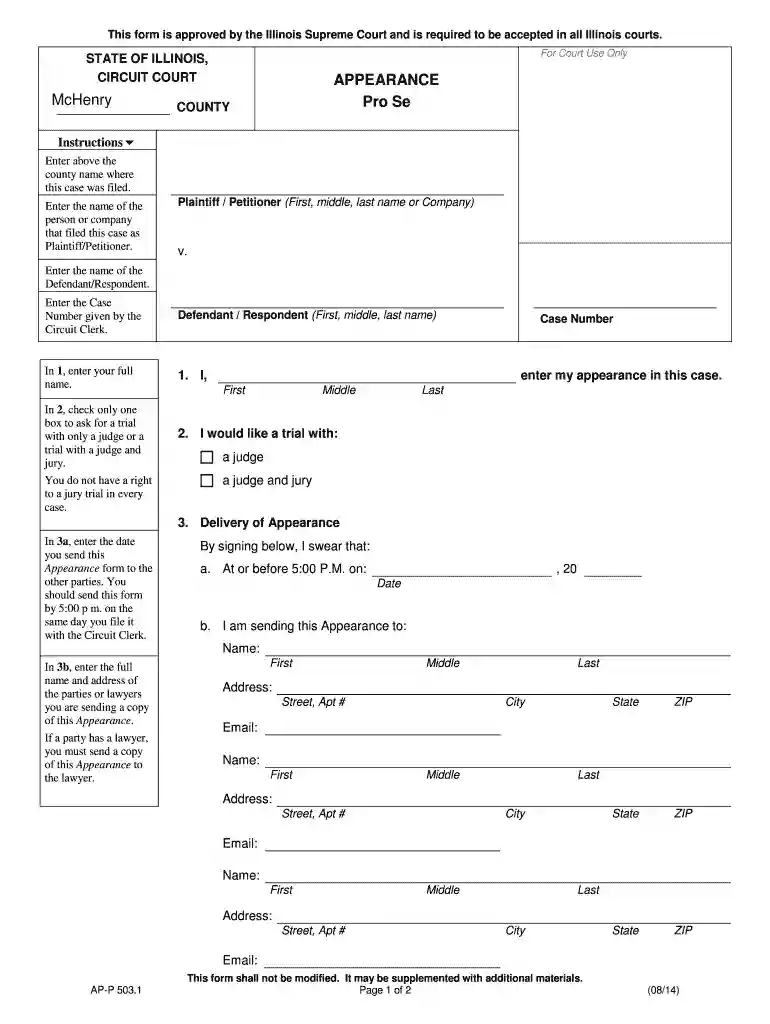
Illinois Statewide Forms - APPROVED - Appearance Pro Se AP-P503 1 2026

Get Form
Illinois Statewide Forms - APPROVED - Appearance Pro Se AP-P503 1 Preview on Page 1

Here's how it works

01. Edit your form online
Type text, add images, blackout confidential details, add comments, highlights and more.

02. Sign it in a few clicks
Draw your signature, type it, upload its image, or use your mobile device as a signature pad.

03. Share your form with others
Send it via email, link, or fax. You can also download it, export it or print it out.

Definition and Meaning

The Illinois Statewide Forms - APPROVED - Appearance Pro Se AP-P503 1 is an official legal document sanctioned by the Illinois Supreme Court. This form is essential for individuals who elect to represent themselves, known legally as Pro Se, in a court case within the state of Illinois. By filling out this form, the self-representing party formally informs the court and other parties involved that they are handling their legal representation. Key details provided include the case number, names of the involved parties (plaintiff/defendant), and preferences for the type of trial. This form is critical because it officially enters the individual into court records as their own legal representative.

How to Use the Illinois Statewide Forms - APPROVED - Appearance Pro Se AP-P503 1

When utilizing the Appearance Pro Se AP-P503 1 form, you need to provide accurate personal and case-related information. The following steps guide the process:

  1. Accurate Identification: Clearly input your full name, contact information, and address.
  2. Case Details: Enter the case number, court name and location, and names of other parties such as the plaintiff or defendant.
  3. Representation Notice: Explicitly state that you are appearing without legal counsel.
  4. Trial Preferences: Indicate any preferences regarding the type of trial if applicable.
  5. Truthful Declaration: Confirm that all information is true and correct to the best of your knowledge.

Ensure the form is thoroughly completed before submission to maintain its validity.

Steps to Complete the Illinois Statewide Forms - APPROVED - Appearance Pro Se AP-P503 1

Completing the Appearance Pro Se form involves precise adherence to legal and procedural steps:

  1. Gather Necessary Information: Have all personal, case-related details, and contact information at hand.
  2. Fill Out the Form: Input all required information legibly, using either block letters or electronically, if available.
  3. Review for Accuracy: Double-check the accuracy of all entries to prevent any clerical errors.
  4. Sign and Date: Your signature is necessary to validate your representation status.
  5. File with Appropriate Court: Submit the form to the court where your case is filed, according to court guidelines.

Document verification and proof of submission should be retained for personal records.

Who Typically Uses the Illinois Statewide Forms - APPROVED - Appearance Pro Se AP-P503 1

This specific form is generally used by individuals within Illinois seeking to represent themselves in legal matters, rather than hire an attorney. Common users include:

  • Self-Represented Litigants: Those choosing not to engage legal counsel for personal reasons.
  • Individuals in Civil Cases: Such as those involved in family law disputes or small claims cases.
  • Cost-Conscious Litigants: Those aiming to manage legal costs by handling their representation.

This demographic often includes individuals who feel confident in their ability to manage their legal affairs or those constrained by budgetary considerations.


decoration image ratings of Dochub

Legal Use of the Illinois Statewide Forms - APPROVED - Appearance Pro Se AP-P503 1

The primary legal function of this form is to register the individual as self-represented within a legal proceeding, legally acknowledging their role as their own attorney. It requires compliance with the following criteria:

  • Court Appearance Requirements: Completes the formal appearance mandatorily required when someone decides to represent themselves.
  • Notification: Informs the court and all parties involved of the individual's self-representation status.
  • Adherence to Court Rules: Ensures conformity with the procedural norms and requirements set by Illinois courts.

Failure to comply with these legal requisites may result in the individual's inability to actively and effectively participate in their case.

Key Elements of the Illinois Statewide Forms - APPROVED - Appearance Pro Se AP-P503 1

Several crucial components must be included when preparing this form:

  • Personal Identification: Accurate name and contact information.
  • Case Information: Including case number and details of the court.
  • Declaration of Representation: A clear statement of self-representation.
  • Verification: Affirms that the signatory understands the importance and truthfulness of the information provided.
  • Legal Notices: Statements that notify of the legal implications and responsibilities.

These elements together ensure the form's validity and its ability to fulfil its designed function.

State-Specific Rules for the Illinois Statewide Forms - APPROVED - Appearance Pro Se AP-P503 1

In Illinois, specific statewide rules govern the utilization and submission of this form:

  • Uniformity in Court: Must be recognized and accepted by Illinois courts, according to Supreme Court mandates.
  • Strict Compliance: Required to adhere to not only state-specific legislation but also any local court rules.
  • Statutory Timeliness: Must be submitted in accordance with any set deadlines or cutoffs telegraphed by the court systems.

Understanding and management of these specific rules are imperative for effective form processing and acceptance by the courts in Illinois.

Form Submission Methods

This form offers flexibility in submission, streamlining the process for self-represented litigants:

  • Online Submission: When permitted by the relevant jurisdiction.
  • In-Person Delivery: Directly to the clerk of the court where the case is filed.
  • Mail Submission: Provided a receipt of filing is requested to ensure accountability.

Each submission method requires adherence to associated requirements to ensure successful processing and recording of the form.

be ready to get more

Complete this form in 5 minutes or less

Get form

Got questions?

We have answers to the most popular questions from our customers. If you can't find an answer to your question, please contact us.
Contact us
Before filing any other pleading or motion, a special appearance may be made either in person or by an attorney for the limited purpose of objecting to jurisdiction. Every appearance not expressly designated a special appearance will be considered to be a general appearance.
E-filing option You can use our Appearance with e-filing Easy Form to make your Appearance and optional Jury Request and directly e-file them into your court case. To use our e-filing program, you must also apply for a Fee waiver A document that lets someone file court papers for free or at a reduced cost. .
To change a court date, you must get a judges permission. You ask the judges permission by filing a motion. This motion asks the judge to reschedule a court date. If you are asking for a new court date, it is called a continuance When the judge gives additional preparation time before or during a trial .
Pick one of the following reasons you cannot eFile: I do not have internet or a computer in my home. My only access is through a public terminal at the courthouse, library, or other location. This poses a financial or other hardship.
Supreme Court Rule 451 authorizes and fosters the use of remote appearances in circuit courts with a goal of achieving uniformity in remote appearance practices throughout the state.

Security and compliance

At DocHub, your data security is our priority. We follow HIPAA, SOC2, GDPR, and other standards, so you can work on your documents with confidence.

Learn more
ccpa2
pci-dss
gdpr-compliance
hipaa
soc-compliance

People also ask

An appearance is a written form the defendant must file with the Clerk of the Court. The appearance tells the court that the defendant intends to have the court hear the matter for which the plaintiff has filed the complaint.

Related links