




01. Edit your icap assessment booklet online
Type text, add images, blackout confidential details, add comments, highlights and more.

Type text, add images, blackout confidential details, add comments, highlights and more.

Draw your signature, type it, upload its image, or use your mobile device as a signature pad.

Send icap assessment pdf via email, link, or fax. You can also download it, export it or print it out.
The Inventory for Client and Agency Planning (ICAP) is an essential assessment and planning tool used primarily within the disabilities services sector. It evaluates a client’s adaptive behavior across various domains, such as:
The ICAP serves a dual purpose: it informs service planning for individuals with disabilities and provides agencies with a clear understanding of client needs to facilitate appropriate resource allocation and support service delivery.
Utilizing the ICAP effectively requires a systematic approach. Here is a step-by-step guide:
Access the ICAP Document: Obtain the ICAP assessment form in PDF format. You can often find this through organizational resources or directly from service agencies.
Gather Necessary Information: Prepare detailed information about the client. This includes personal history, current abilities, and any existing assessments.
Complete the Assessment:
Review and Analyze Responses: After completion, analyze the results to identify strengths and areas needing improvement. This can involve calculating composite scores where applicable.
Plan Support Services: Utilize the insights gained from the ICAP to formulate a tailored support plan. This should address the identified needs and set achievable goals for the client.
Regular Updates: Reassess periodically to ensure the plan remains relevant as the client develops new skills or faces new challenges.
Understanding key terms associated with the ICAP is crucial for effective usage. Here are some common terms and their meanings:
Familiarity with these terms can enhance communication between service providers and clients, ensuring clarity in support discussions.
The ICAP consists of several vital components designed to provide a thorough overview of a client’s abilities. The key elements include:
Each element is critical in forming a holistic view of the client’s abilities and necessities, ensuring informed decisions regarding their supports.
The practical application of the ICAP can vary based on the individual circumstances of clients. Here are some illustrative scenarios:
Scenario One: A school district uses the ICAP to evaluate a child with developmental delays. The results indicate significant improvements in motor skills but highlight a need for enhanced social skills training. Consequently, the district arranges for social skills workshops tailored to the child’s specific challenges.
Scenario Two: A community agency conducts the ICAP on an adult client preparing to transition to independent living. The assessment reveals difficulties in personal living skills. Based on these findings, the agency develops a personalized training program that includes budgeting, cooking, and time management skills.
These examples demonstrate the ICAP’s versatile application in different contexts, emphasizing its role in guiding tailored support and service planning.
At DocHub, your data security is our priority. We follow HIPAA, SOC2, GDPR, and other standards, so you can work on your documents with confidence.
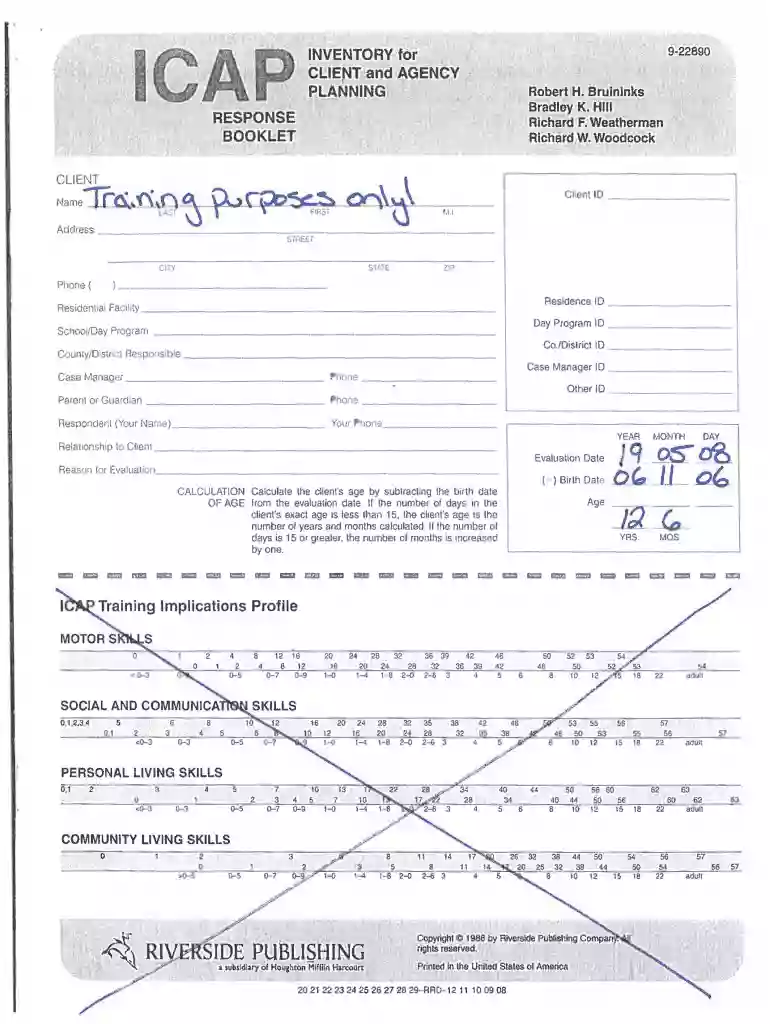
ICAP Training Implications Profile. INVENTORY for CLIENT and AGENCY PLANNING. The ICAP should be completed by a respondent who knows the client well. Rate how
The following indicates the essential resources and guidelines for accessing and completing the Inventory for Client and Agency Planning (ICAP).Read more


