




01. Edit your form online
Type text, add images, blackout confidential details, add comments, highlights and more.

Type text, add images, blackout confidential details, add comments, highlights and more.

Draw your signature, type it, upload its image, or use your mobile device as a signature pad.

Send it via email, link, or fax. You can also download it, export it or print it out.
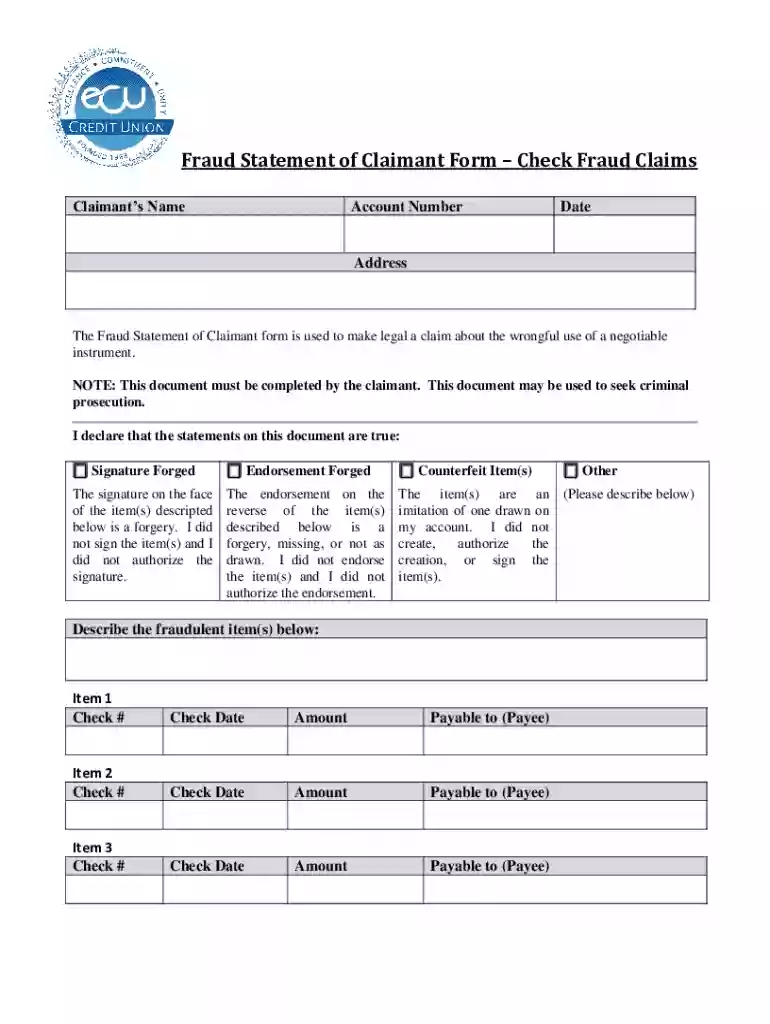
The Fraud Statement of Claimant Form is a legal document used by individuals to officially report instances of check fraud. The form is designed to collect comprehensive details from claimants about fraudulent activities involving negotiable instruments, including personal checks. By completing this form, claimants declare the accuracy of their statements under penalty of perjury. This implies a legal obligation to provide truthful and complete information about the fraud.
To utilize the Fraud Statement of Claimant Form effectively, individuals should carefully gather all relevant information regarding the suspected check fraud. This involves compiling details about the checks and any suspicious activities related to them. Claimants should also be ready to provide any supporting documentation that can strengthen their case.
Obtaining the Fraud Statement of Claimant Form is a straightforward process. You can access it through financial institutions, typically provided by the bank where the fraudulent activity took place. Alternatively, the form may be available for download on legal and financial websites that offer such documentation.
Completing the Fraud Statement of Claimant Form accurately and thoroughly is essential for it to be effective. This involves detailing all known information in the form and ensuring no sections are left incomplete or incorrect.
The Fraud Statement of Claimant Form serves legal purposes by officially documenting instances of suspected check fraud. Its primary function is to provide a foundation for legal proceedings should the need arise. Claimants must agree to the possibility of prosecution and indicate their willingness in the relevant section of the form.
The Fraud Statement of Claimant Form is structured to ensure all necessary information is captured to support the claim against fraudulent activity.
Consider a scenario where an individual notices unauthorized transactions in their checking account. After confirming the transactions have no legitimate basis, they would print the Fraud Statement of Claimant Form, fill in all necessary details about these transactions, and submit it to their bank to initiate a formal investigation.
Submitting the Fraud Statement of Claimant Form can be done through various channels to ensure the claim reaches the authorities needed to address the fraud.
Using these structured approaches, individuals and businesses can effectively document and report check fraud, initiating a process that may lead to recovery and prosecution.
We've got more versions of the Fraud Statement of Claimant Form Check Fraud Claims form. Select the right Fraud Statement of Claimant Form Check Fraud Claims version from the list and start editing it straight away!
| Versions | Form popularity | Fillable & printable |
|---|---|---|
| 2022 | 4.6 Satisfied (51 Votes) |
At DocHub, your data security is our priority. We follow HIPAA, SOC2, GDPR, and other standards, so you can work on your documents with confidence.
The 2021 Form 1040 asks whether at any time during 2021, I received, sold, exchanged, or otherwise disposed of any financial interest in any virtual currency.Read more
Attention Kentucky Residents: Any person who knowingly and with intent to defraud any insurance company or other person files a statement of claim containingRead more
Affidavit of Check Fraud by Payee. If you have questions about this form, please call us at 1-800-278-6256, Monday through Friday, 5:30 a.m. to 5:30 p.m. This


