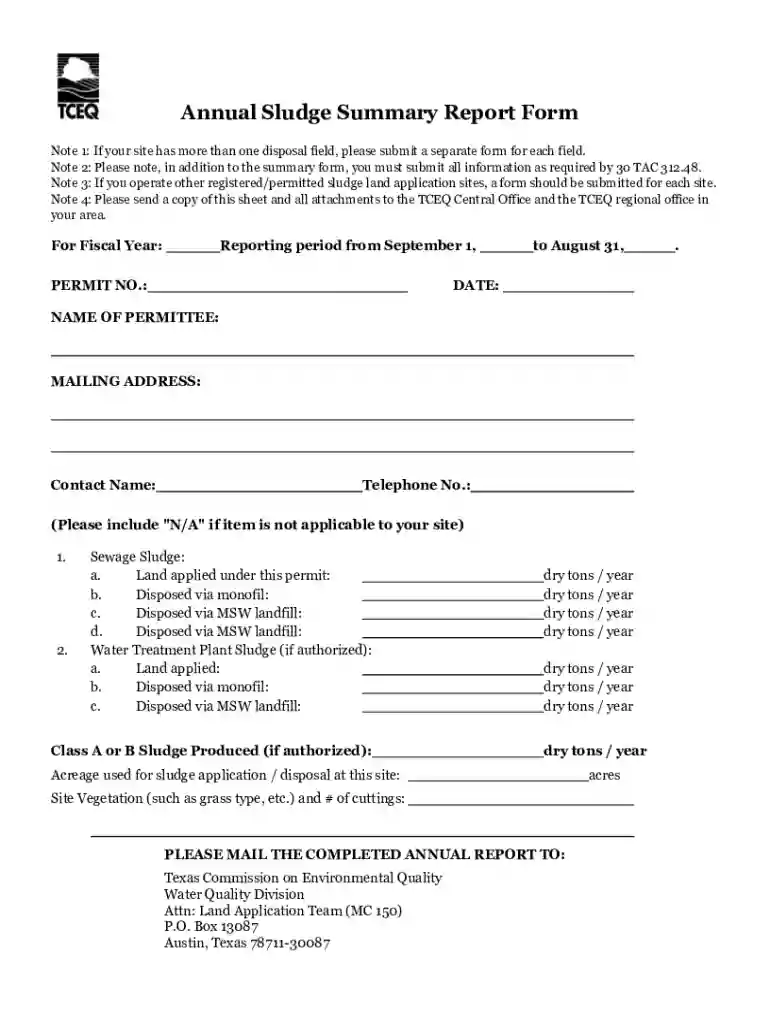
Annual Sludge Summary Report Form Annual Sludge Summary Report Form 2026

Get Form
annual sludge summary report Preview on Page 1

Here's how it works

01. Edit your annual sludge summary report online
Type text, add images, blackout confidential details, add comments, highlights and more.

02. Sign it in a few clicks
Draw your signature, type it, upload its image, or use your mobile device as a signature pad.

03. Share your form with others
Send it via email, link, or fax. You can also download it, export it or print it out.

Definition & Meaning

The Annual Sludge Summary Report Form is used by permit holders to detail the disposal and application of sludge from sewage and water treatment plants for a fiscal year. This form ensures compliance with environmental regulations by documenting the types and amounts of sludge managed. The collected data is crucial for both regulatory bodies and the entities reporting, as it provides insights into waste management practices and environmental impact.

Steps to Complete the Annual Sludge Summary Report Form

  1. Gather Necessary Information: Before starting, collect data on the types and amounts of sludge processed during the fiscal year.
  2. Identify Disposal Sites: Record each location where sludge has been disposed of or applied.
  3. Complete Required Fields: Fill in all mandatory sections; each data field should reflect accurate and complete information.
  4. Review for Accuracy: Cross-check the details entered to ensure compliance with regulatory requirements.
  5. Sign and Date the Report: Ensure the report is signed by an authorized representative of the permit holder.
  6. Submit to the Appropriate Authority: Send the completed form to the Texas Commission on Environmental Quality.

Important Terms Related to the Report

  • Sludge: Semi-solid by-products from the treatment of wastewater.
  • Permit Holder: The entity licensed to manage and report the disposal of sludge.
  • Disposal Fields: Designated areas approved for sludge application or dumping.

How to Obtain the Form

  • Online Access: Forms can often be downloaded from the regulatory body's website, such as the Texas Commission on Environmental Quality.
  • Request by Mail: Contact the regulatory body to have a physical copy sent via mail.
  • Visit Local Offices: Obtain the form in person by visiting a regional office.

Who Typically Uses the Form

The form is primarily used by:

  • Municipalities: Cities and towns that manage wastewater treatment facilities.
  • Private Waste Management Companies: Businesses involved in handling industrial and municipal sludge.
  • Industrial Plants: Facilities that produce sludge as part of their manufacturing process.
decoration image ratings of Dochub

Legal Use of the Form

Submission of the Annual Sludge Summary Report Form is a legal requirement for compliance under environmental regulations. Failure to submit or accurately complete the form could lead to penalties, legal action, or revocation of operational permits. It is crucial that the form be used solely for reporting truthful and accurate data related to sludge management.

Key Elements of the Form

  • Identification Information: Details about the permit holder, including name and contact information.
  • Sludge Quantity and Type: Specifics about the volume and type of sludge handled.
  • Disposal Method: How and where the sludge was disposed of, including specifics on land application.
  • Compliance Checklists: Sections to confirm adherence to relevant environmental standards.

State-Specific Rules

While this content is tailored for Texas, other states may have varying requirements. It's essential for permit holders to be familiar with rules that are specific to their state's regulatory framework. These might include additional reporting requirements or different deadlines based on local environmental priorities and policies.

Form Submission Methods

  • Online Submission: Check if digital submission is possible through the state's environmental quality website.
  • By Mail: Send the completed form to the address provided on the form's instructions.
  • In-Person Delivery: Some entities may prefer or require hand-delivered submissions to ensure immediate and secure processing.

This comprehensive coverage aims to ensure a nuanced understanding and effective completion of the Annual Sludge Summary Report Form within regulatory frameworks.

be ready to get more

Complete this form in 5 minutes or less

Get form

Got questions?

We have answers to the most popular questions from our customers. If you can't find an answer to your question, please contact us.
Contact us
Sludge means any solid, semi-solid, or liquid waste generated from a municipal, commercial, or industrial wastewater treatment plant, water supply treatment plant, or air pollution control facility exclusive of the treated effluent from a wastewater treatment plant.
Sludge (possibly from Middle English slutch mud, mire, or some dialect related to slush) is a semi-solid slurry that can be produced from a range of industrial processes, from water treatment, wastewater treatment or on-site sanitation systems.
The U.S. Environmental Protection Agency typically uses the term biosolids to mean sewage sludge that has been treated to meet the agencys regulatory requirements and is intended to be land applied as a soil conditioner or fertilizer.
The Part 503 rule establishes requirements for the final use or disposal of sewage sludge [biosolids] when biosolids are: applied to land to condition the soil or fertilize crops or other vegetation grown in the soil; placed on a surface disposal site for final disposal; or fired in a biosolids incinerator.
Sewage Sludge refers to the solids separated during the treatment of municipal wastewater. The definition includes domestic septage. Biosolids refers to treated sewage sludge that meets the EPA pollutant and pathogen requirements for land application and surface disposal.

Security and compliance

At DocHub, your data security is our priority. We follow HIPAA, SOC2, GDPR, and other standards, so you can work on your documents with confidence.

Learn more
ccpa2
pci-dss
gdpr-compliance
hipaa
soc-compliance