




01. Edit your aha evaluation form online
Type text, add images, blackout confidential details, add comments, highlights and more.

Type text, add images, blackout confidential details, add comments, highlights and more.

Draw your signature, type it, upload its image, or use your mobile device as a signature pad.

Send aha bls course evaluation form via email, link, or fax. You can also download it, export it or print it out.
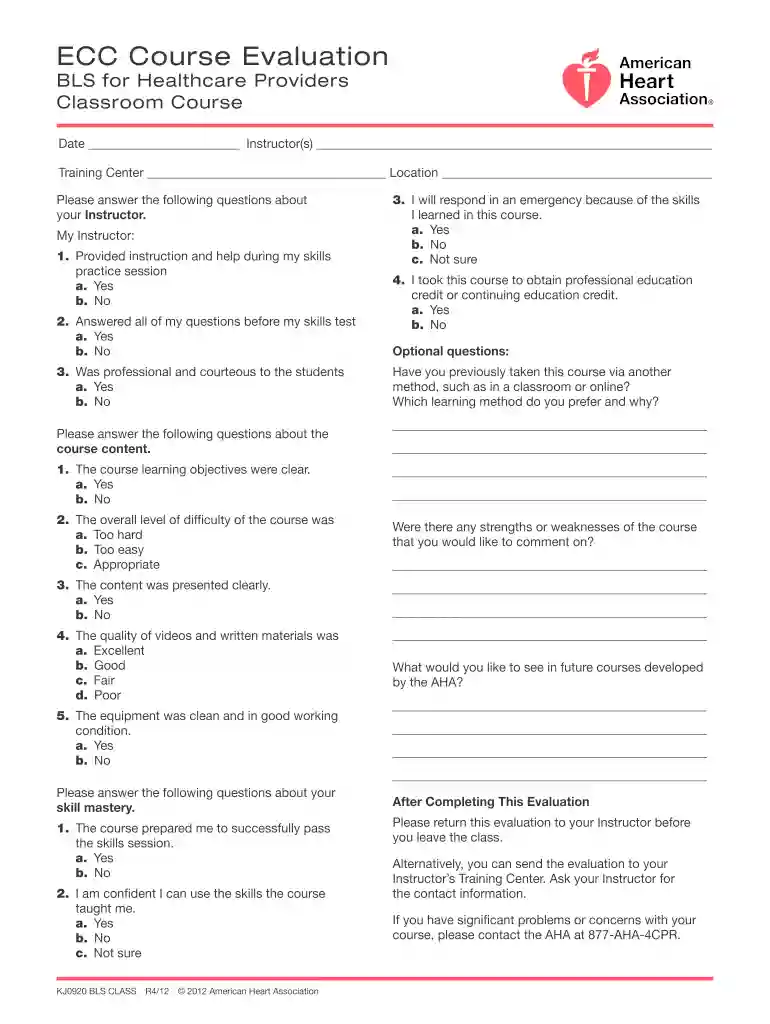
The AHA course evaluation form is primarily designed to gather feedback from participants after completing an American Heart Association (AHA) course, such as the Basic Life Support (BLS) or Heartsaver training. This form plays a crucial role in assessing the effectiveness of the instructor and the course material. Feedback collected can lead to improvements in the delivery of the course and enhance the learning experience for future participants.
Several essential components are included in the AHA course evaluation form:
Instructor Performance: Participants are asked to evaluate the instructor's teaching skills. Questions may cover the clarity of instructions, the instructor's knowledge, and the ability to engage the audience.
Course Content: This section assesses whether the learning objectives were met. It includes questions about the relevance and clarity of the materials provided.
Learning Environment: Feedback on the classroom or online environment is also crucial, addressing aspects such as facilities, technology use, and overall comfort during the course.
Skill Mastery: Evaluation of skill mastery is often featured to determine the participant’s confidence and competence in performing the necessary tasks or procedures taught during the course.
Suggestions for Improvement: Participants may provide open-ended feedback on how the course can be improved, including suggestions for additional topics or resources.
Feedback gathered from the AHA course evaluation form is vital for several reasons:
Improvement of Educational Programs: Course evaluations can help educators identify what is working well and what needs adjustment, allowing for continuous improvement of training materials and delivery methods.
Enhancing Participant Experience: Understanding participants' experiences can highlight areas where the course delivery can be adjusted to meet learners' needs better.
Maintaining High Standards: The feedback ensures that AHA courses are consistently meeting the high standards expected by the organization and the learners.
The AHA course evaluation form typically contains a mix of rating scale questions and open-ended questions. Commonly included questions might involve:
Collectively analyzing the responses from these evaluation forms allows course coordinators to:
Utilizing the AHA course evaluation form effectively can lead to significant advancements in the quality of training programs provided by the AHA. By actively encouraging participants to express their thoughts, instructors and coordinators can foster an environment of learning that adapts to meet the needs of every student. This commitment to excellence ultimately enhances the overall mission of promoting health and safety through education and training.
Managing your paperwork with DocHub this way is very easy after you have downloaded its extension for Google Chrome. Navigate to the Chrome Web Store and set up DocHub - Sign PDF from Gmail to obtain it. Give our tool access to your Google account, and then open an email with the aha bls evaluation form attached and point to the file with your cursor - the DocHub extension key will automatically show up there. Click on it to open your file in our editor. Make any essential adjustments, complete the blanks, and click Sign to create your legally-binding electronic signature.
As a comprehensive document editing platform, DocHub is accessible on mobile devices. Open DocHub in your choice of mobile internet browser and employ our intelligent mobile-friendly toolset to complete your aha instructor evaluation form.
At DocHub, your data security is our priority. We follow HIPAA, SOC2, GDPR, and other standards, so you can work on your documents with confidence.


