




01. Edit your form online
Type text, add images, blackout confidential details, add comments, highlights and more.

Type text, add images, blackout confidential details, add comments, highlights and more.

Draw your signature, type it, upload its image, or use your mobile device as a signature pad.

Send it via email, link, or fax. You can also download it, export it or print it out.
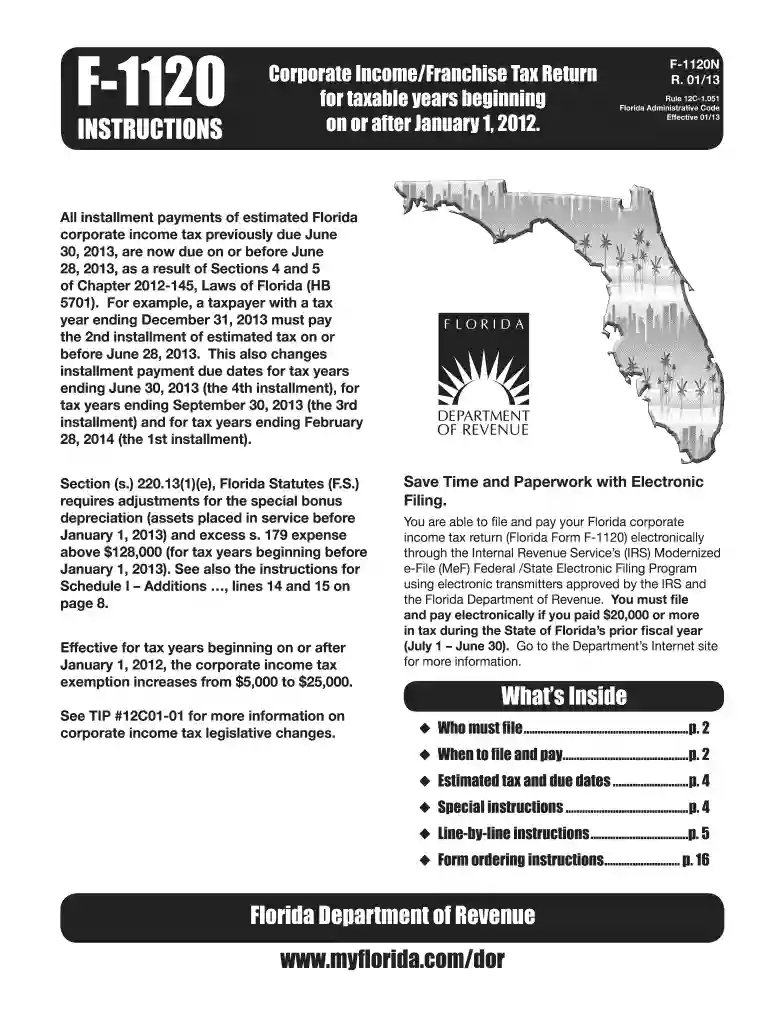
The Florida Corporate Income/Franchise Tax Return, or Form F-1120, is a specific form used by corporations operating in Florida to report their income and calculate the amount of tax due to the state. It applies to taxable years beginning on or after January 1, 2012. The form accounts for the corporate income tax, which is essential for maintaining compliance with Florida's tax laws.
Referring to the instructions for Form F-1120 is vital to properly filling out and submitting your corporate tax return for the year 2013. The instructions provide detailed guidance on which income figures to report, how to calculate certain deductions, and the correct ways to apply exemptions.
Properly completing the F-1120 form requires a methodical approach. Each section must be filled out according to the guidelines provided in the 2013 instructions.
Keeping track of important deadlines related to the F-1120 form ensures your corporation remains compliant with Florida tax laws.
Failure to submit Form F-1120 correctly or on time can result in significant penalties. Understanding these consequences encourages timely and accurate filing.
Corporations have the choice between digital and traditional paper methods for filing Form F-1120.
To determine if your corporation needs to file Form F-1120, the eligibility criteria must be reviewed carefully.


Florida's tax regulations impact how Form F-1120 should be completed in relation to other state tax forms.
By utilizing these structured details on the Form F-1120 instructions for 2013, corporations can ensure accurate and compliant submissions, helping avoid penalties and errors during tax filings.
We've got more versions of the fl f 1120 instructions 2013 form form. Select the right fl f 1120 instructions 2013 form version from the list and start editing it straight away!
| Versions | Form popularity | Fillable & printable |
|---|---|---|
| 2026 | 4.4 Satisfied (36 Votes) | |
| 2024 | 4.1 Satisfied (41 Votes) | |
| 2024 | 4.8 Satisfied (31 Votes) | |
| 2023 | 4.8 Satisfied (40 Votes) | |
| 2022 | 4.9 Satisfied (42 Votes) | |
| 2020 | 4.8 Satisfied (110 Votes) | |
| 2019 | 4.1 Satisfied (25 Votes) | |
| 2018 | 4.4 Satisfied (123 Votes) | |
| 2017 | 4.1 Satisfied (39 Votes) | |
| 2016 | 4.3 Satisfied (169 Votes) | |
| 2013 | 4.3 Satisfied (313 Votes) | |
| 2012 | 4.3 Satisfied (24 Votes) | |
| 2009 | 4.9 Satisfied (52 Votes) |
At DocHub, your data security is our priority. We follow HIPAA, SOC2, GDPR, and other standards, so you can work on your documents with confidence.
Jan 23, 2013 Filing address. Effective January 1,. 2013, the filing address for corporations with a principal business, office, or agency located in Florida.
Use Form 1120, U.S. Corporation Income. Tax Return, to report the income, gains, losses, deductions, credits, and to figure the income tax liability of a
This report is required for every class I railroad operating within the United States. Three copies of this Annual. Report should be completed.


