




01. Edit your form online
Type text, add images, blackout confidential details, add comments, highlights and more.

Type text, add images, blackout confidential details, add comments, highlights and more.

Draw your signature, type it, upload its image, or use your mobile device as a signature pad.

Send it via email, link, or fax. You can also download it, export it or print it out.
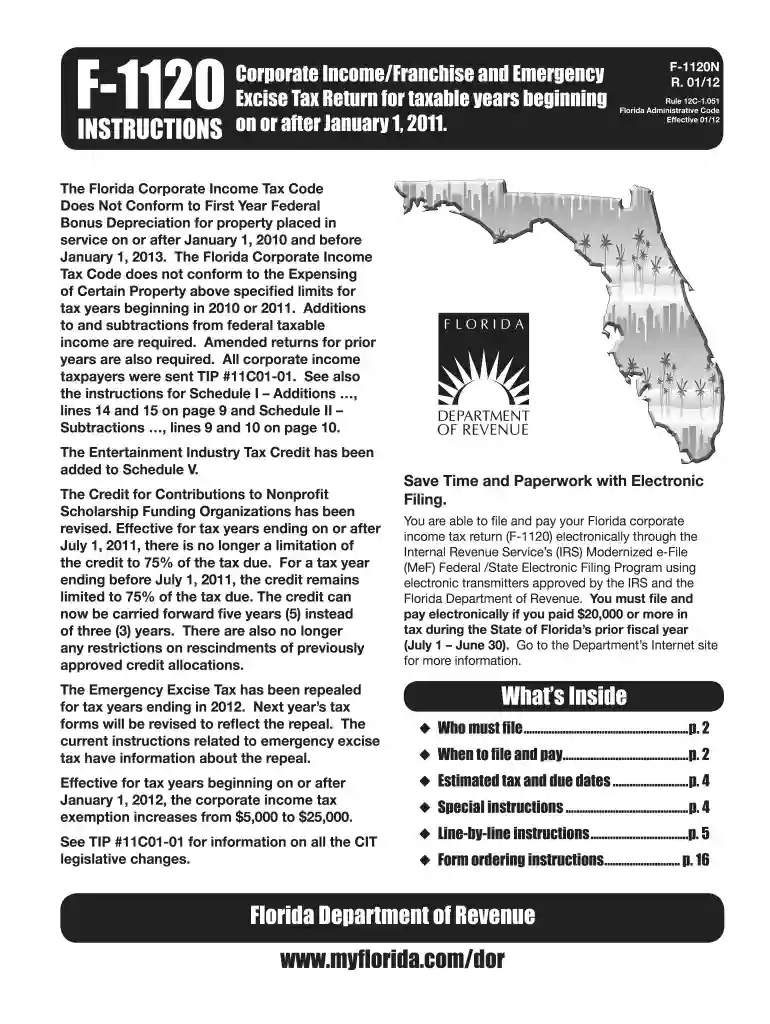
The Form F-1120 is specifically tailored for corporations that need to file the Florida Corporate Income/Franchise and Emergency Excise Tax Return. Introduced for taxable years beginning on or after January 1, 2011, it serves as a critical tool for businesses operating in Florida to comply with state tax regulations. This form captures relevant financial data to assess corporate tax liabilities. Understanding its intricacies is crucial for accurate reporting and avoiding potential penalties.
Gather Required Information: Assemble all financial documents, including income statements, balance sheets, and details of tax credits.
Calculate Income and Deductions: Begin by accurately computing the gross income and permissible deductions applicable under Florida tax laws.
Determine Taxable Income: Follow the instructions to adjust federal taxable income according to Florida's tax regulations, reflecting state-specific modifications.
Evaluate Tax Credits: Identify eligible credits, such as the Entertainment Industry Tax Credit, and accurately report them to reduce taxable liability.
Complete the Form: Fill out each section with precise figures, ensuring all calculations align with the supporting documents.
Review and Verify: Double-check all entries for accuracy to prevent errors that could lead to non-compliance.
Businesses can access the Form F-1120 through the Florida Department of Revenue's official website. It can also be acquired from authorized tax preparation software that includes state tax forms. By ensuring an up-to-date version, entities can comply with current filing standards, avoiding issues related to using outdated forms.
Corporate Income Reporting: Detailed sections require information on gross income, net income, and adjustments according to Florida statutes.
Tax Credits and Deductions: Specific areas to declare statutory credits, along with instructions to accurately claim reductions.
Adjustments for Non-Conformity: Information on non-conformity with certain federal provisions, like bonus depreciation, requires careful attention.
The Form F-1120 is utilized primarily by corporations conducting business in Florida, including both domestic and foreign entities. It is crucial for any business with a filing obligation for Florida state taxes to familiarize itself with the form, regardless of size or revenue scale.


Corporations are required to submit the completed Form F-1120 by the first day of the fifth month following the close of their fiscal year. Keeping track of this deadline is essential to avoid penalties. Extensions may be available, but must be requested prior to the original due date.
Failure to file Form F-1120 in a timely manner may result in significant penalties, including late filing fees and interest on unpaid taxes. Submitting incorrect information can also attract fines and legal action, emphasizing the need for accuracy and adherence to deadlines.
The F-1120 form follows legal mandates for corporate tax filing in Florida. Incorporating the latest updates in tax laws and compliance requirements, it serves as the primary means for legal tax declaration, aligning with state and federal regulations.
While the F-1120 form aligns with IRS policies, corporations must account for variances in state tax laws, such as differences in allowable deductions and credits. Understanding these nuances supports accurate filing and minimizes risks of discrepancies between state and federal tax obligations.
We've got more versions of the f 1120 2012 form form. Select the right f 1120 2012 form version from the list and start editing it straight away!
| Versions | Form popularity | Fillable & printable |
|---|---|---|
| 2026 | 4.4 Satisfied (36 Votes) | |
| 2024 | 4.1 Satisfied (41 Votes) | |
| 2024 | 4.8 Satisfied (31 Votes) | |
| 2023 | 4.8 Satisfied (40 Votes) | |
| 2022 | 4.9 Satisfied (42 Votes) | |
| 2020 | 4.8 Satisfied (110 Votes) | |
| 2019 | 4.1 Satisfied (25 Votes) | |
| 2018 | 4.4 Satisfied (123 Votes) | |
| 2017 | 4.1 Satisfied (39 Votes) | |
| 2016 | 4.3 Satisfied (169 Votes) | |
| 2013 | 4.3 Satisfied (313 Votes) | |
| 2012 | 4.3 Satisfied (24 Votes) | |
| 2009 | 4.9 Satisfied (52 Votes) |
At DocHub, your data security is our priority. We follow HIPAA, SOC2, GDPR, and other standards, so you can work on your documents with confidence.
A 2012 Form 1120-SN must be used to file for the calendar year 2012, or a fiscal year beginning in 2012. Space is provided at the top of the return to enter the
Jan 31, 2012 1120S, page 1, item F) are: Call the IRS for information The 2012 Form 1120S is not election termination or revocation box
For Paperwork Reduction Act Notice, see separate instructions. Cat. No. 11450Q. Form 1120 (2012). Page 2. Form 1120 (2012). Page 2. Schedule C. Dividends and


