Definition and Purpose of the Gallistel-Ellis Test
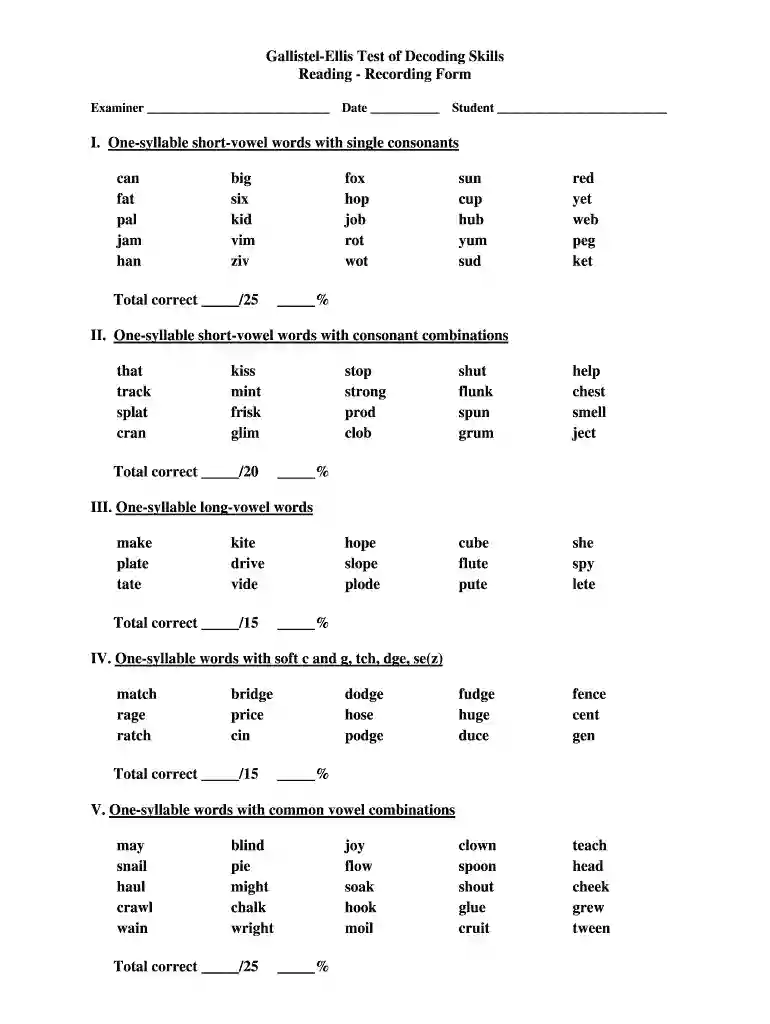
The Gallistel-Ellis Test of Decoding Skills is a comprehensive assessment tool that evaluates a student's ability to decode various word types and phonetic patterns. It is specifically designed to help educators understand a student’s reading proficiency by analyzing their decoding skills, which are crucial for reading development. The test covers one-syllable short-vowel words, long-vowel words, multisyllable words, and phonetically irregular words. Additionally, it assesses isolated sounds, allowing for a holistic view of a student's reading capabilities.
Key Benefits of the Gallistel-Ellis Assessment
- Identifies Reading Deficits: The test aids in pinpointing specific areas where a student may struggle, guiding targeted intervention strategies.
- Tracks Progress: By administering the test over time, teachers can track improvements in decoding skills, helping to tailor instruction to individual needs.
- Research-Based: Developed from literacy research, the Gallistel-Ellis Test employs strategies grounded in educational best practices.
How to Effectively Use the Gallistel-Ellis Test
Implementing the Gallistel-Ellis Test requires systematic planning and execution to ensure that the results are valid and actionable.
Preparation Steps
- Familiarize Yourself with the Test: Review the test materials, including instructions and recording sheets, to understand its structure and requirements.
- Select the Appropriate Environment: Conduct the assessment in a quiet, distraction-free setting to help the student focus fully on the task.
Administering the Test
- Follow the Directions: Ensure that all instructions are followed as outlined in the test manual to maintain consistency.
- Record Responses Accurately: While the student performs tasks, carefully note their responses to ensure accurate scoring.
Analyzing Results
- Calculate Scores: After completion, calculate the total correct answers and percentages for each section.
- Use Data to Drive Instruction: Integrate assessment results into lesson planning to address specific decoding skills that require reinforcement.
Steps to Obtain the Gallistel-Ellis Test
Acquiring the Gallistel-Ellis Test can enhance diagnostic capabilities within educational settings.
Methods for Obtaining the Test
- Purchase from Educational Publishers: The test can be obtained through approved educational publishers that specialize in standardized testing materials.
- Downloadable PDF Versions: Some resources may offer free or paid PDF versions of the Gallistel-Ellis Test, which can be printed for immediate use.
Checking for Updates
It is important to verify whether you are using the latest version of the Gallistel-Ellis Test. Educational authorities often update assessments to reflect current best practices and research findings.
Why Educators Should Use the Gallistel-Ellis Test
Using the Gallistel-Ellis Test provides significant advantages in academic settings.
Importance of Decoding Skills
- Foundation for Reading: Proficient decoding is essential for students to understand texts, making the test a vital part of reading instruction.
- Tailored Learning Approaches: Results from the test permit educators to develop individualized learning plans that address unique student needs.
Supporting Diverse Learners
- Special Needs Consideration: The assessment can help identify students who may require additional support, ensuring all learners receive appropriate instruction.
Key Elements of the Gallistel-Ellis Assessment
Understanding the critical components of the Gallistel-Ellis Assessment can enhance its administration and application.
Structure of the Test
- Syllable Types: Assessments encompass various word structures, including short-vowel, long-vowel, and multisyllabic words.
- Phonetic Variety: The test includes phonetically irregular words, helping assess a student’s adaptability in decoding unfamiliar text.
Intended Users of the Test
- Educators and Specialists: Primarily, teachers and literacy specialists use the Gallistel-Ellis Test to evaluate student performance and determine instructional needs.
- Researchers: The test is also utilized in academic research to study literacy development and decoding skills among various populations.
Examples of Using the Gallistel-Ellis Test
Practical examples enhance the understanding of how the Gallistel-Ellis assessment functions in a real-world context.
Case Study Scenario
Consider a third-grade classroom where several students struggle with reading proficiency. The teacher administers the Gallistel-Ellis Test to assess individual decoding skills.
- Analysis of Results: Upon reviewing the results, the teacher finds that certain students excel in short-vowel word recognition but struggle with multisyllabic words.
- Targeted Intervention: Based on these insights, the teacher can implement focused strategies, such as phonics instruction specifically targeting multisyllabic decoding, to enhance overall reading skills.
Additional Learning Environments
- Tutoring Centers: Private tutors may also utilize the Gallistel-Ellis Test to create customized learning plans for students needing extra support in reading.
By leveraging the Gallistel-Ellis Test, educators can significantly improve their approach to teaching reading, ultimately leading to better learning outcomes for students.